
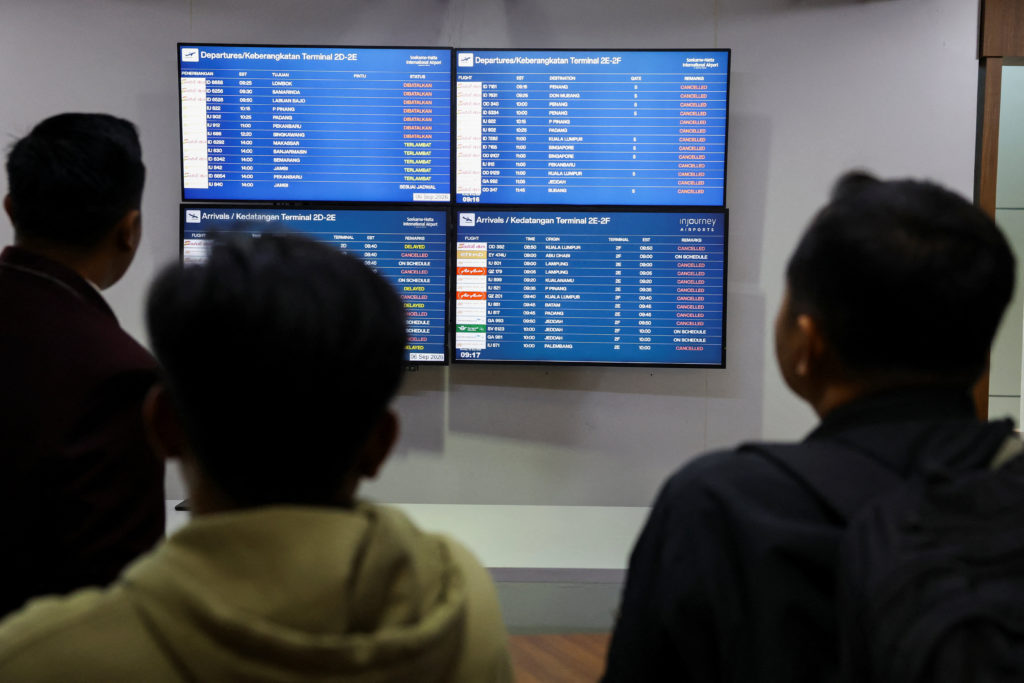
In Indonesia, a significant volcanic eruption occurred early on a Sunday morning, leading to the suspension of all flights at Jakarta’s Soekarno-Hatta International Airport. The eruption disrupted operations at other domestic airports as well, as ash clouds spread over the western regions of the country.
Volcanic Activity and Eruption Details
Anak Krakatau, a volcanic island located in the Sunda Strait between Java and Sumatra, had shown signs of activity since the previous Friday. It erupted for 30 seconds at 3:53 a.m. and again for 16 seconds a few hours later. Lava flares were visible from the volcano, as shown by closed-circuit camera footage.
Impact on Air Travel
No casualties were reported, and no evacuation orders were issued since the nearest settlement is over 16 kilometers away. However, authorities advised staying at least 3 kilometers from the active crater.
AirNav Indonesia closed the airspace around Jakarta’s Soekarno-Hatta and Halim Perdanakusuma airports, along with six others, due to volcanic ash. By Sunday evening, the closure had affected 170,000 passengers and resulted in 1,558 canceled flights. Eight airports were ordered to remain closed until midnight.
Travelers, such as Spanish tourist Diego Urdiales, expressed inconvenience due to the flight cancellations. Michele Gouw, an Indonesian passenger, noted the necessity of accepting the situation as a natural disaster, advising passengers to wait for airline and airport directions.
Authorities’ Response and Monitoring
The Directorate General of Civil Aviation in Indonesia monitored the eruption’s impact on air travel, coordinating with relevant agencies. Safety was emphasized as the prime concern in operational decisions. The eruption also affected services at Bali’s I Gusti Ngurah Rai International Airport and Medan.
Volcanic Activity Analysis
Indonesia’s volcanology agency, in cooperation with the Darwin Volcanic Ash Advisory Centre, identified two ash clouds using satellite images. One plume reached 20,000 feet, affecting Jakarta and nearby regions. Another plume soared to 50,000 feet, extending over broader areas.
Lana Saria, head of Indonesia’s Geological Agency, noted increased activity at Anak Krakatau since July, with this eruption being the most powerful. She stated that continued monitoring is crucial, observing not only eruption counts or ash heights but other indicators as well. Potential hazards include volcanic ash, gas concentrations, and the ejection of hot rocks.
Educational Adjustments
The fallout from the eruption extended to education. Schools in ash-affected areas received authorization to move to online learning temporarily. This decision aims to minimize students’ exposure to ash and permits local authorities to adapt schooling based on current conditions.
Background of Anak Krakatau
Anak Krakatau, meaning “child of Krakatau,” arose from the famous Krakatau, whose 1883 eruption influenced global climatic conditions. In 2018, Anak Krakatau’s eruption led to a deadly tsunami due to an underwater landslide triggered by the volcanic activity.
Researchers found that the 2018 event resulted in a significant reduction of the island’s size. It now stands at just a fraction of its original dimensions after that eruption.