
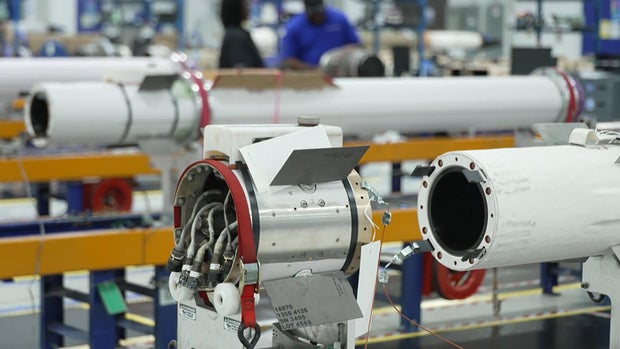
During a visit to Lockheed Martin’s production facility in Camden, Arkansas, Tim Cahill, head of the missile division, showcased the latest Patriot air defense missile. This advanced weapon is designed to intercept and destroy incoming ballistic missiles by direct impact. Cahill highlighted its effectiveness, mentioning, “It’s going to vaporize pretty much whatever it hits.”
Each Patriot missile costs about $4 million. Lockheed Martin currently manufactures 750 annually, insufficient to replace the approximately 1,500 used in the conflict with Iran. Mark Cancian from the Center for Strategic and International Studies has estimated the total cost of munitions used against Iran at around $25 billion, including other critical weapons like the Tomahawk and THAAD missiles.
The ongoing war with Iran, now in its seventh month, has revealed a troubling shortage of advanced weapons. This issue had been ignored by previous administrations, only coming to the forefront after increased military aid to Ukraine post-2022.
Cancian noted, “The war in Ukraine was the wake-up call,” as it exposed inadequate weapon inventories and the inability to sustain a prolonged conflict. By April 2026, the U.S. military had struck over 13,000 targets in Iran, substantially depleting munitions stockpiles. Cancian warned that while the U.S. might have sufficient weapons for the Iran conflict, a confrontation with China could prove much more challenging.
The Pentagon disputes claims of munition shortages, stating such assertions could encourage adversaries to attack U.S. troops. Nevertheless, Defense Secretary Pete Hegseth has urged the industry to ramp up production to “wartime footing.” Lockheed Martin plans to increase Patriot production to 2,000 units per year, according to Cahill, by enhancing automation and increasing shifts.
The complex supply chain, involving up to 1,000 suppliers, can cause potential bottlenecks. A single missing part can halt production. Cahill humorously remarked on the necessity of every component, “Our joke is, ‘How many parts does it take to build a missile?’ And the answer is, ‘All of them.'”
Nearby, L3Harris produces the rocket motors under strict safety regulations. Ken Bedingfield, president of missiles, pointed out that curing the rocket fuel can take days or weeks. Despite nearly doubling motor production and working on a new plant, supply chain issues remain a challenge.
In response to Hegseth’s call for increased military output, defense budgets have soared, although many Americans oppose such spending. This scenario mirrors the past Cold War military-industrial complex, including new players like CoAspire.
CoAspire, led by Doug Denneny in Virginia, is developing cost-effective cruise missiles to be launched from aircraft at a significantly lower price than traditional models. Although their missiles carry smaller warheads and have shorter ranges, they’re intended for production in high volumes. The Pentagon plans to procure 10,000 low-cost missiles from companies like CoAspire.
Denneny emphasized their strategy to inundate sophisticated air defense systems with numerous, less refined missiles. His product, notably incorporating commercial parts, offers a budget-friendly option.
As the U.S. navigates contracts like Lockheed Martin’s $59 billion agreement for Patriots, Cancian estimates it could take between one to five years to restore pre-Iran conflict stockpile levels, and longer to reach conditions suitable for potential challenges from China.