
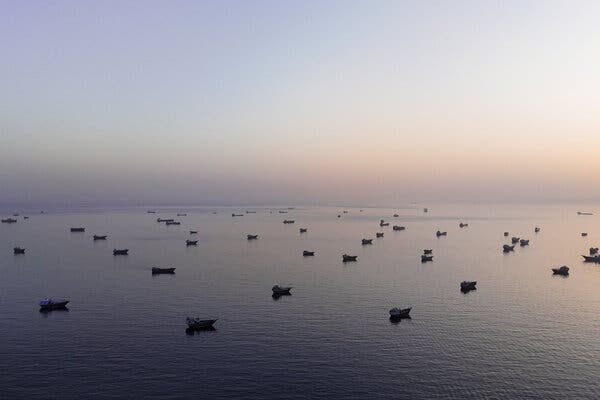
A U.S. Army Apache helicopter gunship went down near the Strait of Hormuz on Monday. Both crew members were safely rescued, according to two individuals briefed on the matter.
The cause of the incident remains unknown, with possibilities including Iranian fire, mechanical failure, or another issue, an informed source indicated. An investigation is ongoing.
This event follows a period of fluctuating hostilities in the region. Recently, both Israel and Iran engaged in military exchanges before easing tensions, highlighting the fragile cease-fire in place.
The Trump administration had not yet disclosed information about the helicopter by the time inquiries were made by The New York Times on Monday night. President Trump’s spokesperson did not immediately provide a statement, and the military’s Central Command has not commented.
The U.S. military employs Apaches, as well as MQ-9 Reaper drones and F/A-18 and F-35 attack planes, in efforts by Central Command to counteract Iran’s effective shutdown of the Strait of Hormuz to most commercial traffic.
Since the war commenced on Feb. 28, Iran has shot down around 30 unmanned Reaper drones, and a few U.S. fighter jets have been lost due to both hostile and friendly fire. However, this marks the first Apache helicopter lost in the conflict.
Last month, Central Command shared imagery on social media showing Adm. Brad Cooper flying over waters near the strait. This coincided with a U.S. Navy operation, called Project Freedom, to facilitate commercial shipping through the strait.
The AH-64 Apache gunship, equipped with Hellfire missiles, is a formidable aircraft in the region. It helps deter small-boat attacks and targets drones, patrolling the strategic waterway. In recent maneuvers, the helicopters have approached closer to Iranian territory, including islands controlled by Iran in the strait and Persian Gulf amid strained negotiations to reopen the strait.
Following Iran’s blockade, the U.S. imposed its own blockade on April 13, preventing commercial ships from accessing Iranian ports. Since then, U.S. military vessels have turned away 134 ships.
The Navy disabled seven additional vessels that failed to heed American warnings, including a Palau-flagged oil tanker headed towards Iran from the Gulf of Oman, as stated by Central Command.
In April, two crew members of an F-15E Strike Eagle fighter jet, downed by Iran, were rescued after ejecting and landing deep in enemy territory.
Eric Schmitt, a national security correspondent for The Times, covers U.S. military affairs and counterterrorism. Contact him securely on Signal: ericschmitt.36.
Maggie Haberman, a White House correspondent for The Times, covers President Trump.
Jonathan Swan, a White House reporter for The Times, reports on the Trump administration. Contact him securely on Signal: @jonathan.941.