
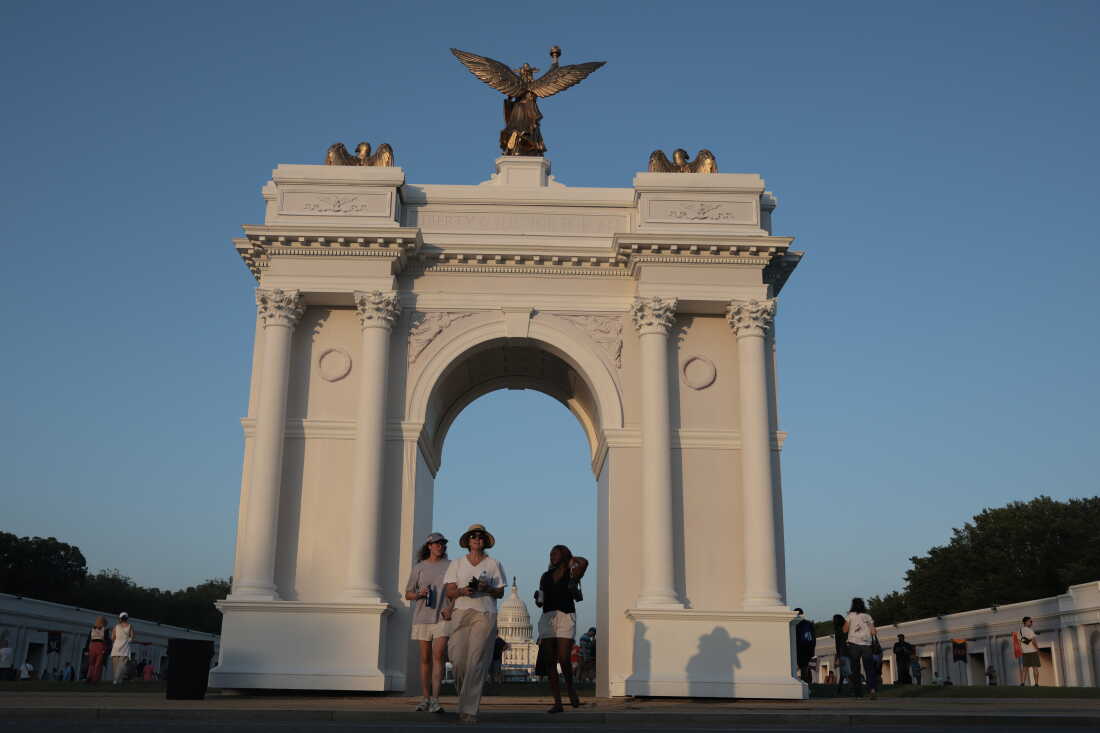
A replica of President Trump’s planned arch stood at the Great American State Fair in July, garnering attention amid the controversial plans to construct a 250-foot arch near Washington, D.C.’s National Mall. The Trump administration, headed by Interior Secretary Doug Burgum, announced plans to begin excavation work for the Great Triumphal Arch and Military Observation Deck despite lacking crucial approvals.
Burgum informed through social media that the excavation would commence in the next two weeks. However, final approval from the National Capital Planning Commission is pending, alongside federally mandated reviews for aviation safety and historic preservation. The administration faces criticism for expediting the approval process and potentially bypassing necessary protections for historic sites.
A statement from the White House asserted that initial work would begin to aid in the approval process, denying any intent to sidestep required protocols. However, questions about the timeline and scope of excavations remain unaddressed, as well as the addition of ‘military’ to the structure’s name.
President Trump indicated last year that the arch was for him, but the administration later specified it as a tribute to the nation’s 250th anniversary. Renderings show a white-and-gold structure crowned with three gilded statues, intended to honor Arlington Cemetery and align with the historical significance of the capital.
“This will be one of the Great Pieces of American Architecture, honoring the history and significance of Arlington Cemetery and befitting the most powerful Capital in the World,” stated Burgum.
Since its inception, the arch has seen federal panels supporting Trump allies greenlighting the project, despite unanswered public concerns and ongoing legal challenges. An architectural historian and Vietnam War veterans, backed by Public Citizen, have sued to halt the construction, arguing potential desecration of Arlington National Cemetery and citing the need for congressional approval.
On Friday, plaintiffs sought a restraining order to prevent construction on Memorial Circle, emphasizing premature efforts without legal clearance. Nicolas Sansone, the attorney leading the case, opposed any preparatory work, asserting its lack of legal foundation.
The administration disputes the necessity for congressional approval, yet acknowledges the authority of the federal planning commission, which hasn’t sanctioned the arch and will not convene until October. Sansone expressed concern over the executive branch potentially rushing through the project without regulatory compliance.
The arch would be positioned between Arlington National Cemetery and Lincoln Memorial, significantly altering the skyline and impacting views meant for post-Civil War reconciliation. Additionally, questions about aviation safety due to proximity to Ronald Reagan Washington National Airport arise.
Critics from various fronts express disapproval, including Rep. Don Beyer, who labeled the arch as a gridlock-increasing and narcissistic project unsupported by constituents within his district.
The debate continues on the impact of the arch on D.C.’s planned aesthetic and height restrictions. The National Park Service confirmed potential disruptions to historical sites, yet insisted on the arch’s placement at Memorial Circle due to its purpose.
The rapid approval pace concerns historic preservation advocates, who contest the current approach as mere procedural box-checking rather than genuine assessment. Political implications of the midterm elections loom, with speculation that a shift in congressional majority may hinder progress on such projects.
Beyer suggested the Vietnam veterans’ lawsuit holds potential to halt the construction. Meanwhile, the legal battle intensifies, with the Trump administration seeking case dismissal based on recent Supreme Court precedents.
A Supreme Court decision related to the White House ballroom has prompted parallels, although Sansone believes the veterans’ connection to Arlington provides a stronger basis than what was seen in the ballroom suit.
Beyer anticipates public protests and predicts any constructed structure may face removal under future presidencies, as the prospect of construction endangers public sentiment and legal basis.