
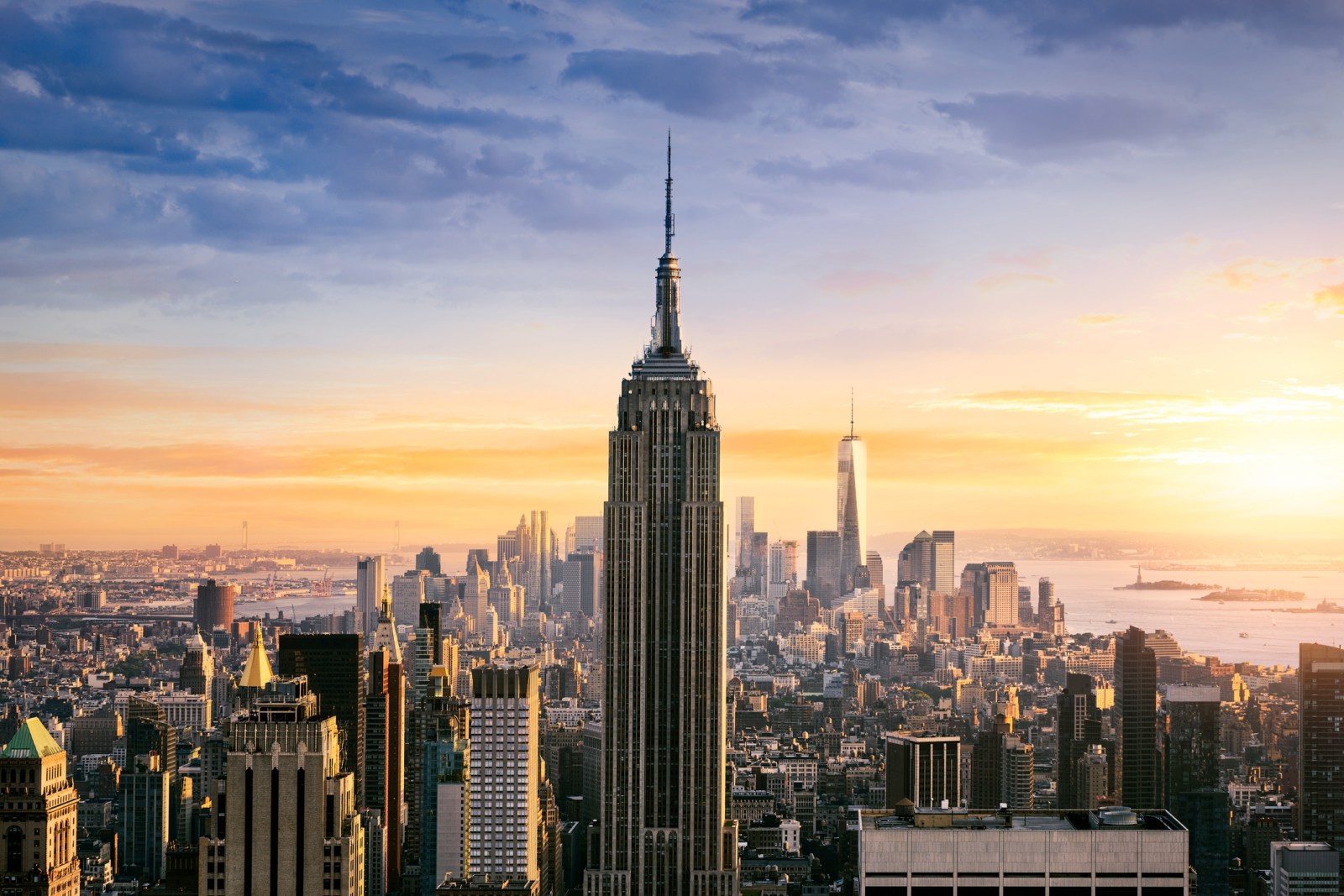
The Empire State Building stands as one of New York City’s most iconic structures. Yet, nearly a century ago, it was designed with an unexpected feature: an airship docking station. The building’s distinctive spire was intended to serve as a mooring mast for dirigibles, allowing passengers to disembark directly into the structure.
The Airship Vision
The idea was born during a period in the late 1920s and early 1930s when airships were considered the future of long-distance travel. The architectural firm Shreve, Lamb & Harmon envisioned this modernistic plan. The spire was designed as a 200-foot metal tower with stylized wings and an octagonal room for transferring passengers to trans-Atlantic airships.
The Skyscraper Museum describes the mast as “a 200-foot tall, modernistic metal tower, flanked by stylized wings clamped tight to the ribbed shaft and topped with a small octagonal room.”
In theory, travelers would step off airships into the heart of Midtown Manhattan, offering a seamless connection to the city.
Challenges in Reality
In practice, the concept faced significant challenges. Wind conditions around the building’s top posed safety risks for docking dirigibles. In 1931, a privately owned dirigible briefly moored to the mast, battling 40 mph winds. No airship successfully used the structure for passenger service, leading to the project’s quick abandonment.
Legacy of the Spire
Despite its initial failure, the spire contributed to the Empire State Building’s historical significance. By adding height, it surpassed the Chrysler Building by around 200 feet, claiming the title of the world’s tallest skyscraper in 1931. The Empire State Building retained this title until the construction of the World Trade Center.
Over time, the summit evolved from an airship terminal to an observation point with panoramic views of New York City. The Skyscraper Museum notes that “the views from the rooftop outdoor observation deck and from the 102nd floor room were unparalleled,” emphasizing the building’s dual role as an urban center and lofty landmark.
Interested in architecture or design stories? Contact us at [email protected] to have your story featured by Newsweek.