
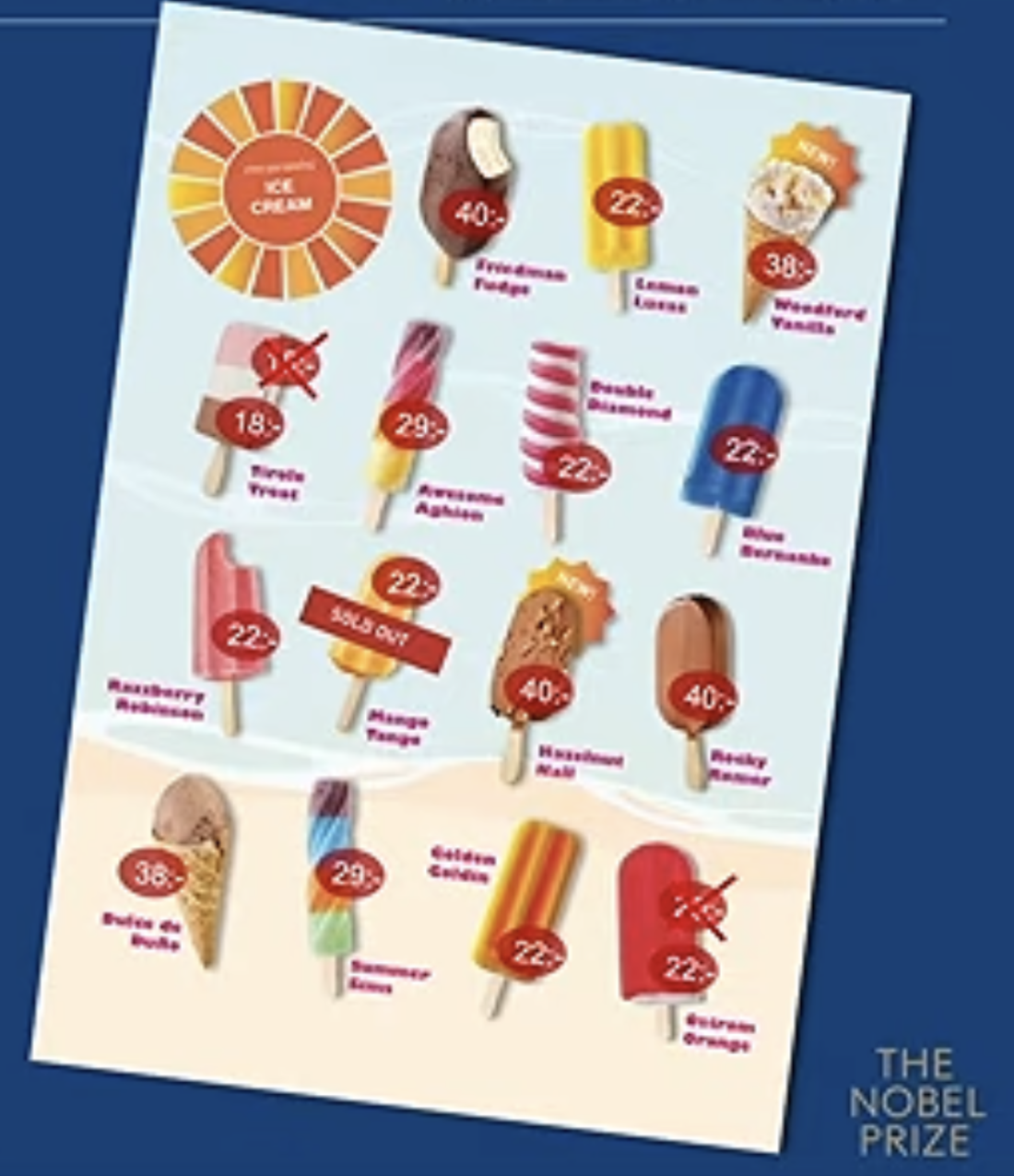
The Royal Swedish Academy of Sciences announced the winners of this year’s economics Nobel prize: Robert Hall from Stanford University and Michael Woodford from Columbia University. Their work focused on the microeconomic foundations of macroeconomic stabilization. To illustrate these ideas, Timo Boppart, an economist from Stockholm University, used an ice cream menu as a practical example.
Understanding Sticky Prices
Boppart explained that businesses often set prices for an entire season rather than continually adjusting them. He used the ice cream menu to discuss ‘sticky prices,’ a term in economics describing how prices remain inflexible even when economic conditions vary. This concept is central to New Keynesian economics, reshaping macroeconomic theories and strategies for managing recessions and controlling inflation.
The Rise and Fall of Keynesian Economics
John Maynard Keynes, a pivotal figure in macroeconomics, advocated for government intervention during economic slumps. His ideas dominated economic policies until the 1970s when stagflation challenged the validity of Keynesian approaches. That period witnessed simultaneous rises in inflation and unemployment, a situation called stagflation, which traditional Keynesian models struggled to explain.
Milton Friedman famously remarked, “We are all Keynesians now,” acknowledging Keynes’s influence. However, the crises of the 1970s prompted economists like Robert Lucas and Edward Prescott to question Keynesian reliance on governmental interventions.
The Call for Microfoundations
Critics argued that Keynesian models overly depended on past economic patterns without explaining the individual decisions underlying these patterns. This highlighted the need for microfoundations, basing economic models on the choices of individuals and firms.
Real Business Cycle theory emerged, assuming flexible prices and wages. This model addressed economic fluctuations as adjustments in prices and employment, minimizing the need for government intervention.
A New Chapter for Keynesian Economics
Gregory Mankiw, now at Harvard, observed that Michael Woodford, alongside Hall, contributed to integrating individual decision-making into macroeconomics. Their work on forward-looking decisions and sticky prices helped rebuild macroeconomic models, maintaining the essence of Keynesian theory.
Using the ice cream example again, in a recession, ice cream shops might not instantly cut prices during low demand due to costs involved in changing menus. This delay in price adjustment can result in reduced sales and employment.
Sticky prices, including wages, influence economic inflexibility, explaining prolonged unemployment during downturns. Boppart emphasized that acknowledging price rigidities unveiled the limitations of the invisible hand, allowing room for policy interventions.
The Impact of New Keynesian Models
New Keynesian models have become crucial in formulating government and central bank strategies. For example, Woodford’s research supported the Federal Reserve’s ‘forward guidance’ during the Great Recession, influencing expectations about future interest rates to stimulate current spending.
Keynesian ideas evolved but remain influential, with Mankiw noting, “We’re all New Keynesians now.”
Note: While referred to as the Nobel Prize in economics, this designation is debated. The award, officially named the Sveriges Riksbank Prize in Economic Sciences in Memory of Alfred Nobel, wasn’t part of Nobel’s original prizes.