
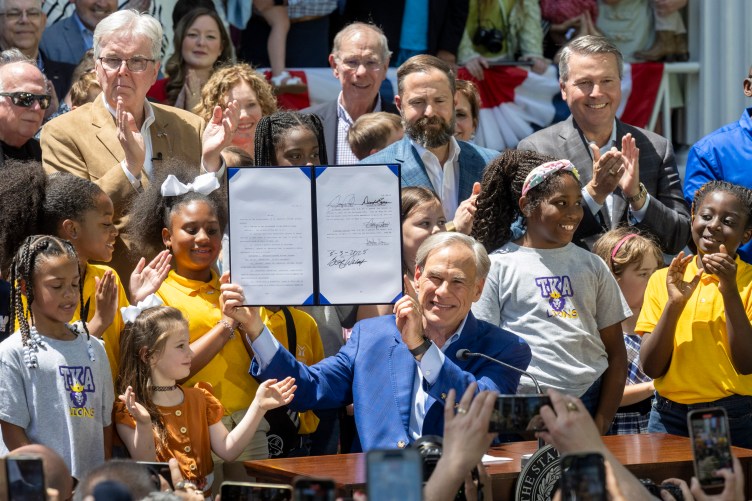
Texas Governor Greg Abbott saw his educational policies take a significant turn recently. A voucher program, which allowed around 110,000 of Texas’ over 5 million schoolchildren to attend private schools using taxpayer money, has come under scrutiny. Texas Education Agency Commissioner Mike Morath, appointed by Abbott, initiated a vast public school takeover. Additionally, a new social studies curriculum prioritized Texas and U.S. history with Bible stories while reducing global history topics, supported by Abbott and the Texas State Board of Education.
The political landscape shifted when Democrats captured numerous state offices. Governor-elect Gina Hinojosa responded to this change by promising to reverse Abbott’s educational policies. Her promises include terminating Morath and ending public school takeovers. A significant objective is to neutralize the voucher program.
Hinojosa’s strategies face uncertainty as outright elimination of the program requires legislative action. Democrat Sarah Eckhardt, who heads the state office overseeing the program, plans to enhance accountability and transparency, though comprehensive changes need legislative support. Democrats have regained control of the Texas House after 24 years, yet Republicans hold a Senate majority.
State Representative Diego Bernal expressed optimism about altering the voucher program significantly. Reports indicate that some Republican colleagues privately questioned the program due to leadership pressure. Bernal emphasized that changes are inevitable, suggesting the program will undergo substantial transformation.
“I guarantee that program is not going to be untouched, and it will be probably unrecognizable, if not extinct, by the time we’re done with it,” Rep. Bernal stated.
Rural opposition to the voucher program has been a long-standing challenge for Abbott. Efforts to pass statewide vouchers were thwarted by rural Republicans who valued public schools. Abbott invested heavily to replace these opponents with pro-voucher candidates, leading to a $1 billion voucher program. Recently, several of Abbott’s supported candidates lost to Democrats or faced close races, highlighting a shift in voter sentiment.
Many voters in rural communities, traditionally Republican strongholds, opposed vouchers, according to a Texas Tribune analysis. Abbott’s margin in these areas decreased significantly from previous elections. Former State Rep. Dewayne Burns noted a growing skepticism toward Abbott’s policies, suggesting rural communities felt neglected.
Former State Rep. Steve Allison emphasized that constituents in his suburban San Antonio district largely opposed the voucher system. Despite pro-voucher campaigns against him, voter sentiment was predominantly against diverting funds from public schools.
The focus on vouchers influenced elections in other districts as well. Republican supported candidates, such as Marc LaHood and Hillary Hickland, faced backlash and narrow election outcomes. Democratic opponents perceived the voucher debate as a critical issue driving voter dissatisfaction.
Democrat Zack Dunn, who won against LaHood, remarked that voters prioritized public school funding over voucher systems, recognizing the program’s detrimental impact on education.
“Across the board, overwhelmingly the sentiment was, ‘We need to fully fund our public schools,’” Dunn noted.
Post-election, efforts to increase transparency in voucher fund allocation are underway. State Comptroller Eckhardt pledged to audit and release more program information, countering previous practices that withheld data under privacy concerns.
Sen. Paul Bettencourt, a key voucher supporter, advocates for evaluating the program’s outcomes. He recommended assessing its effects without emotional biases and emphasized understanding factual consequences.
Meanwhile, private schools involved in the voucher program, represented by attorney Scott Schneider, are uncertain about their future dependence on state funding. They consider lobbying to secure current benefits or strategizing for a potential funding cessation.