
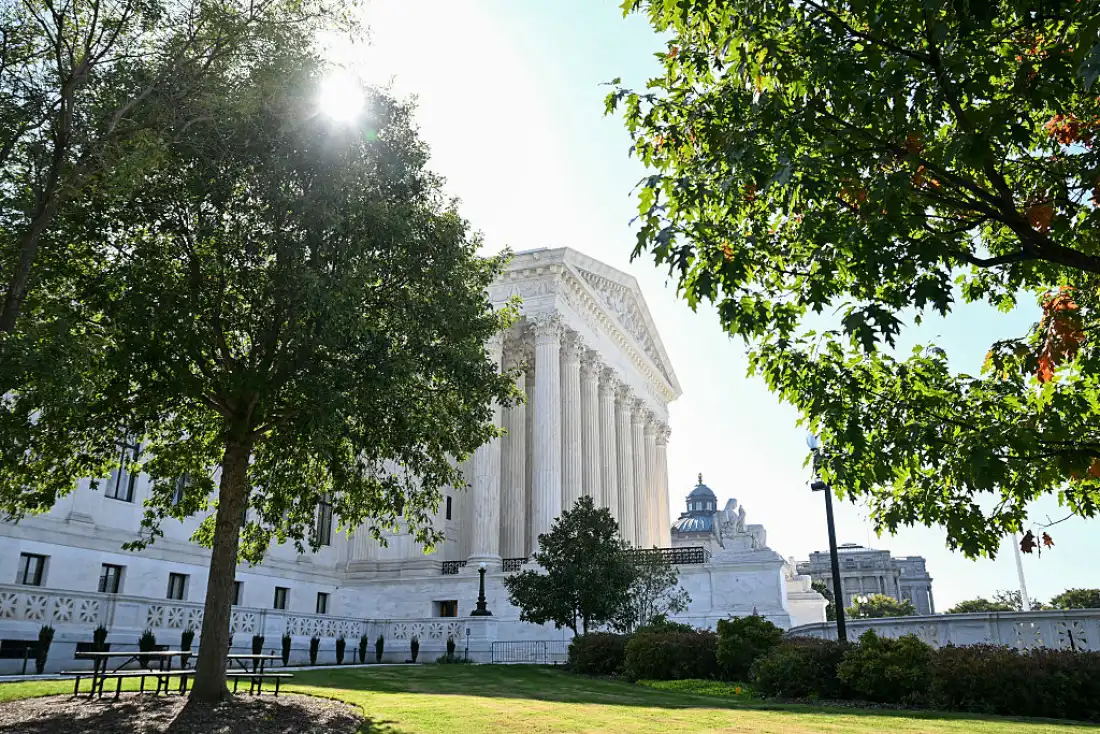
The Supreme Court is hearing arguments regarding a contentious case in Colorado involving religious schools. The Catholic Church is challenging taxpayer-funded school programs for all 4-year-olds in the state. The core issue is whether these religious institutions can deny admission to children of gay and trans parents, which conflicts with state anti-discrimination laws.
The First Amendment’s establishment clause states: “Congress shall make no law respecting an establishment of religion, or prohibiting the free exercise thereof.” Thomas Jefferson interpreted this as a “wall of separation between church and state,” and it was formally adopted by the Supreme Court in the 1940s. However, the past decade has seen a shift in the Court’s focus to the free exercise of religion aspect of the clause.
Michigan State University law professor Frank Ravitch explains that there has been a complete reversal in legal doctrine. For example, in 1983, the Supreme Court ruled 8-to-1 that Bob Jones University lost its tax-exempt status due to racial discrimination, disallowing government support for such practices. The current Court’s stance on similar issues remains uncertain, especially in cases involving non-racial discrimination.
Douglas Laycock, emeritus law professor at the University of Texas and University of Virginia, notes that race holds a unique place in U.S. history, impacting judicial decisions. In contrast, the Colorado case focuses on discrimination based on sexual orientation and gender identity, raising questions about whether this constitutes a protected religious practice.
The Colorado program, aimed at providing universal pre-K education, includes religious schools that abide by laws prohibiting discrimination. Colorado Rep. Emily Sirota emphasizes the program’s goal of offering parents diverse educational choices, including select religious institutions, supported by $6,300 per student from tobacco tax revenue.
The Denver Archdiocese, however, argues that the law discriminates against Catholic schools by excluding them based on their religious beliefs. Mark Rienzi from the Becket Fund for Religious Liberty contends that Colorado’s legal approach is unconstitutional, penalizing schools organized around certain religious teachings.
Tim Uhl, interim director at Notre Dame High School, disagrees with the archdiocese’s perspective. He argues that a diversity of thought enriches educational experiences, and Catholic schools do admit and accommodate non-Catholic students and families. Nevertheless, Denver’s archdiocese reports a 20% drop in Catholic school enrollment, attributing it to the pre-K program’s requirements.
Archbishop James R. Golka claims that Colorado’s stance threatens Catholic education and cultural values, emphasizing the importance of schools that teach religious beliefs. Denver’s Catholic school superintendent, Scott Elmer, notes that cases involving LGBTQ parents are rare.
The Supreme Court’s conservative majority, including appointees by former President Trump, indicates a leaning towards expanding religious rights. A prior case involving taxpayer-funded charter schools was dismissed due to Justice Amy Coney Barrett’s recusal, but her participation in the Colorado case could lead to decisive outcomes.
Berkeley Law School dean Erwin Chemerinsky wonders about the extent to which the Supreme Court will require funding for religious schools. Other concerns involve whether religious charter schools might receive taxpayer money, as public charter schools operate under performance-based contracts.
Recently, a federal judge in Oklahoma allowed a Jewish charter school with state funding, projecting growth in funds by 2030. The outcome of the Colorado case could influence the future of such religious charter schools.