
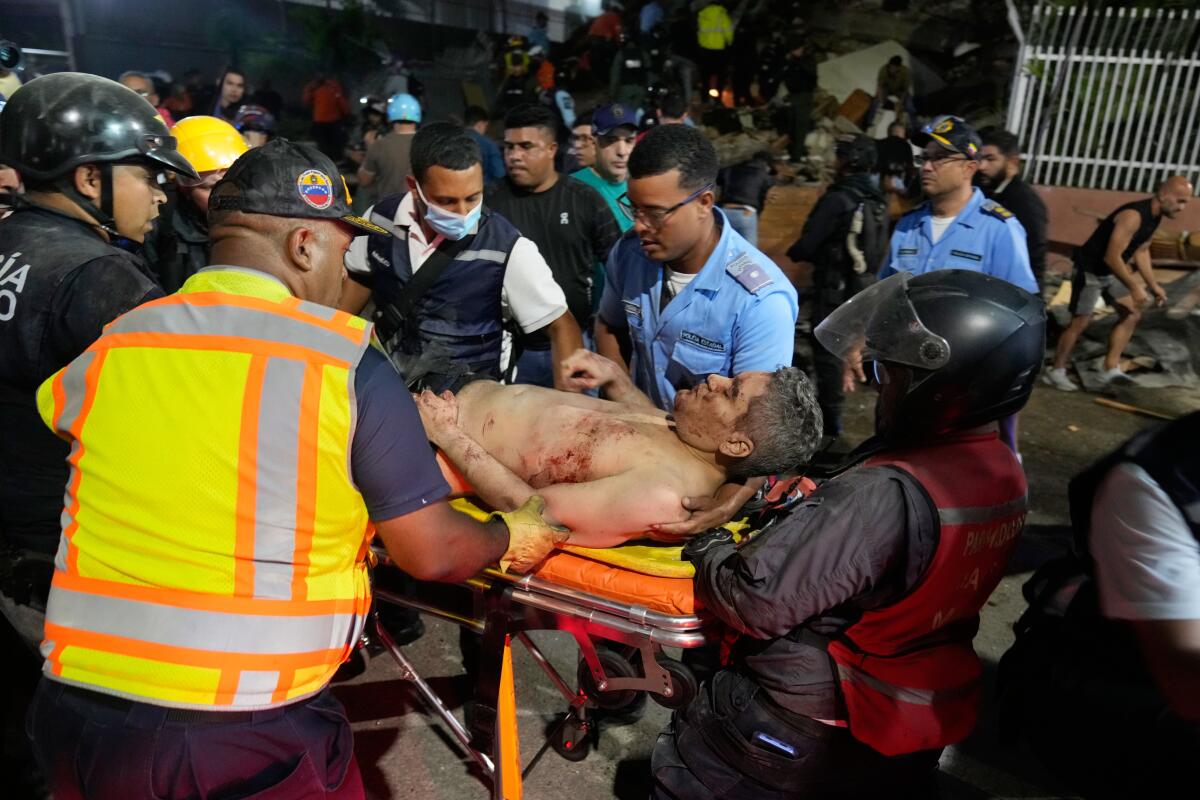
CARACAS, Venezuela — Two powerful earthquakes hit Venezuela on Wednesday evening, leading to the collapse of buildings and causing residents to rush into the streets. The earthquakes, with magnitudes of 7.2 and 7.5, shook the region. Their impact was so significant that buildings were evacuated as far as the Amazon region in Brazil, located about 1,050 miles away.
In a brief national address late Wednesday, acting President Delcy Rodríguez confirmed the earthquakes caused damage in several states. However, she did not provide details regarding the number of buildings affected or casualties. The country’s main airport, Simón Bolívar International Airport, suffered extensive damage, prompting its closure. She also announced the cancellation of classes for several days.
We urge our population to remain calm. We urge unity,Rodríguez said. She also called for healthcare professionals to assist at hospitals and mentioned that some schools would serve as shelters and donation centers.
In Falcon, a coastal state, Governor Víctor Clark reported 32 hospitalizations and noted that 15 people remained trapped more than four hours after the earthquake.
The U.S. Geological Survey initially registered the first earthquake as having a magnitude of 7.1, later revising it to 7.2. Its epicenter was west of Morón along the Caribbean coast, approximately 104 miles west of Caracas, at a depth of 14 miles. An even stronger quake of magnitude 7.5 followed one minute later, with an epicenter 10 miles southwest of Morón and a depth of six miles. These were the most robust earthquakes to occur in Venezuela in over a century.
In Caracas, people evacuated buildings as walls collapsed, leaving furniture exposed to the street. Dust clouds rose in parts of the city, where businesses are typically bustling. Residents stayed outdoors long after sunset, with some sitting on the ground holding their pets. Collapsed buildings and debris blocked roads, and power outages affected parts of the capital.
It started off gently and then gradually grew, and in the end, we all had to leave our houses, go outside and gather together,Caracas resident Hector Ricci said.
Rodríguez declared a state of emergency, suspending subway and natural gas services in Caracas. She encouraged Venezuelans to report damage via a government app. The earthquake’s repercussions worsened concerns for families affected by communication outages, especially those among the 7.7 million people who have left the country amidst its ongoing political crisis.
Venezuelan opposition leader María Corina Machado, who left the country in December, expressed solidarity on social media, offering prayers and strength to Venezuelans.
Impact Throughout Venezuela
Interior Minister Diosdado Cabello stated the quake was felt in various states, noting collapsed homes and buildings in Caracas. He requested that motorists yield to emergency vehicles and emphasized the importance of checking on family members, especially children and the elderly.
Cabello urged citizens to remain outdoors due to the potential risk of aftershocks further destabilizing structures. Roberto Gamas, a Caracas resident, described the intense shaking and how he managed to escape a damaged apartment.
Support messages flowed on social media from various governments, including the United States, Chile, and El Salvador. U.S. Deputy Secretary of State Christopher Landau expressed solidarity, declaring that assistance was being mobilized.
El Salvador’s President Nayib Bukele offered aid via social media, extending prayers and support to Venezuela. Ecuador’s President Daniel Noboa also pledged immediate humanitarian aid, emphasizing the need for swift response during such emergencies.
Regional Effects of the Earthquakes
In Brazil, cities like Manaus, Belem, and Macapá evacuated buildings. The earthquakes were also felt in Colombia’s Caribbean and northeast areas, though no damages or injuries were reported. The U.S. Pacific Tsunami Warning Center initially issued, then swiftly lifted, several tsunami alerts following the earthquakes.
Venezuela’s location near fault lines makes it vulnerable, although strong earthquakes are uncommon compared to regions like Mexico and Chile. Those countries are part of the seismically active “Pacific Ring of Fire,” responsible for a significant portion of global earthquakes.