
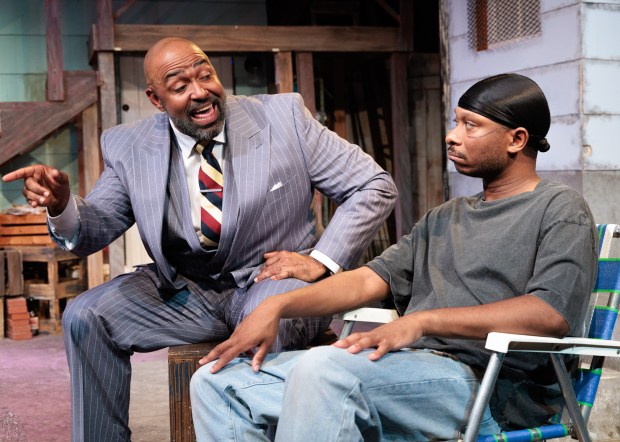
In 2024, City Lit Theater presented the first non-Equity Chicago production of August Wilson’s ‘Seven Guitars’ from the 1940s iteration of his Century Cycle. Manny Buckley, who directed the Jeff Award-winning staging, returns with ‘King Hedley II,’ a quasi-sequel set in 1985. Buckley’s direction explores anger simmering beneath the surface in the story of an ex-convict attempting to begin anew. Although the nuances of King’s journey could be more developed, the cast offers intense performances complemented by moments of dark humor. The creative team highlights elements of magical realism while staying true to the urban Pittsburgh setting. This creates a compelling three-hour experience in Wilson’s world.
James Lewis makes his City Lit debut as King Hedley. The character has spent seven years in prison for murdering Pernell, a local whom King blames for the scar on his cheek. At the play’s start, King plants seeds in his backyard, hoping they will thrive despite the adverse conditions. This act mirrors his aspirations of forging a stable life with his wife, Tonya, and their coming child. However, King’s efforts put him at risk of legal trouble. He and his friend, Mister, sell stolen refrigerators to fund a video store. Additionally, Pernell’s cousin seeks revenge, prompting King to carry a pistol. The presence of guns on stage adds tension, likening it to a Chekhovian gun range.
Buckley describes the play as ‘Wilson’s profound exploration of identity.’ King, explaining his reasons for killing Pernell, clings fiercely to his name, inherited from his father in ‘Seven Guitars,’ as a symbol of dignity. This is reminiscent of John Proctor’s plea in ‘The Crucible’ for his name, even as the characters differ in their methods of asserting identity. Parenthood emerges as another central theme. Tonya, played by Isis Elizabeth, grapples with pregnancy and the difficulty of avoiding the perceived fate for her children.
Tonya’s monologue articulates her painful decision about the pregnancy, highlighting that King has his struggles with fatherhood. Raised by his late great-aunt, whom he regards as his mother, he often disputes with his birth mother, Ruby, played by Andrea Conway-Diaz. Learning of Tonya’s pregnancy drives King toward extreme actions for his family. Regardless, Tonya values his supportive role over material concerns.
Previously, Lewis portrayed morally complex characters tied to fatherhood themes. As King, the audience witnesses minimal progression toward fatherhood. Instead, a transformative realization occurs near the play’s end. Although consistent with Wilson’s portrayal, a more gradual reveal could enhance the moment.
The entire play unfolds in 1985, but characters such as King, Ruby, and Elmore, played by Jelani Julyus, often reflect on past events connected to ‘Seven Guitars.’ Other characters add texture to the realistic setting, like Aunt Ester’s mystical off-stage presence and Stool Pigeon, a prophetic figure. Mike McShane’s lighting and sound design heighten these sequences with dramatic visuals and reflective music.
Chicago often stages Wilson’s works in large venues, such as the Goodman Theatre, where ‘King Hedley II’ premiered in 2001. At City Lit, proximity to the actors intensifies the emotional impact of their anger and despair. While performances sometimes challenge the intimate space, it remains a powerful way to experience Wilson’s words.
Emily McClanathan provides freelance critiques.
Review: ‘King Hedley II’ (3 stars)
When: Through Nov. 29
Where: City Lit Theater, 1020 W. Bryn Mawr
Running time: 3 hours
Tickets: $40 at 773-293-3682 and citylit.org