
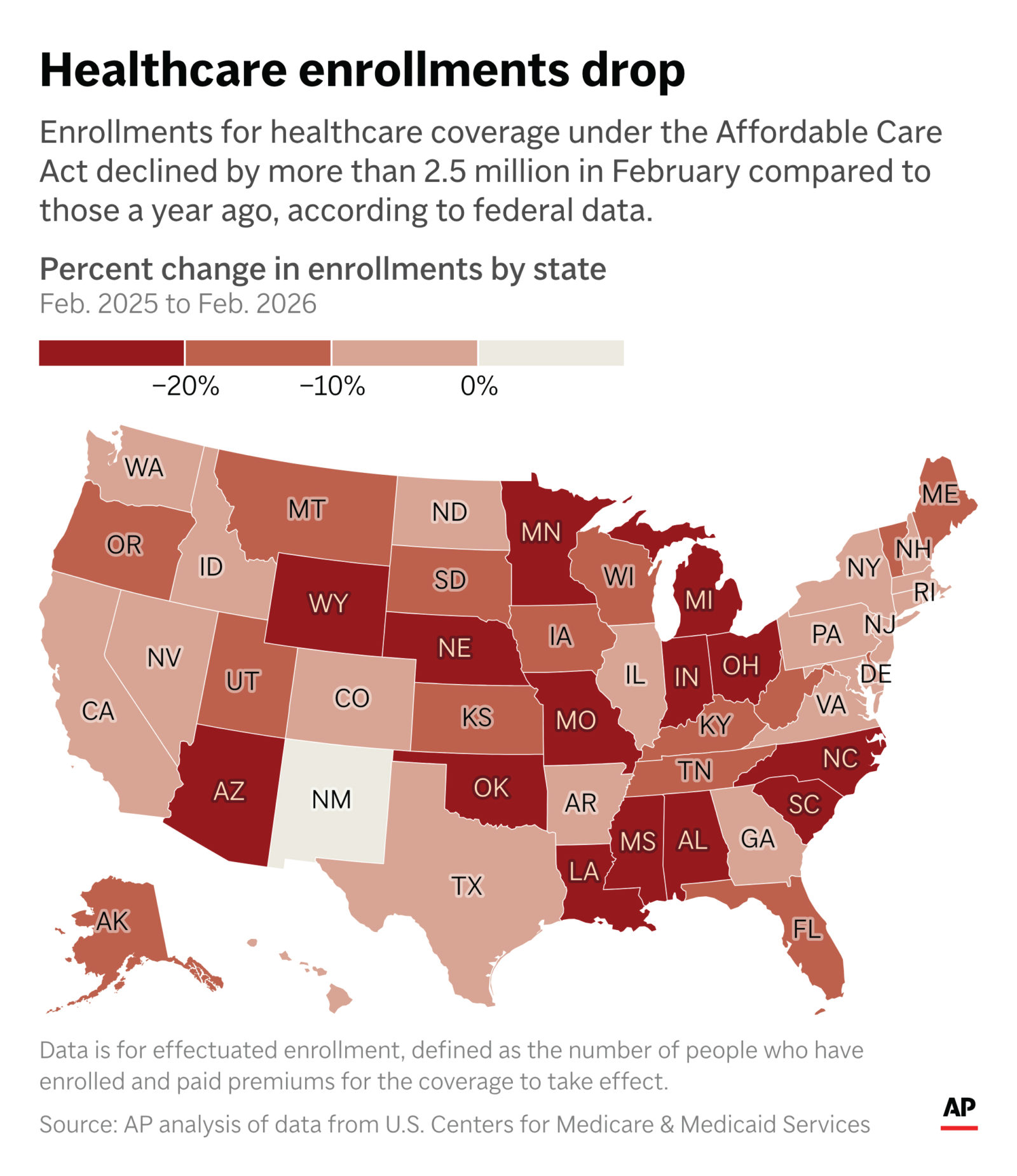
States throughout the United States have experienced a marked decrease in Affordable Care Act (ACA) coverage over the past year. According to new federal data analyzed by the Associated Press, Ohio and Oklahoma each witnessed nearly a one-third reduction in enrollees. The study provides a state-by-state breakdown, highlighting a reduction of approximately 2.6 million Americans covered by Obamacare plans as of February this year compared to the previous year. This decline followed the expiration of enhanced subsidies in January.
The federal dataset, released in late June by the Trump administration and analyzed by Cynthia Cox, a vice president at the nonprofit KFF, offers insight into enrollment figures. It accounts for individuals who enrolled or were automatically reenrolled in 2026 and those who paid their first monthly premiums to maintain coverage. It also reflects people removed retroactively after the nonpayment grace period.
This is the first time we’ve seen state-level data that shows how much ACA marketplace enrollment truly fell,said Cox.It’s in line with our expectations, but it does show a very steep drop in the number of people with ACA coverage.
Impact of Rising Costs and Policy Changes
The reduced enrollment figures coincide with the expiration of enhanced premium tax credits, which had previously lowered monthly insurance costs for many. Political debates in Congress surfaced around renewing these subsidies, with Democrats and some Republicans supporting their continuation. Rising health insurance costs remain a key concern for voters as elections approach.
The U.S. Department of Health and Human Services pointed to a crackdown on fraudulent or ‘phantom’ enrollments as a potential reason for decreased enrollment. However, analysts suggest the January expiration of federal subsidies and tighter requirements for immigrants accessing subsidized plans played a more significant role.
States Experiencing Major Enrollment Declines
The data shows Ohio and Oklahoma experienced enrollment declines exceeding 32%, leading the nation in percentage drops. Arizona, South Carolina, Minnesota, Indiana, Michigan, Mississippi, Louisiana, and Missouri also saw a reduction of over 25% in enrollees.
Florida, a state with a significant number of ACA enrollees due to its lack of Medicaid expansion and its substantial gig economy, lost around 443,000 enrollees. Despite not all individuals finding alternative coverage, some may have switched to employer plans or other options. Yet, Cox emphasized that many likely remain uninsured, as the ACA marketplace often serves as a last resort for coverage.
Interestingly, some of the states with notable enrollment declines were those that had gained enrollees when enhanced subsidies were first introduced during the COVID-19 pandemic.
State-Specific Efforts to Maintain Coverage
New Mexico was the sole state to increase its ACA-covered population, with a 14% rise in enrollment. It managed to fully replace the lost federal subsidies with state funds, a strategy others did not employ. In a special legislative session, the state allocated funding to sustain coverage through mid-2026 and later extended support through mid-2027.
States using the federal Healthcare.gov marketplace experienced more significant enrollment losses compared to those with state-based exchanges. This trend is attributed to some states developing measures to offset costs following the lapse of enhanced subsidies.
Support for trusted journalism and informed public debate is essential for a healthy democracy.