
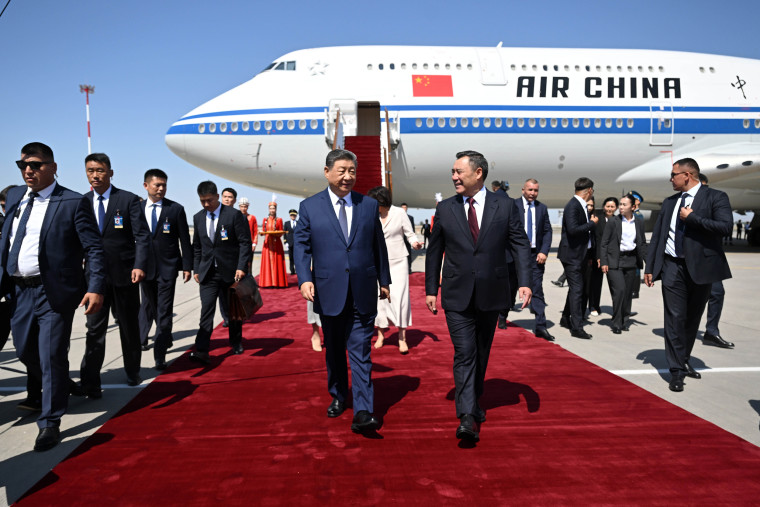
The Shanghai Cooperation Organization (SCO) summit took place in Kyrgyzstan on Monday, gathering leaders from China, Russia, and India among others. This organization aims to balance U.S. global influence. Chinese President Xi Jinping, Russian President Vladimir Putin, and Indian Prime Minister Narendra Modi attended the events in the capital, Bishkek.
Putin had separate meetings with Xi and Modi, part of numerous bilateral talks during the summit. He assured Xi of Russia’s intention to establish a permanent visa-free regime with China. Additionally, Putin highlighted the strengthening ties between Russia and India. Putin’s discussions with Iranian President Masoud Pezeshkian were slated for Tuesday, coinciding with the official SCO sessions.
Russia, amid its ongoing conflict with Ukraine, along with Iran, amidst its tensions with the U.S. and Israel, view the SCO summit as a venue to boost relations with non-Western countries. Modi expressed support for ending the Ukraine conflict, noting the importance of moving from prolonged war to peace for humanity’s benefit.
Established in 2001 by China, Russia, and four Central Asian countries, the SCO has expanded over the years, encompassing 10 nations: Russia, China, India, Iran, Pakistan, Belarus, Kazakhstan, Kyrgyzstan, Tajikistan, and Uzbekistan. Several other countries participate as dialogue partners. The organization, despite its growth, has vague objectives and low brand recognition.
China and Russia present the SCO as a contrast to Western organizations like the G7. China, aiming to broaden the SCO’s influence, pledged to assist development and financial matters, promoting the idea of a new global order with Russia’s aid. China’s Ministry of Foreign Affairs recently commended the SCO for exploring new paths for regional cooperation.
Many SCO members see the summit as a chance to reaffirm their global connections despite worsening relations with the West.
The SCO is not a unified military or political bloc, with members often having significant differences and individual goals. Analysts believe that for India, and others, the summit revolves around optics and strategic messaging rather than tangible outcomes. India’s involvement allows it to safeguard its interests and remain informed on regional changes.
Turkey uses its partner status within the SCO to elevate its regional standing. While maintaining NATO ties, Turkey aims to increase its influence in Eurasia. President Recep Tayyip Erdogan seeks permanent SCO membership for Turkey, which was granted dialogue partner status in 2012. Despite its trade relations with the European Union, Turkey’s EU membership application remains stalled.
Security measures in Bishkek included closing major shopping centers, markets, and implementing air travel restrictions. Kyrgyz President Sadyr Zhaparov’s spokesman, Askat Alagozov, warned of regular traffic disruptions in central Bishkek, advising residents to avoid the city. The school year start was delayed to September 15, and a public holiday was declared for civil servants on the summit’s second day.