
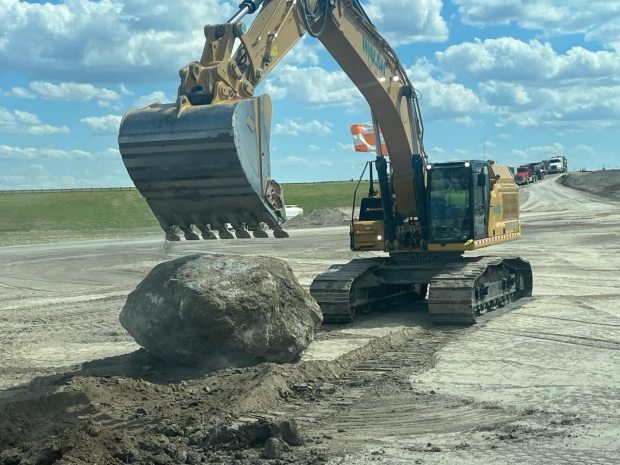
Ron Pitelka, age 23, took an interest in large rocks when he first brought home a 10,000-pound limestone boulder from a construction site near Chicago. He employed his new dump truck to transport it. Over two decades, Pitelka, now 45, a Local 150 excavator operator, has collected hundreds of rocks. These are distributed between his mother’s residence in New Lenox and his own home in Homer Glen, southwest of Chicago. Neighbors may not share his enthusiasm, but his collection remains visible on his property.
The most significant rock in his collection emerged this summer under O’Hare International Airport’s airfield. Using his Caterpillar 352 excavator, Pitelka and bulldozer operator Matt Tracy uncovered a boulder weighing 50 tons. This discovery occurred during Walsh Construction’s early-stage work on a terminal modernization project costing $8.8 billion. The excavation site was a stormwater detention basin. According to Cortney Harris from the Chicago Department of Aviation, the boulder lay about 30 feet underground.
Pitelka and Tracy’s find was analyzed by a geologist working on the terminal expansion. The rock was classified as dolostone. Dolostone, a sedimentary carbonate rock akin to limestone, constitutes much of Illinois’s bedrock and is recognized as the state’s official rock. This classification followed an elementary school campaign.
Currently, a public contest aims to name the O’Hare boulder. The Aviation Department has received over 2,300 name proposals, including Da Layover, Jean Baptiste Point du Pébble, Ferris Boulder, and The BaRock Obama Presidential Memorial Airport Boulder. Public voting will finalize the name.
Pitelka, informed of the contest by a neighbor, expresses satisfaction with the initiative. Typically, construction workers are tasked with burying or breaking boulders, but Pitelka advocates to preserve them, citing previous encounters with buried granite rocks.
The O’Hare boulder’s material is estimated to be more than 400 million years old, according to Pat McLaughlin from the Illinois State Geological Survey. Dolostone formation traces back to when Illinois was tropical, hosting a shallow sea with marine life. Seashells from these organisms transformed into limestone and then dolostone. Glacial movement eventually shifted these rocks.
The boulder’s formation, shaping, and eventual position around O’Hare date back 12,000 to 15,000 years. Clara Blättler, from the University of Chicago’s geophysical sciences department, suggests fossil analysis for precise aging.
The boulder, noteworthy for Chicago’s area, is displayed publicly at O’Hare’s Multi-Modal Facility. This venue accommodates airport rental car operations, a people mover stop, and Metra and Pace connections.
Pitelka’s excavation career stems from family influence; his father and uncle were in the same field, starting him young. In the 1980s, children often accompanied their fathers to work sites. His passion for boulders started with rocks outside his childhood home.
Diverse interests in excavation range from dinosaur discovery to meteorite searches. Pitelka values focus and skill in excavation work, acknowledging its stress but also enjoyment.
Pitelka prefers a simple name like “Geo” for the boulder, due to its geological relevance. He cherishes Geo’s permanence, expecting it to endure beyond his lifetime. Chicagoans have approximately a week to propose rock names.