
Lawmakers are expressing concerns over increasing costs associated with streaming NFL games. Representative Jim Jordan, R-Ohio, highlighted these issues at a congressional hearing. The focus was on the NFL’s streaming practices and financial burdens on fans. Jordan referenced the 1961 Sports Broadcasting Act, raising antitrust concerns amidst reports of steep prices for accessing games on various platforms.
Jordan emphasized the importance of making NFL content accessible to all fans, not just those who can pay for pricey packages. Recent data revealed that the New England Patriots-Seattle Seahawks game, held last week, became the NFL’s lowest-rated opening-night game since 2022. The game attracted 25.1 million viewers on NBC and Peacock, marking a 12% drop from the Dallas Cowboys-Philadelphia Eagles opener the previous year, which had 28.3 million viewers.
Changes to Nielsen’s measurement system have been considered, and the notable decline in viewership over the years draws attention. Despite this, NFL and NBC partially blamed the ratings drop on the unusual scheduling of the game on a Wednesday. This was a shift from the usual Thursday games, which typically attract more viewers.
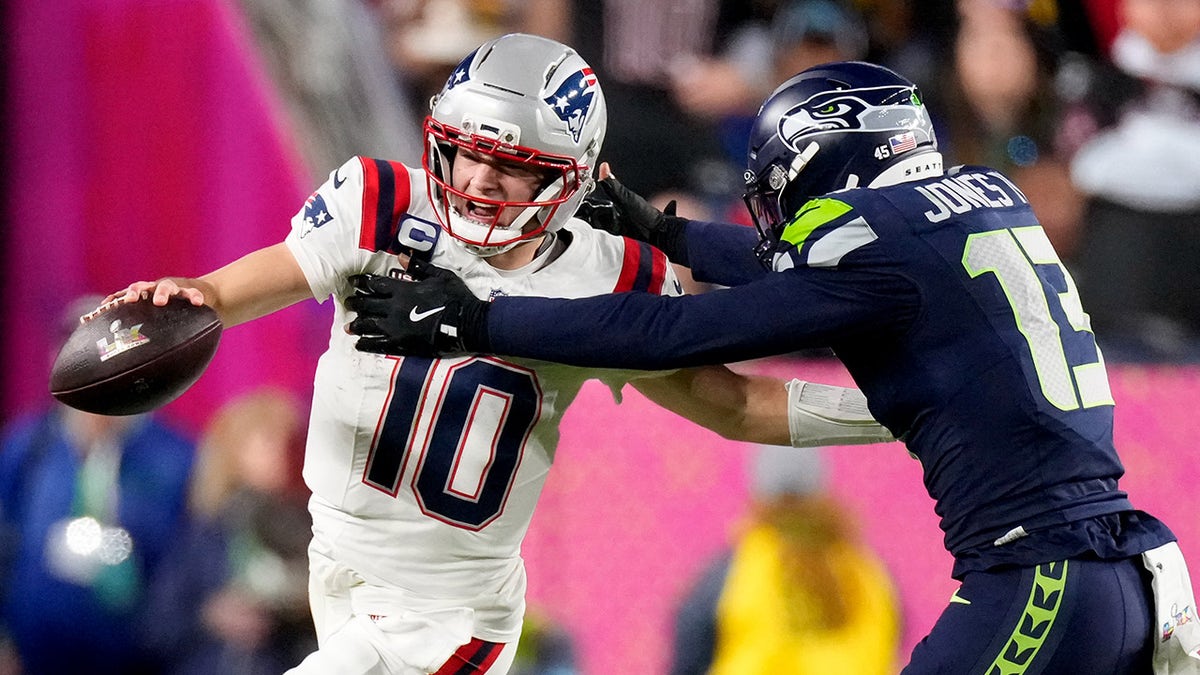
New England Patriots quarterback Drake Maye (10) is tackled by Seattle Seahawks linebacker Ernest Jones IV (13) during the second half of the NFL Super Bowl 60 football game in Santa Clara, California. February 8, 2026. (Mark J. Terrill/AP Photo)
The NFL’s decision to open the season mid-week stemmed from its broader growth strategies, including prioritizing streaming and international games. Yet, the Sports Broadcasting Act of 1961 restricts televised games on most Fridays during the high school and college football seasons. This prohibited the Los Angeles Rams-San Francisco 49ers game in Australia on a Friday, necessitating its move to Thursday. Consequently, the Patriots-Seahawks game was pushed to Wednesday.
Further changes include a Wednesday game on Netflix before Thanksgiving and several Friday games, such as those on Black Friday and Christmas Day. The NFL will also host nine international games.
While this expanded schedule means more football broadcasts, potential drawbacks include degraded game quality. The additional fixtures, unusual scheduling, extensive travel, and limited rest can affect team performance. Fans noted last season that frequent games on short rest, including overseas clashes, often resulted in poorly coordinated and prepared teams. The altered schedule also diluted the significance of traditional Sunday games.
The drop in viewership for last Wednesday’s game comes as no surprise. Factors included a sluggish game pace and added workdays leading to early wake-ups for many Americans. Moreover, the Rams-49ers followed on the next night. Despite this, the NFL’s popularity remains unmatched, with the game still attracting more than 25 million viewers, surpassing any individual NBA Finals game in June.
NFL Commissioner Roger Goodell looks on as President Donald Trump speaks during an event announcing that Washington, D.C., will host the 2027 NFL Draft in the Oval Office of the White House in Washington, D.C., on May 5, 2025. (AFP via Getty Images)
Nevertheless, signs of fan discontent and fatigue increase. The high cost of following games across different networks and streaming services raises significant concerns. Media analysts speculated on possible resistance to further NFL expansion and its appetite for growth.
OutKick reported during the summer that increasing prices for an underwhelming product could be ineffective. The NFL seems to assume this rule does not apply. Viewership trends suggest some overconfidence in their approach. Bobby Burack, a writer for OutKick, pointed to these issues.