
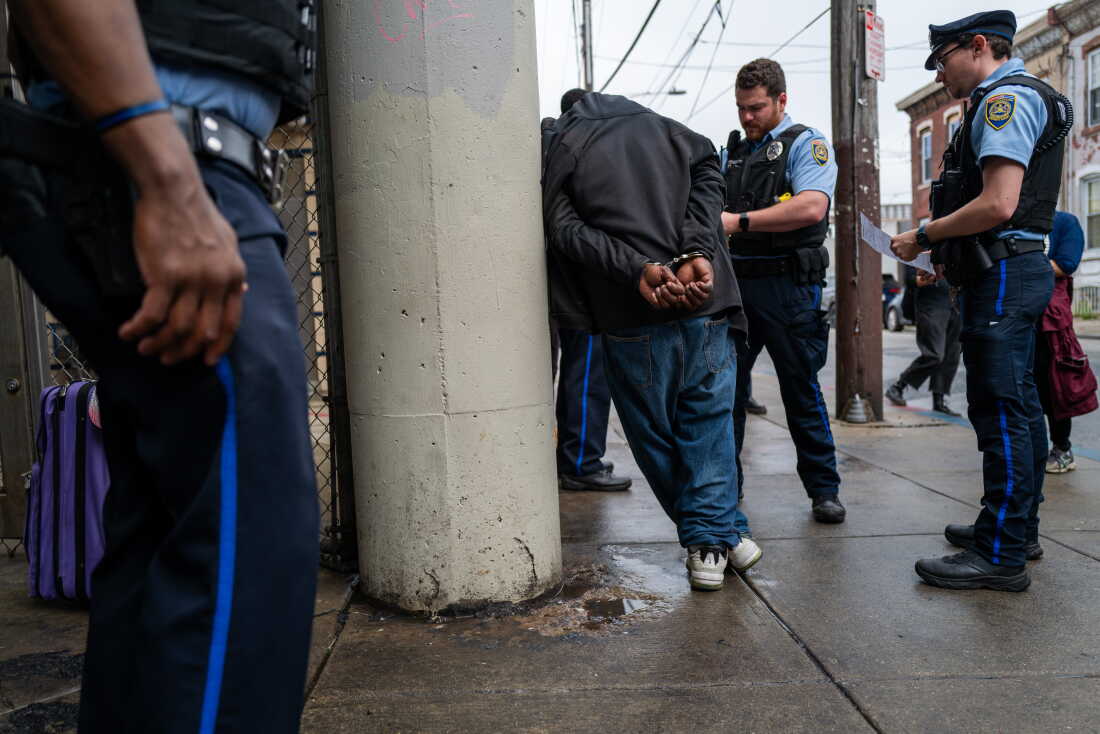
Philadelphia recently started clearing a drug encampment in Kensington, which led to the arrest of a man. Arrests for minor offenses, such as vagrancy and drug possession, increased across the U.S. from 2024 to 2025. This is documented in a new analysis by FWD.us, a criminal justice and immigration reforms advocacy group. Surprisingly, during the same period, rates of violent crimes, including homicide, dropped to historic lows.
Zoë Towns, FWD.us executive director, shared insights with NPR prior to the report’s release. “This increase signals a troubling return to extreme law and order policies from the 1980s and 1990s,” Towns stated. These policies led to higher incarceration rates, driven by mandatory minimum sentences.
The report utilizes FBI and immigration arrest data. It does not specify whether charges were dropped or the duration of any incarceration. Towns emphasized the impact of an arrest: potential jail time, job loss, missed financial obligations, and family separations can result.
“An arrest has life-changing consequences,” Towns asserted.
The report indicates significant arrest increases in four states: California, Hawaii, Nevada, and Arizona. These states represented over half the rise in vagrancy arrests. Vagrancy is defined legally as moving without permanent employment or resources, targeting mainly the homeless population. Arrests for vagrancy increased 44% from 2024 to 2025.
Two demographic groups, Asian Americans and Native Hawaiian/Pacific Islanders, were disproportionately affected. Although they comprise about 7% of the population, these groups accounted for 17% of the vagrancy arrest increase, mostly in Hawaii.
Arrests for marijuana possession also rose by 6%, primarily in Southern states. In 2024, there were 190,182 arrests compared to 201,273 in 2025. A racial disparity was evident. Black individuals represented 83% of the increase in marijuana-related arrests, totaling 45% of all cannabis arrests.
Furthermore, arrests for non-marijuana drug possession rose slightly by 3% from 2024 to 2025. California experienced a notable jump in possession arrests. Voters approved Proposition 36, raising penalties for repeat offenders and drug users.
Oregon reinstated a policy that criminalized simple drug possession, resulting in a 39% increase in non-marijuana drug possession arrests.
Immigration violations saw a dramatic rise, with arrests growing 188% from 2024 to 2025. In 2024, there were 109,936 arrests compared to 316,304 a year later. FWD.us attributes this to changes at the federal level, notably during President Trump’s second term. His administration focused on tough crime policies and deportation efforts, with significant funding for local police through the 287(g) program.
Federal deployments of immigration officers and the National Guard also increased arrests. For example, marijuana possession arrests in Washington, D.C. doubled after the deployment of National Guard troops.
Supreme Court rulings contributed to the rise in vagrancy arrests. A decision allowed cities to prohibit sleeping and camping in public places, resulting in increased restrictions in locales such as Oregon.
Despite rising arrests, crime overall continues to decline. Insha Rahman from the Vera Institute highlighted the resilience of localities investing in effective methods. Adult drug crime arrests peaked in 2006 but have since decreased, reflecting investment in treatment, violence intervention, youth services, and alternative response programs.