
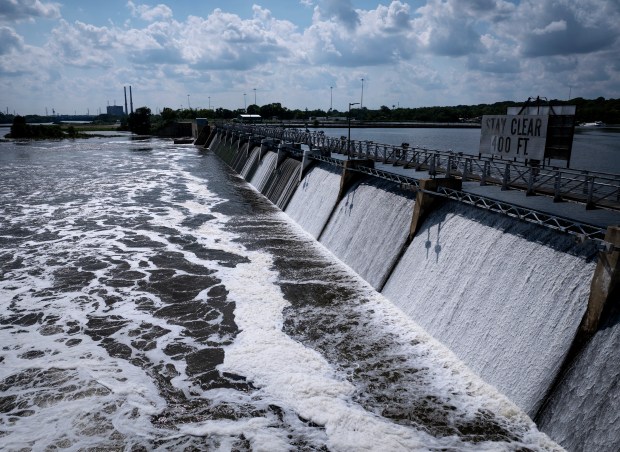
The U.S. Army Corps of Engineers has restarted construction on the Brandon Road Lock and Dam near Joliet. This decision comes after more than a month of halted work on the $1.15 billion project designed to prevent invasive carp from entering the Great Lakes.
Initial Project Halt
On July 24, the Army Corps’ Rock Island District issued a stop-work order without explanation, citing an “administrative review.” This pause came before the discovery of hundreds of small silver carp in the Illinois River, 80 miles from Lake Michigan. This finding suggested possible spawning activity closer to the lake, raising alarms about an establishing carp population.
Attempts to reach the Army Corps for comments on the halt were unsuccessful. An Illinois Department of Natural Resources survey revealed the carp issue, highlighting the urgency of completing the project.
Trump’s Directive and Bipartisan Efforts
President Donald Trump had earlier urged federal agencies to accelerate the project. Efforts to prevent carp invasion have involved decades of bipartisan cooperation among Illinois, Michigan, and federal entities. These invasive species threaten the native ecosystem and the billion-dollar fishing and boating industries of the Great Lakes.
The last line of defense against these species relies on unreliable electrical barriers near Romeoville along the Illinois River.
Advocates’ Concerns and Support
Advocates, including the Alliance for the Great Lakes, expressed concern over the work stoppage. Joel Brammeier, the organization’s president and CEO, emphasized regional support for the initiative, urging continued progress without delay. Discussions between Trump and Michigan Governor Gretchen Whitmer led to lifting the stop-work order.
Financial and Political Considerations
Debates over project funding have affected its progress. Illinois contributes $50 million, while Michigan adds $64 million. Congress has increased federal cost-sharing for operations and maintenance to 90%, with federal funds covering the same percentage of construction costs. An appropriation of $274 million supports the first of three project phases.
Technological Solutions
The project’s first phase includes bedrock removal, site preparation, and installing multilayered technologies. These include a bubble barrier to stop fish carried by barges and an acoustic deterrent targeting silver carp’s unique auditory systems. Subsequent phases will incorporate electric barriers and additional sound-deterrent methods. A flushing lock at completion will redirect larval fish and eggs back downstream.
Background on Invasive Carp
Originally introduced in the 1960s in Arkansas for non-chemical seaweed management, invasive carp have proliferated in American waterways. Flooding in the 1980s and 1990s allowed these fish to escape into the Mississippi River basin, expanding to 31 states. Bighead and silver carp pose particular risks due to their lack of natural American predators and ability to eat quickly, outcompeting native species.
Monitoring and Future Actions
Enhanced monitoring on the Illinois River aims to manage carp populations. Techniques such as electrofishing and microchemistry analysis are underway to trace carp origins. Contract commercial fishing will target adult carp near Lake Michigan, emphasizing the need to prevent young fish from establishing.
Despite challenges, protecting the Great Lakes from invasive carp remains a top priority for state and environmental organizations, reinforcing the necessity of maintaining project momentum.