
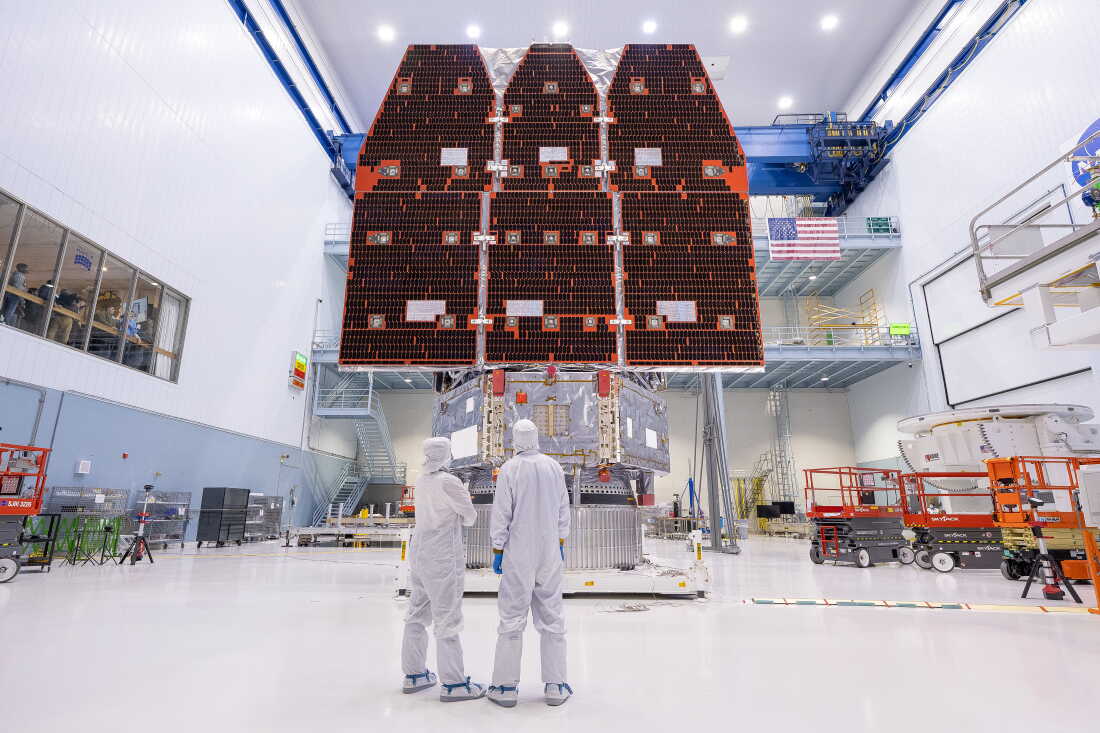
Technicians will connect the inner and outer segments of NASA’s Nancy Grace Roman Space Telescope in 2025 at NASA’s Goddard Space Flight Center in Greenbelt, Maryland.
When NASA launched the Nancy Grace Roman Space Telescope from the Kennedy Space Center in Florida last month, engineers were filled with anticipation. Expectations soared, as the telescope is set to gather unprecedented data on the universe’s expansion and uncover hidden planets in the galaxy.
“Fifteen years of preparation and $4 billion had led to this moment,” remarked an engineer overseeing the launch.
Despite the efforts, NASA’s teams at Goddard faced fragile conditions due to rapid relocations over the past year. NASA’s management required scientists to frequently vacate their labs at Goddard, impacting the telescope’s development. Propulsion engineers had to conduct tests on Roman’s fuel with less sensitive equipment, as some tools were lost during a relocation.
NPR spoke with seven scientists and engineers, revealing significant challenges due to the relocations. Many labs and specialized equipment were lost, impacting the development of current and future spacecraft. NASA aimed to reduce costs and eliminate redundancies, aligning with a master plan for Goddard’s campus.
The relocations hinder NASA’s mission, according to workers. Goddard’s diminished capacity delayed projects and hampered the agency’s ability to produce spacecraft.
Jack Kiraly, chief of advocacy at the Planetary Society, expressed concern over the risky environment for engineers, potentially affecting taxpayer investment worth billions.
An engineer revealed they launched a satellite, GRITSS, before it was ready, risking its ability to track Earth’s water levels and landmasses.
Further relocations saw a radio communications lab lose equipment and a unique testing facility. “This was ripped away from NASA employees most capable of utilizing the equipment,” lamented an engineer from the team.
Another team faced delays on a Venus exploration spacecraft, DAVINCI, due to losing their workspace.
NASA’s relocations contradict a report from June by the NASA Office of Inspector General, stating no ongoing projects were impacted.
NPR found some equipment auctioned or discarded, including restricted items crucial to national security. The government’s actions followed a significant federal workforce reduction, resulting in Goddard losing about a third of its staff in 2025.
The White House budget request projects a $5.6 billion reduction for NASA in 2027. Many scientists fear the agency’s future performance may not match previous standards.
“We were told to ‘pack as if you are never going to build another propulsion system again,'” shared an engineer involved with Roman’s project.
Almost 60% of Goddard engineers surveyed are considering leaving, according to internal survey results.