
The legendary writer Nelson Algren often spent time in the apartment where I grew up, mingling with my parents’ friends and other writers, engaging in lively discussions, surrounded by smoke and the sound of clinking glasses. Unbeknownst to me at the time, Algren’s drinking didn’t quite match the notorious enthusiasm of other famous writers of his era. Despite this, he was still a great writer, though perhaps his output could have been more extensive.
An upcoming three-day event in Chicago, however, is not about Algren’s relationship with alcohol. Instead, it highlights his affection for saloons and the community around them. Taverns during Algren’s time played a crucial role in neighborhoods, offering solace from life’s challenges. He once wrote, “Between (streetcar) stops stretch the streets where the shadow of the tavern and the shadow of the church form a dark and double-walled dead end.” Though Algren left Chicago in 1975 and passed away in 1981 at Sag Harbor on Long Island, his presence endures through his books, films, a museum, and various events dedicated to him.
Mary Wisniewski, author of the 2016 biography Algren: A Life, explained that while some of Algren’s friends thought he drank excessively, few considered him an alcoholic. The drinking culture among writers and artists in the mid-20th century was more prevalent than today. For Algren, spending time in bars was partly due to loneliness; he preferred being surrounded by others rather than alone with his typewriter, especially as selling his work became increasingly difficult.
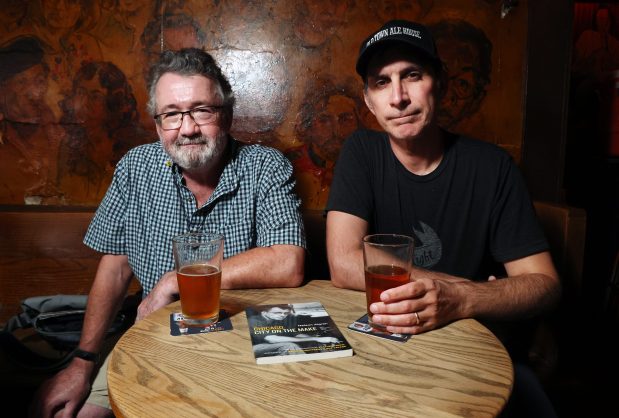
The weekend event celebrates the 75th anniversary of Algren’s work, Chicago: City on the Make. Organized by avid Algren enthusiasts Paul Durica and Bill Savage, the event includes tavern tours in Chicago. Durica, an exhibitions director at the Chicago History Museum, and Savage, a Northwestern University professor, both cherish Algren’s continued relevance. They aim to ensure the author’s legacy remains vibrant.
“I think we came up with this idea over beers at Miller’s Pub,” Durica shared. “We believe the book still holds significance. This event is yet another way to preserve Algren’s memory.”
At each location, they will read excerpts from City while sharing historical and biographical insights. “A key comparison with City is Carl Sandburg’s poem ‘Chicago,’” said Savage. “Both might be dated, but they capture enduring elements of the city. Algren’s language continues to resonate.” Enthusiasts can enjoy music and surprises, with tickets priced between $5 and $20, and a cash bar available.
The event kicks off at 7 p.m. on Friday at Bernice’s Tavern, located at 3238 S. Halsted St. Growing up on the South Side, Algren idolized the White Sox and used the 1919 Black Sox scandal to highlight corruption in City. The tour continues at 1 p.m. on Saturday at the Old Town Ale House, 209 W. North Ave., praised by Roger Ebert as “the best bar in the world.” Adorned with painter Bruce Elliott’s creations, this spot was a regular haunt for Algren.
The final stop is at 5 p.m. on Sunday at the Hideout, 1354 W. Wabansia Ave., the event’s largest location, featuring a stage and multiple readers. Guests include journalist Lester Munson, beer historian Liz Garibay, and poet Gregorio Gomez Aguayo, among others. A limited edition poster by Ethan D’Ercole will also be available. Participants will learn about Algren’s time living nearby at 1523 W. Wabansia Ave., now the site of the Kennedy Expressway.
Savage plans to showcase portions from the Holiday magazine where City first appeared, along with other items from his extensive Algren collection. Some attendees plan to join all three days, while others will drop in for one. Additionally, a few intend to extend the celebrations by visiting the Nelson Algren Museum in Indiana next Saturday to commemorate the annotated 50th anniversary edition of City with museum members Dick Bales and Wisniewski. The local brewery Hop Butcher for the World is offering four beers inspired by City on the Make throughout the tour. Cheers to Algren’s enduring legacy.