
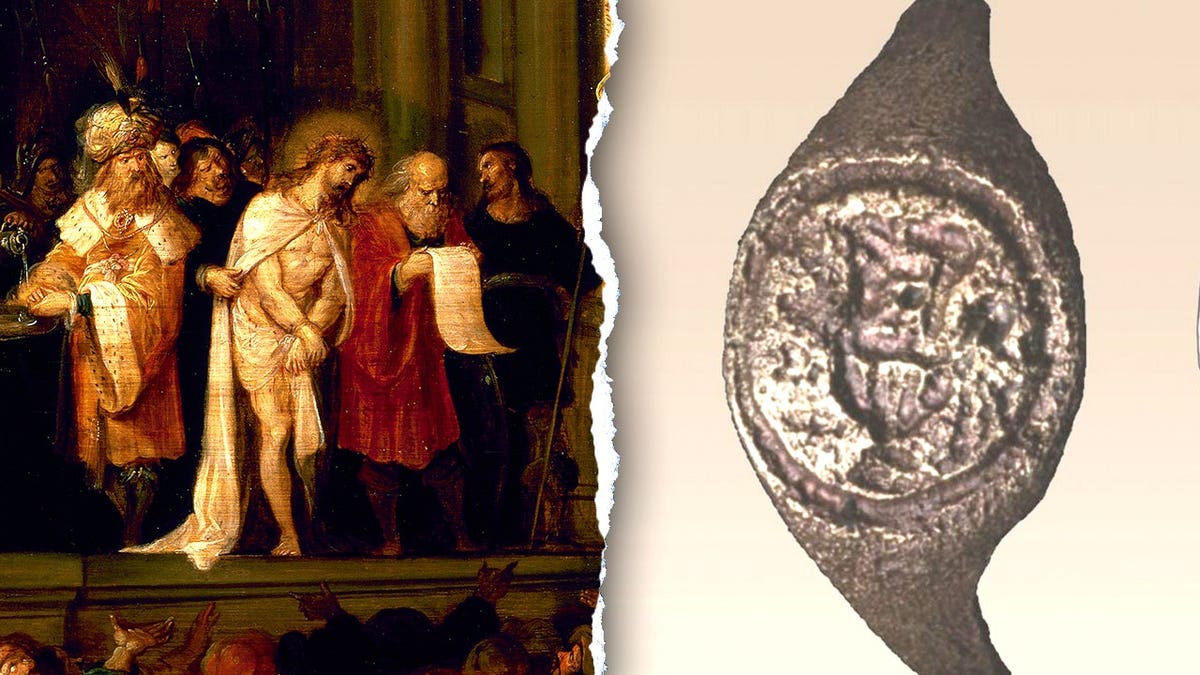
Recent research has shed new light on an old artifact linked to Pontius Pilate, the Roman governor who condemned Jesus Christ. A ring found at Herodium, a fortress in the Judean desert, holds significance due to its inscription related to Pilate. Though discovered in the 1960s, the ring’s details only emerged in 2018.
New Interpretations of the Inscription
Catherine Bonesho, a UCLA professor, explored this connection in a study published in Palestine Exploration Quarterly. The ring’s inscription, which uses Greek letters to transliterate the Latin “PILATO,” suggests a relationship with Pilate. Bonesho posits the ring likely belonged to a lower-status worker involved in administrative duties for Pilate.
This conclusion challenges earlier interpretations that claimed the inscription meant “belonging to Pilate.” Instead, the wording indicates an extension of the governor’s influence through subordinate personnel.
The Role of the Ring in Roman Administration
Bonesho emphasizes the ring’s significance in understanding Roman governance in Judea. The transliteration and the ring’s modest quality suggest it was used by enslaved or formerly enslaved workers, such as secretaries, engaged in official business.
Understanding this ring enriches our comprehension of how authority was spread throughout the Roman government’s lower ranks. – Catherine Bonesho
Connecting with Biblical Accounts
The ring also offers perspectives on biblical narratives. Candida Moss, a historian of early Christianity, suggests the ring clarifies why Pilate, noted in the Gospel of John as labeling Jesus “King of the Jews,” did not craft the inscription himself. Instead, a representative likely executed such tasks under Pilate’s authority, illustrating how act delegation functioned.
Moss points out the ring’s use by those working for Pilate, emphasizing the importance of such items in asserting and distributing Roman administrative power.
Thus, this ancient artifact not only provides archaeological insights but also contributes to historical understandings of the biblical era and its governance structures.