
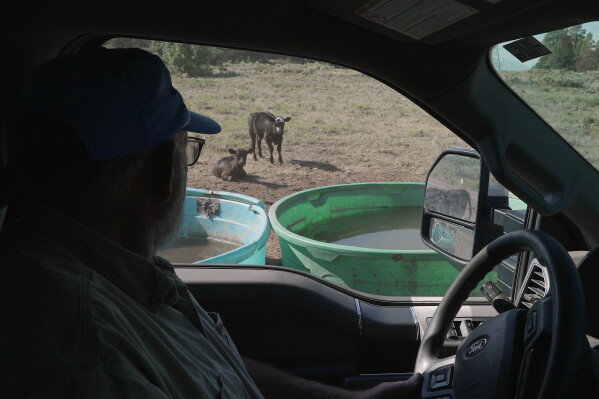
In Montrose, Colorado, Scott Snyder manages Mex and Sons Ranch with his family. Water spills from a stock tank as Snyder tries to conserve every drop. Operating a ranch in the high country mesa demands tremendous effort.
Snyder recently made eight arduous trips in searing heat to provide water for 800 cow-calf pairs. This has become a daunting daily task for many ranchers in the U.S. Rockies. They once depended on snowmelt for ponds and springs, but this year’s snowpack in the Upper Colorado River Basin, covering states like Wyoming, Colorado, Utah, and New Mexico, was the worst ever recorded. Climate change driven by human activity has made such conditions about 14 times more likely, according to a new study.
Ranchers Adjust to Tough Conditions
The Snyders, like other ranchers, face increased stress while trying to maintain family traditions and supply beef to Americans. They have reduced their herd, bought hay, and transported cows to new grazing areas. Now, they also transport water.
Scott’s brother Monte and he are adapting by adjusting herd size and watching wildfire paths. They express gratitude for a local landowner allowing them to fill a 6,500-gallon tanker. Nearby, Mark Ragsdale, who works as a water commissioner, also hauls water for his smaller herd. His solar-powered well still functions, offering a glimmer of hope.
“If Mother Nature doesn’t want to help out here, we’re probably in a lot of trouble,” Snyder notes.
Monsoonal rains have brought some relief, but a full recovery would require ten years of above-normal precipitation, says Ragsdale.
Hopes and Concerns About Drought
Adrienne Marshall from the Colorado School of Mines notes that while the current drought’s severity might not repeat soon, ongoing climate change raises the risk of similar conditions. The Brays, managing 500 cattle, expanded their water transport fleet in response.
Ranchers can apply for the U.S. Department of Agriculture reimbursement for increased drought-related costs, but time lost remains irrecoverable. Zandon Bray reflects on persistent struggles with drought, highlighting the difficulty of ranching under prolonged dry conditions.
Stanford Salazar, managing the responsibility of water transport, faced equipment damage due to the workload. He recalled times when winter snow levels reached several feet, now reduced to mere inches.
Meanwhile, Jeff Christensen in Utah is drilling two wells, each 500 feet deep, to address water scarcity. Supported partly by grants, these wells symbolize a cautious hope for relief.
“I spend the majority of my time on water,” Christensen remarks, underscoring the constant urgency in finding and transporting water.
The Associated Press acknowledges support from the Walton Family Foundation for its environmental reporting.