
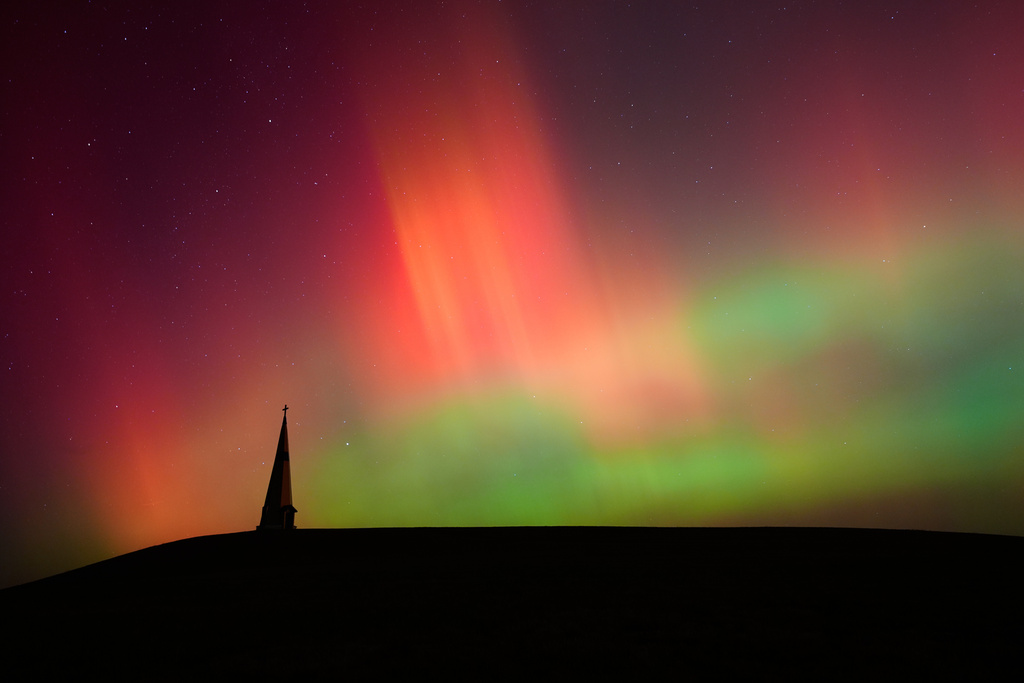
Nature might provide an unexpected fireworks show this July 4 weekend, as forecasters predict a chance to see the northern lights on Friday. The National Oceanic and Atmospheric Administration’s (NOAA) Space Weather Prediction Center (SWPC) has been monitoring two major sunspot groups this week. A significant solar flare, reaching X1 strength, has been observed, according to Shawn Dahl, a service coordinator with SWPC. While ‘X’ represents the highest classification for solar flares, ‘1’ is the weakest level in that category.
Dahl mentioned that the flare was a swift, energy-laden event. Initially, it was uncertain if the associated coronal mass ejection (CME) was heading toward Earth. By Wednesday, SWPC confirmed the CME is expected to affect Earth, likely increasing geomagnetic activity. If the magnetic field orientation is favorable, moderate geomagnetic storm conditions could occur. This might allow some to see the northern lights on the eve of Independence Day.
Where to See the Northern Lights
If geomagnetic conditions are as strong as predicted, residents in the northern U.S. could glimpse the aurora. Moderate G2 level geomagnetic storms can bring the northern lights as far south as New York and Idaho, according to SWPC. Therefore, individuals in Washington, Oregon, Idaho, Montana, North Dakota, South Dakota, Minnesota, Wisconsin, Michigan, Vermont, New Hampshire, New York, and Maine might witness the lights. Although Alaska is included, the state generally has a consistent chance of seeing the northern lights.
Further south, regions like Wyoming, Nebraska, Iowa, Illinois, Indiana, Ohio, Pennsylvania, and Massachusetts might observe the northern lights on their northern horizon, as forecasted by the University of Alaska Fairbanks. However, visibility depends on timing, as the display could be overshadowed if the strongest geomagnetic storming occurs before sunset.
SWPC predicts that conditions might intensify around 2 a.m. EDT and persist throughout the day. By sunset, the aurora may be visible for a few hours if activity remains strong. If conditions aren’t perfect, the northern lights might not materialize as expected. Current forecasts are available on the SWPC website.
To improve your chances of seeing the aurora, look toward the northern horizon. If visibility is challenging, use your phone’s camera. New digital camera lenses, more sensitive to light than human eyes, can capture the green, pink, and red hues of the northern lights.