
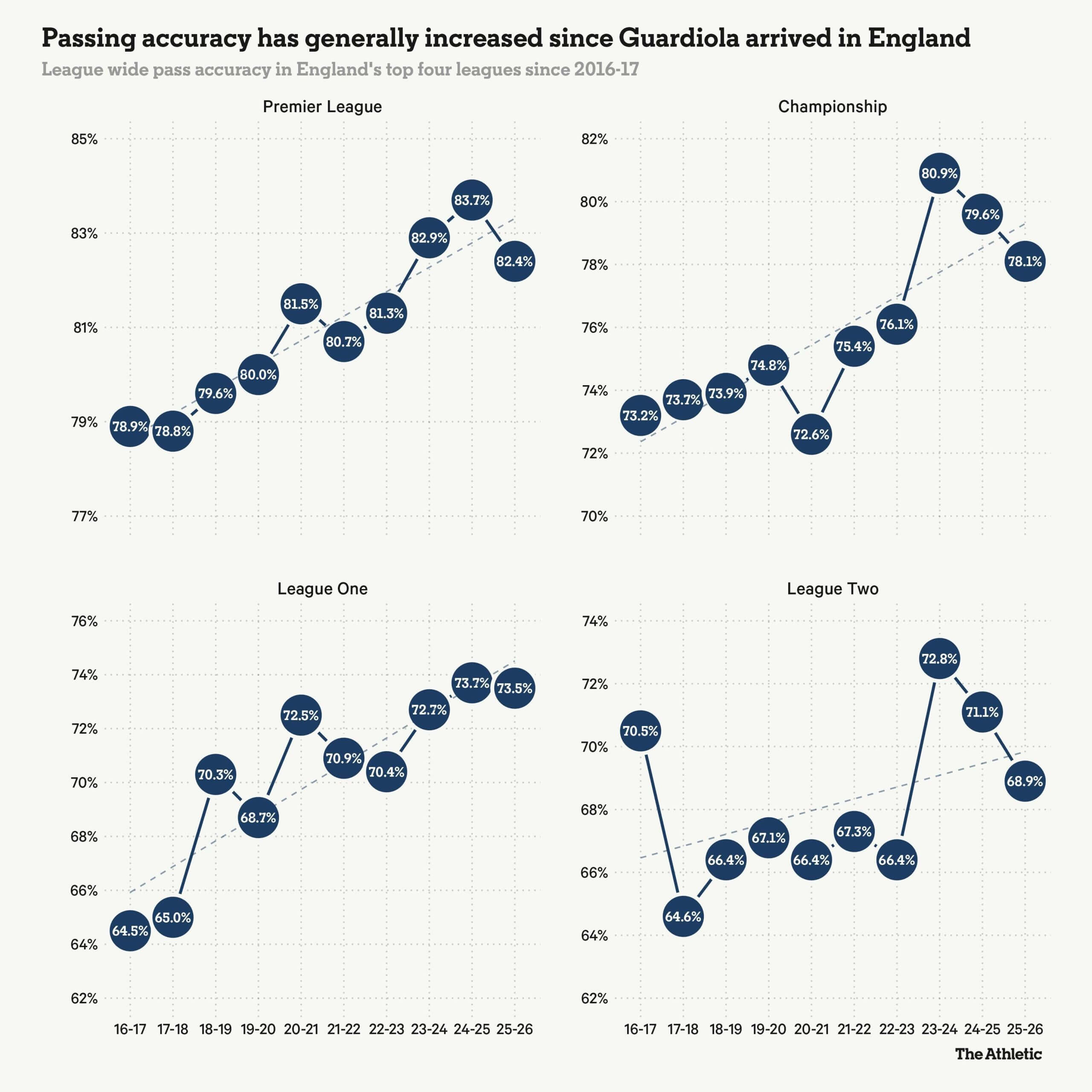
Pep Guardiola began his journey at Manchester City with a surprising statement in early 2017: ‘the process of my goodbye has already started.’ Initially, both he and the club’s executives saw his stint as short-term, possibly just the duration of his three-year contract. Yet, Guardiola defied expectations, staying nearly a decade and significantly altering the landscape of English football.
Under his leadership, City secured six Premier League titles, three FA Cups, five League Cups, and a UEFA Champions League, among other trophies. Beyond these achievements, Guardiola’s influence extended to instilling a possession-based playing style across English football, initially seen as contradictory to traditional English values. This style became prevalent across leagues, from the Premier League to amateur games.
‘In terms of offensive concepts, he [Guardiola] is by far the best manager I’ve seen.’ – City captain Bernardo Silva
Nonetheless, recent trends show a shift away from ‘Pep-ball’. There’s more emphasis on set pieces and a decline in pass completion rates across several leagues, including the Premier League. Even Guardiola has adjusted, focusing on players like Erling Haaland and Gianluigi Donnarumma, who excel in core roles but offer less to possession play—a nod to the Premier League’s physical demands he once criticized.
Guardiola’s early seasons exposed him to England’s football quirks, leading to doubts about his methods’ viability in the Premier League. Yet, he silenced critics by winning back-to-back titles with a possession-heavy style, defying the expectation for physical resilience. His teams played with lower long-pass ratios and high possession, contrasting with previous title-winning teams.
Xavi Hernandez predicted Guardiola’s transformative impact when he arrived: ‘I think he will change the face of English football.’ Indeed, Guardiola and counterparts like Mauricio Pochettino and Jurgen Klopp introduced a focus on intensity and skill. Their modern strategies on and off the ball reinvigorated English football.
Despite his successes, Guardiola faced criticism for supposedly stifling creativity. Supporters saw free-flowing football, yet some critics argued his style demanded too many sideways passes and curtailed individual flair. Guardiola’s teams, though seen as perfect, often faced the ‘boring’ label due to their precision and dominance.
Guardiola’s influence on coaching is unparalleled. Many coaches, including Enzo Maresca, Mikel Arteta, and others, have been directly shaped by his philosophy. However, Guardiola’s tenure coincided with allegations of financial misconduct against City, potentially impacting his legacy. The club denies any wrongdoing, yet the outcomes of ongoing investigations could alter perceptions of their achievements.
Guardiola’s final seasons saw lessened success domestically and in Europe. Although adaptable, even he acknowledged the changing dynamics of the Premier League, mentioning clubs emphasizing speed and transitions. Despite setbacks, his resilience fulfilled broader objectives for City and the Premier League alike.
As Guardiola departs, his legacy remains vast. His departure opens possibilities for rival teams, perhaps challenging the dominance City, under Guardiola, achieved. While skepticism surrounds Maresca’s ability to fill Guardiola’s shoes, change might benefit City as found with Klopp’s recent success at Liverpool.
Guardiola has long been noted for his relentless pursuit of excellence. His relentless drive and tactical brilliance solidified his reputation, transcending typical coaching boundaries. Although leaving, Guardiola’s legacy at Manchester City and English football endures, marked by significant transformations in style, success, and influence over a decade.