
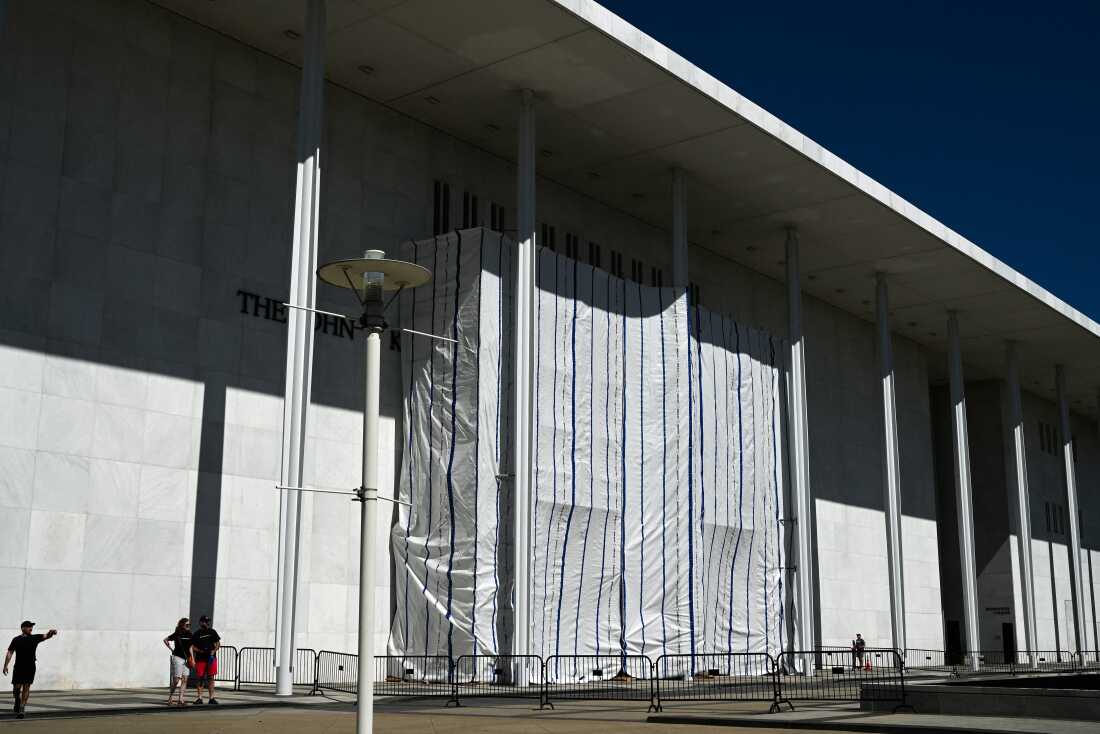
The John F. Kennedy Memorial Center for the Performing Arts in Washington, D.C., covered by a tarp since June 13, is under scrutiny. A federal judge has requested clarity from the center’s leadership about the purposes of the tarp and scaffolding encompassing the facade.
Judge Christopher R. Cooper, overseeing the lawsuit involving the Kennedy Center, has demanded a status update on the center’s operations and programming. This report is required within a few weeks. In his recent order, Judge Cooper instructed the center to clarify both the purpose and the current status of the tarp and scaffolding. Previously, the names of President Trump and President John F. Kennedy were displayed on the main signage.
Recent court directives required the Kennedy Center’s administration to immediately disclose plans concerning construction, programming, and public accessibility. Trump’s announcement on July 5 about major renovations included possible closure plans
Matt Floca, appointed as the center’s president and CEO in March, outlined various options to the board. These options include a complete closure for extensive renovations, partial closure, or a phased approach targeting crucial infrastructure while maintaining programming. Judge Cooper denied Floca’s request for an extension, postulating a status report filing within seven days following the July board meeting or by July 31.
The covering of the center’s signs is related to efforts to remove Trump’s name from the premises and all digital content, as ordered by the court, with a deadline of June 12. The actual removal took place overnight into June 13, accompanied by the tarp installation. The legal actions stem from a lawsuit brought by Rep. Joyce Beatty against President Trump and the Kennedy Center’s board. Judge Cooper ruled that Beatty should be permitted to participate in board meetings.
The Kennedy Center is facing challenges in reviving its programming. Numerous artists canceled appearances due to the venue’s politicization, and many programming staff have left. Unlike other performing arts administrators, Matt Floca lacks experience in key areas such as artistic direction and fundraising. Scheduling conflicts could arise as artists generally plan tours years ahead. This year, the center’s calendar only includes a limited number of free outdoor movie screenings and workshops for children. Historically, the Kennedy Center hosted over 2,000 events annually.
Legal disputes also extend to the Washington National Opera, which sued the Kennedy Center on June 12 for $17 million. The opera company alleges the center withheld substantial donor funds intended specifically for their use.