
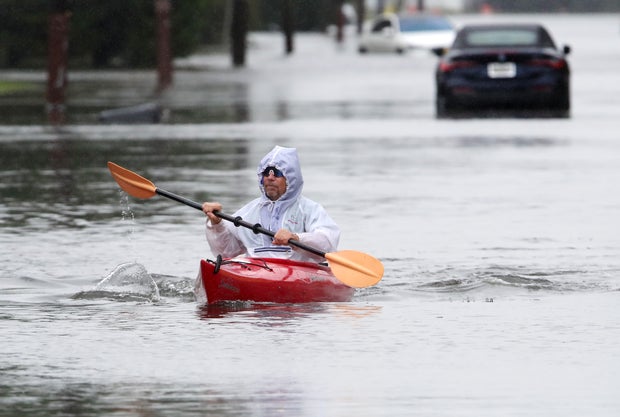
A nor’easter brought severe weather conditions to the U.S. East Coast over the weekend. The storm, which began its impact on Friday, delivered heavy rain, strong winds, and dangerous waves, severely affecting areas in its path.
In parts of New York and New Jersey, the storm caused flooding so intense that residents used kayaks and canoes to navigate through water-filled streets, passing parked cars almost entirely submerged. Meteorologists maintained flood warnings for large coastal areas, stressing that the storm’s worst effects might yet hit some communities.
Throughout the Northeast, power outages affected tens of thousands, with over 40,000 in New York and around 30,000 in Connecticut lacking electricity on Sunday morning. PowerOutage.us, a utility tracker, reported these statistics as the storm continued. Tragically, the storm claimed at least one life. In Brooklyn, New York, 56-year-old Leighton Brown, a New York City Housing Department employee, died after being struck by a falling tree. Meanwhile, authorities searched for a missing person who disappeared while swimming at a Fire Island beach.
The forecast indicated worsening conditions on Sunday. The storm, slowly advancing along the northeastern coastline over the Atlantic, had shifted direction to travel directly over New Jersey. Governors Kathy Hochul of New York and Mikie Sherrill of New Jersey declared states of emergency in regions most affected by the nor’easter, which was expected to dissipate later in the week.
The National Weather Service’s latest forecast projected more rain across mid-Atlantic and northeastern states through Monday night, raising the potential for further flooding incidents. Dangerous surf conditions, including rip currents, threatened beachgoers as far south as the Carolinas. Wind gusts reaching up to 50 mph were expected to pass through areas from New Jersey to Long Island.
The storm’s winds posed a risk of additional power outages and falling trees. Excessive rainfall suggested potential flooding in some inland regions from New Jersey to New England. The National Weather Service highlighted the risks of localized flash flooding, especially in urban environments, smaller waterways, and narrow canyons.
An advisory from the weather service urged residents along the eastern seaboard to prepare for significant coastal damage. It warned of recurrent flooding throughout the weekend, particularly at high tide. “Prepare immediately for significant inundation in low-lying areas near the shore, including roads under water and impacts to homes and businesses,” the advisory stated. The storm was expected to align with at least one more high tide cycle on Sunday morning.
Reports of river, creek, and stream flooding, along with damaging winds, occurred from North Carolina to New York between Friday and Saturday. The strongest wind gusts, nearly 75 mph, were recorded in Surf City, New Jersey, and Astoria, Pennsylvania, comparable to a low-grade hurricane.