
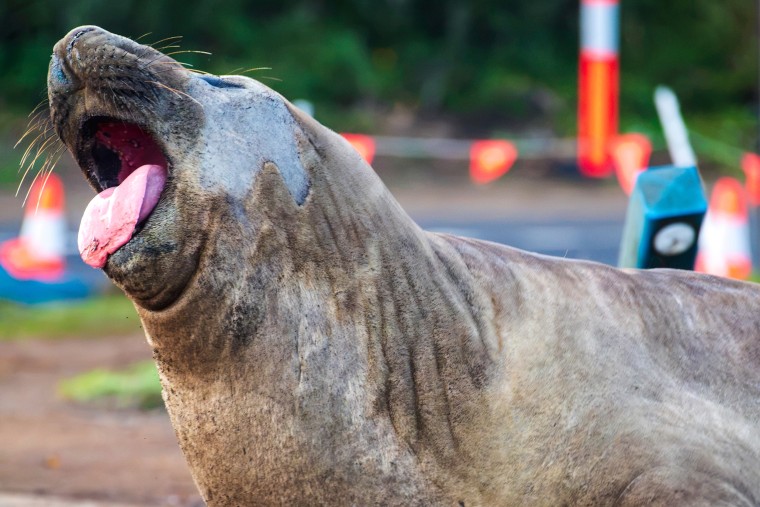
Wellington, New Zealand — Neil, an elephant seal weighing 1,000 kg (2,200 pounds), has returned to his birthplace on the coast of southern Tasmania, Australia. His notoriety, along with property damage, follows him. This mammal, only 5 years old, embarks on a biannual shore visit after feeding at sea. During these visits, Neil presents challenges due to his size, social media fame, and interactions with local infrastructure.
Neil’s antics have resulted in damaged traffic bollards, a bent warning sign, and a demolished fence. On occasion, he rests in the middle of roads, halting local activities. Officials express concern about human-seal interactions, which could pose threats to both parties.
The seal, Neil, stands as the sole male elephant seal visitor to Tasmania. He gains attention not only for his activities but also for his 1.4 million TikTok followers, surpassing Tasmania’s human population. His actions, including challenging parked cars and breaking barriers, have garnered him a following, coined as rebellious by some.
Elephant seal scientist Sophia Volzke from the University of Tasmania explains Neil’s behaviors as typical for juveniles practicing dominance battles. Without peers, Neil practices with vehicles.
Officials worry that social media fame might negatively impact Neil. Kris Carlyon from Tasmania’s Department of Natural Resources and Environment urged fans to respect Neil’s privacy, noting risky behaviors from admirers attempting to capture selfies with the seal.
Carlyon highlighted potential dangers, drawing parallels with a 2023 incident involving a walrus named Freya, euthanized after raising safety concerns.
The tendency for seals to revisit birthplaces biannually is common, involving resting, fasting, and shedding fur. Neil’s presence is noteworthy because no other male elephant seal hauls ashore in Tasmania.
Breeding elephant seal populations exist on sub-Antarctic islands south of Tasmania. Neil’s mother likely came from one of these islands to give birth. Although female seals appear on Tasmania’s shores, their lesser size doesn’t incite similar disturbances.
“Humans previously eliminated these animals, and now they seem to be repopulating areas they once inhabited,” Volzke states. “We must learn to coexist.”
With Neil potentially growing to 5 meters (16 feet) in length, weighing three times his current size, challenges lie ahead if he reaches adulthood. However, Volzke notes that about 90% of male elephant seals do not survive until breeding age.
For now, Neil occupies a section of sidewalk, attracting online followers by interacting with an orange traffic cone. He frequently returns to his preferred location, inciting mixed feelings among the local community.
Resident Dale Creamer shares, “He’s one of our biggest exports right now. It’s Neil’s world, and we’re just living in it.”