
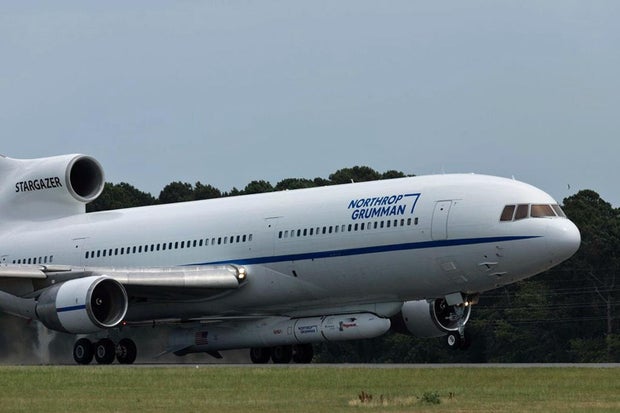
On Friday, a small company joined forces with NASA and Northrop Grumman to launch an experimental space tug. This mission aims to recover a space telescope that would otherwise burn up upon re-entering Earth by the end of the year.
The mission involves using robotic arms to secure the $250 million Neil Gehrels Swift Observatory and elevate it to a safer orbit. This could extend its life, allowing it to continue detecting violent space explosions.
Northrop Grumman’s last operational L-1011 jet transported the Pegasus XL rocket from NASA’s Wallops Island, Virginia, to the Marshall Islands. The Katalyst Space’s LINK satellite is designed to operate this mission. This ambitious plan was developed under a $30 million contract with NASA.
After overcoming weather and software delays, LINK and its booster were released from the jet at an altitude of 40,000 feet. NASA confirmed that the booster’s stages fired to place LINK in orbit. Details about LINK’s next steps will be verified once its solar arrays are confirmed operational.
Controllers will then spend weeks checking LINK’s systems before initiating contact with Swift. If successful, LINK’s ion thrusters will boost Swift to an altitude of around 370 miles, prolonging its mission by another decade.
Ghonhee Lee, CEO of Katalyst Space, praised the team’s rapid development of the spacecraft capable of this challenging mission. The urgency stems from the fact that Swift is falling from orbit, with its current descent rate endangering its future operations.
Swift was launched in 2004 to study gamma-ray bursts, which are high-energy explosions believed to be caused by events like supernovae or neutron star collisions. These phenomena contribute to the formation of heavy elements like gold and platinum in the universe.
Although designed for a two-year mission, Swift has lasted much longer. It is gradually losing altitude due to atmospheric interactions and lacks thrusters to maintain its position. The observatory is predicted to reach a critically low altitude soon, risking its re-entry.
Katalyst Space’s mission provides a timely opportunity to test satellite servicing technologies, potentially saving valuable scientific assets like Swift. LINK is equipped with ion engines, solar panels, robotic arms, and advanced systems to rendezvous with and capture Swift.
As NASA strives to preserve Swift, Katalyst Space hopes to demonstrate capabilities that could apply to other missions. These include refueling and repairing satellites, transitioning from a disposable to a sustainable space model.
NASA’s collaborative efforts with Katalyst Space embody a vision for extending the lives of satellites through innovations that could one day be applied to other essential spacecraft.