
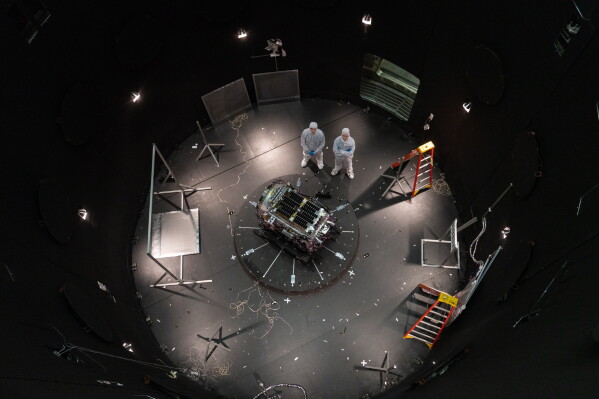
A spacecraft with three arms successfully launched into orbit on Friday to rescue a NASA telescope at risk of falling back to Earth. Northrop Grumman sent Katalyst Space Technologies’ Link spacecraft from the Marshall Islands in the Pacific. The Pegasus rocket ascended from a modified airplane, setting Link on track to reach and secure NASA’s Swift Observatory in about a month.
Swift, launched in 2004, has been descending rapidly due to recent solar storms. To counter this, NASA is investing $30 million in Katalyst’s mission to capture the telescope and elevate its orbit. This will enable Swift to continue monitoring significant cosmic events such as gamma ray bursts and supernovae. If the mission succeeds, Swift might resume operations by September. For now, observations have been paused to conserve its current orbit.
Similar measures might be considered for NASA’s Hubble Space Telescope in the future, as it too is dropping in altitude because of increased atmospheric friction caused by solar activity.
Presently, Swift orbits 224 miles (360 kilometers) above the Earth. The objective for Katalyst is to increase its altitude by 150 miles (240 kilometers), restoring it to its initial position. Link will carefully use its thrusters to slowly elevate Swift without causing significant movement.
The mission by Katalyst was organized in a mere nine months due to NASA’s urgency; the telescope, without intervention, risks becoming unrecoverable by fall and possibly plummeting to destruction in October. Weather conditions and technical challenges led to several last-minute delays in launching.
“This is a high-risk, high-reward mission,” commented Ghonhee Lee, CEO of Katalyst Space, before the launch. “The main threat was not launching and allowing Swift to burn up in the atmosphere. We have aimed to avert this, and our team has succeeded.”
The Associated Press Health and Science Department is supported by the Howard Hughes Medical Institute’s Department of Science Education and the Robert Wood Johnson Foundation. The content is solely the AP’s responsibility.