
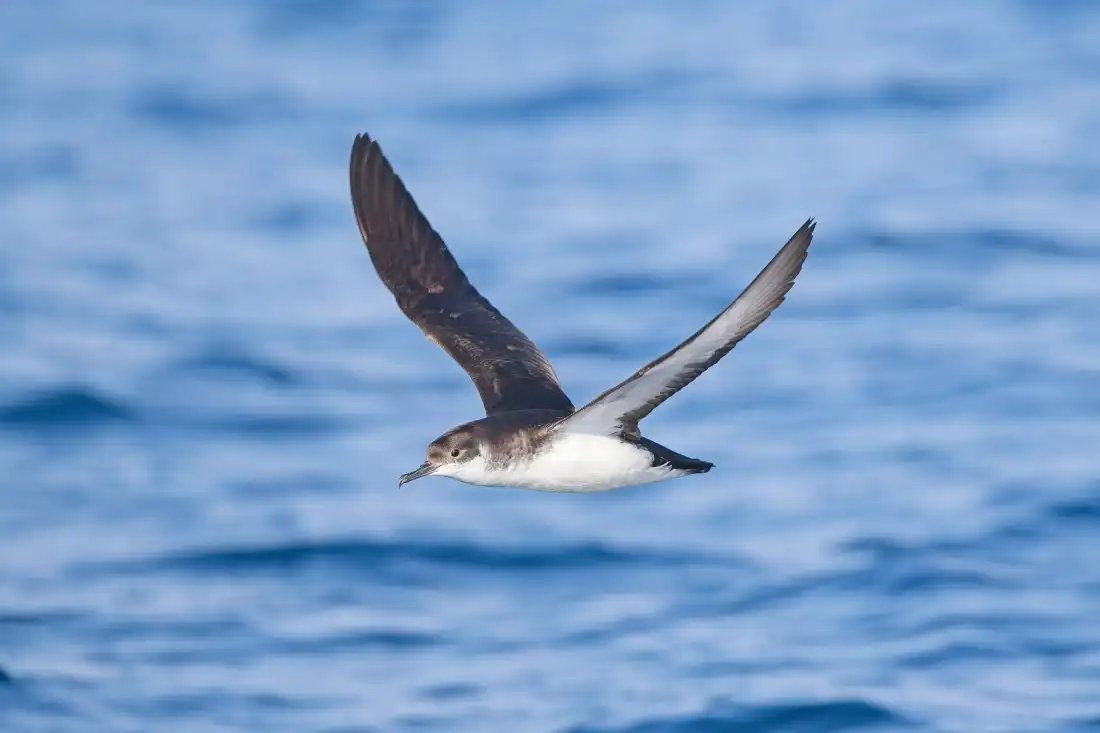
Manx shearwaters are seabirds known for their extensive travels from their nests to hunt at sea. Recent research indicates they might experience feelings akin to jet lag on their return journey. This phenomenon was highlighted in a study published in Science, revealing that these birds become mildly disoriented during flights across the Atlantic Ocean.
This disorientation happens because the birds’ internal clocks can fall out of sync with the sun’s position. Manx shearwaters are common in the British Isles and resemble seagulls. Notably, they share a closer relation to albatrosses. According to Patrick Lewin, a behavioral ecologist at the University of Oxford, these birds are lifelong mates, laying just one egg per breeding season. The partners take turns incubating the egg, with one remaining on it while the other ventures into the sea.
For approximately two weeks, the traveling partner forages across the North Atlantic for food, often covering hundreds of miles. Once their hunting is done, these birds rush back to their nests. Lewin noted that they typically make this return journey rapidly, sometimes within a single day. This rapid return raised the question: do they experience something similar to jet lag?
To investigate, Lewin leveraged two decades of data from GPS trackers attached to the birds. These devices had been collecting flight data, and Lewin sought to identify any indicators of jet lag. The Manx shearwaters rely on the sun as a navigation tool. Knowing the sun’s position across different times of day is crucial for accurate navigation, particularly since the sun’s trajectory moves from east in the morning to west in the evening.
Lewin and his colleagues observed that the birds accidentally veered slightly off course during their return journeys. The maximum observed deviation was a seven-degree error. Over a 600-mile trip, this error led to a divergence of around three miles. Although this difference is minor, it is noteworthy.
Alice Boyle, a biologist at the Centre for Animals on the Move at Western University in Ontario, praised the study. She highlighted the scarcity of research that captures navigation decisions in wildlife, making such GPS work invaluable. Such insights reveal the complex nature of these birds’ travels to isolated areas.