
Paris — The French Open tournament has been familiar with the presence of Polish female players reaching the semifinals. This trend has led to the nickname “Poland Garros.” Typically, this has been Iga Świątek, the four-time champion, who reached the semifinals five times between 2020 and 2025. However, unexpected change came when Świątek was knocked out in the fourth round by Ukrainian Marta Kostyuk.
Called the Queen of Clay, Świątek continues her journey to find the tennis form that helped her dominate the women’s tour. Despite her exit, Poland’s representation persisted thanks to Maja Chwalińska. Making her debut in the main draw at Roland Garros, world No. 114 Chwalińska secured her eighth consecutive win by defeating No. 22 seed Anna Kalinskaya 7-6(3), 6-3, becoming the second Polish woman in the Open Era to reach the French Open semifinals.
On Thursday, Chwalińska claimed her ninth win. She stepped into the final by overcoming Diana Shnaider, a Russian player, with scores of 7-6(4), 6-4. Chwalińska became the lowest-ranked finalist in the Open Era at the French Open, achieving changes far beyond sports.
Before participating in the French Open, Chwalińska earned approximately $864,030 in career prize money according to the WTA Tour. Her remarkable performance at Roland Garros has now earned her an additional $1,624,000. In a news conference after her win against Kalinskaya, Chwalińska expressed pride in her composure and ability to succeed under pressure.
“I’m just very proud that I stayed composed, and managed to win this set,” she said. “Then the second set was just a battle. So I’m very happy, happy to win.”
Chwalińska’s composure is noteworthy as she navigates the most significant achievement of her tennis career. A promising junior, she reached the Australian Open girls’ doubles final with Iga Świątek in 2017, but their paths diverged as Chwalińska faced injuries and underwent knee surgery in 2022. Her mental health was another challenge, causing her to compete primarily in WTA 125 tournaments, a level below the WTA Tour.
Chwalińska won her first Grand Slam match at Wimbledon four years ago, after a pause to address her mental health. Reflecting on her sabbatical, she described the difficulty of pushing through at the beginning.
“But then I just couldn’t get out of bed anymore. I was just lifeless, to be honest. … I needed to take a break, and I honestly didn’t know if I was going to come back or not.”
“I needed to kind of figure a few things in my head, I would say. … And I came back. I’m happy that I did.”
In Paris, facing tougher competition than she’s familiar with has not intimidated the 24-year-old. Before May 27, she hadn’t defeated a player ranked inside the top 50, yet coming through qualifying rounds reinforced her conviction in her game.
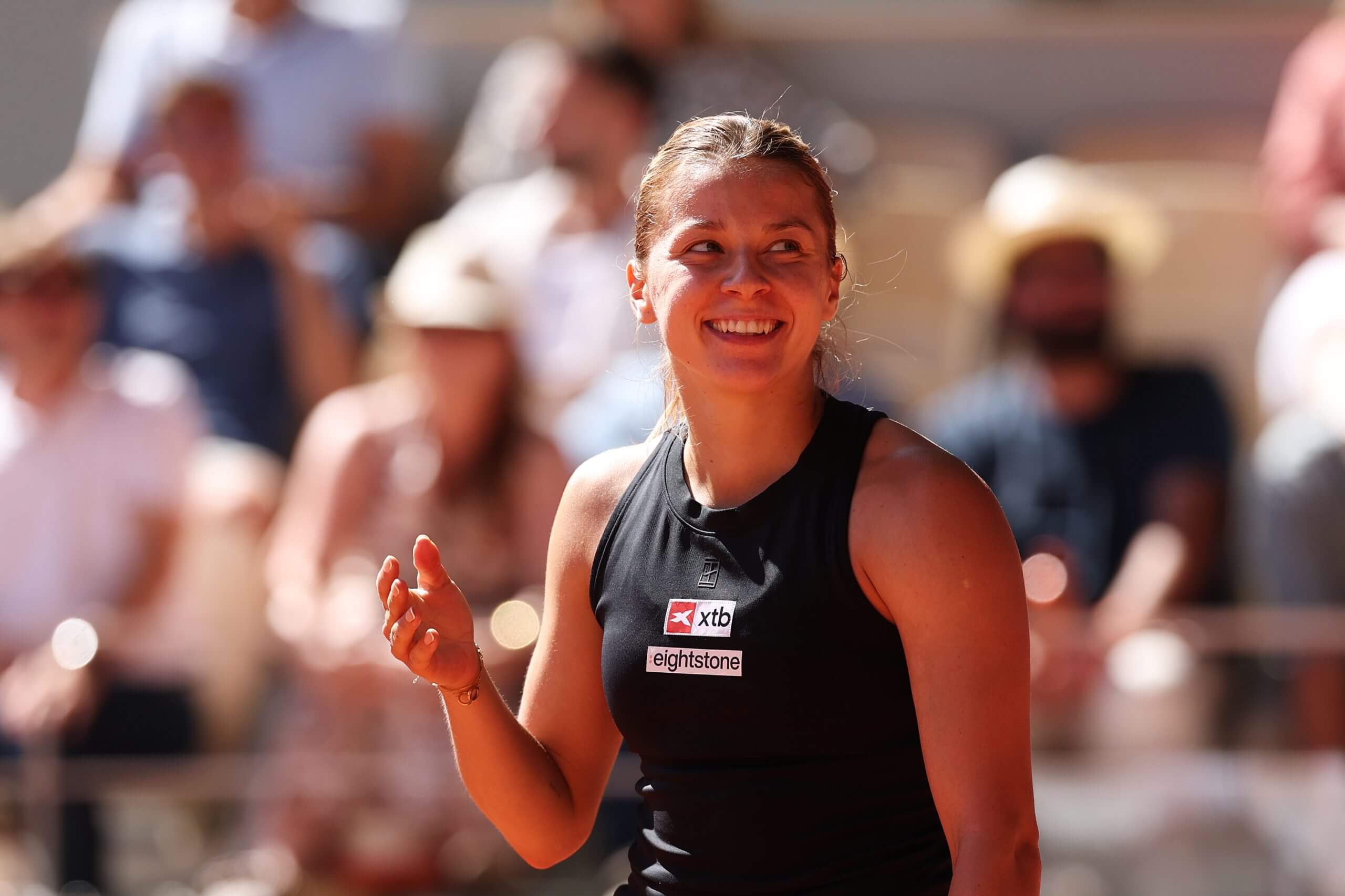
Her path included victories over impressive players like Zheng Qinwen, Elise Mertens, Maria Sakkari, and Diane Parry on Court Philippe-Chatrier. Concerns about hotel expenses arose, but Polish sponsor Oshee, also sponsoring Świątek, offered support. She now wears one of their patches.
“I think the level is very close, like, the qualifying is not much worse than the main draw,” Chwalińska said.
“And the players in the qualifying, they are so good, as well. They are great competitors. We just need to fight, and just believe that maybe some day it will click for us, as well.”
Chwalińska had not advanced beyond the second round of a Grand Slam before this French Open. Keeping her phone usage in check, she limits posts to one per victory, rapidly moving on.
Chwalińska hasn’t processed her streak enough to feel overwhelmed by making it to the final. To that end, she abides by a strict rule these days for time spent on her phone. She publishes one celebratory post per victory, “and then I quit,” Chwalińska said with a smile, slicing her hand through the air like a knife.
Being an unknown to her opponents before matches in Paris worked in her favor. Except for a single previous match against Sakkari on clay, most players had yet to face her. Chwalińska, whose height is 5 feet 5 inches, developed a style using slice and spin, drop shots, and varied rhythms to challenge baseliners.
“I’m aware that it can be very annoying for other players,” she said. “I just try to use it as much as I can.”
Outside of tennis, Chwalińska enjoys playing chess. Her strategic approaches were effective against Kalinskaya amid windy conditions, and against Shnaider with the roof closed. Crafting drop shots unexpectedly, adjusting forehands and backhands beyond Shnaider’s reach, Chwalińska often took early shots down the line.
Most crucially, Chwalińska maintained her composure to achieve significant victories back-to-back, marking a milestone in her tennis career.