
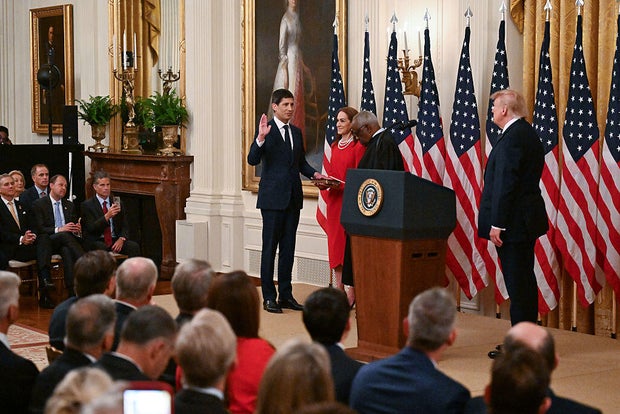
Kevin Warsh has officially become the chairman of the Federal Reserve, succeeding Jerome Powell after a ceremony at the White House. “With this oath, I’ve accepted a high and solemn responsibility,” Warsh declared. He emphasized the Fed’s mission to ensure price stability and maximum employment. Pursuing these goals with independence can lead to lower inflation, stronger growth, and higher real take-home pay, he stated.
Warsh aims to lead a reform-driven Federal Reserve by learning from past experiences and maintaining integrity and performance. President Trump introduced Warsh at the ceremony, which included Supreme Court justices, Congress members, Cabinet officials, and business leaders. Justice Clarence Thomas administered Warsh’s oath, with Warsh’s wife holding the Bible.
President Trump expressed his desire for Warsh to remain independent in his role as Fed chair. “I want him to be independent and just do a great job,” Trump said, underscoring Warsh’s abilities and high regard. Trump’s balance between advocating for low interest rates and stressing the value of a robust economy was evident. Although he did not directly demand lower rates, he emphasized the importance of economic growth.
Previously, Trump had been critical of Powell’s cautious approach to lowering interest rates. Trump openly expressed dissatisfaction by calling Powell names and considered his removal. Some prosecutors investigated Powell, which he claims was intimidation. However, that investigation ended, and the Fed’s internal watchdog took over. Powell led the Fed since 2018, navigating challenges like the COVID-19 pandemic and inflation surges.
Warsh committed to maintaining the Fed’s policy independence, asserting he would not predetermined interest rates at Trump’s behest. He has been receptive to collaborating with the administration on other matters, like potentially drafting an “accord” involving the Fed and Treasury Department.
Whether Warsh will meet Trump’s interest rate expectations remains uncertain. Fed policy decisions involve a 12-member committee, requiring consensus. Current discussions among committee members show a split on reducing rates, with some still favoring rate stability due to ongoing inflation concerns, exacerbated by the Iran war.
The committee’s latest meeting, resulting in stable rates, highlighted differences among members about future rate cuts. Three members objected to hints of lowering rates, with a majority anticipating potential rate hikes if inflation exceeds the 2% target.
Market predictions align with steady rates in the short term, with investor sentiment indicating a 70% chance rates will rise by year’s end, according to CME Group’s FedWatch tool.
Powel’s unique situation, remaining on the Board of Governors until the Justice Department probe concludes, means he still influences rate decisions. Warsh, historically known for more stringent policy preferences, has recently shown openness to lower rates, arguing advancements like artificial intelligence could reduce inflationary pressures. This view may spark debate within the committee, where opinions vary on AI’s inflationary impacts.
Randall Kroszner, previously on the Fed board with Warsh, anticipates Warsh will resist short-term political pressure. As a strategic thinker, Warsh recognizes the importance of building consensus for effective governance, Kroszner stated, now a professor at the University of Chicago.