
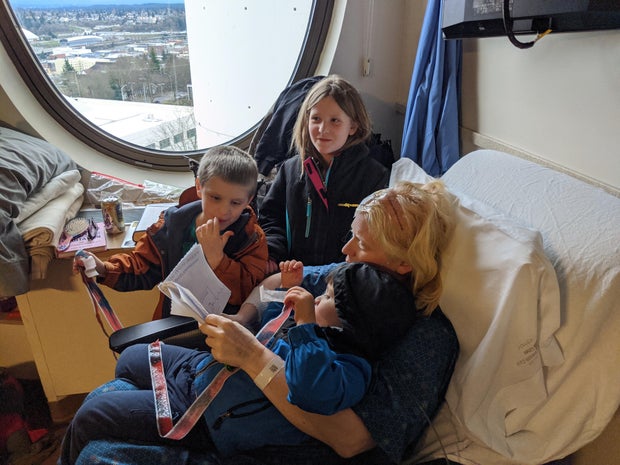
Jenney Bitner eagerly anticipated her family’s yearly visit to her mother in San Diego. For her kids, it meant two weeks of fun at their grandmother’s home. For Bitner and her husband, it provided a relaxing break from the wet weather of Washington. In 2020, this trip brought more excitement as Bitner, 22 weeks pregnant, looked forward to family time during her pregnancy. However, after one day, Bitner felt too ill to leave her bed. She experienced severe headaches, nausea, vomiting, and dizziness.
Two visits to urgent care suggested these were pregnancy symptoms. Bitner intuitively sensed something was wrong but hoped her upcoming obstetrician appointment would clarify. Back home in San Diego, Bitner’s health declined further; she suffered two falls. Her husband insisted on an emergency room visit.
An MRI detected a large tumor in her brain, leading to an operation to remove part of it. Tests revealed Stage IV melanoma, shocking Bitner as she saw no typical symptoms like skin lesions. According to the American Cancer Society, the five-year survival rate at this stage is around 35%.
“I had just turned 38, and I was pregnant with my fourth kid. I was thinking, ‘I’m too young for this to be happening,'” Bitner recalled.
Post-surgery, medical professionals advised aggressive treatment. Although most of the tumor was removed, a complete extract risked permanent brain damage. Further scans found a noticeable tumor in her back. Bitner needed immunotherapy, but it posed risks to her baby. Doctors advised early delivery, proposing a C-section at 34 weeks.
Right before the scheduled delivery, worsening symptoms indicated the brain tumor’s regrowth. Apart from immunotherapy, another brain surgery was necessary. Bitner wrote letters to her children, fearing she wouldn’t see them grow.
On May 4th, Bitner’s son Marcus was born, named after her neurosurgeon. Born at 3 pounds, 12 ounces, he required NICU care. Bitner’s husband described Marcus as “feisty already.” A week after his birth, Bitner underwent another brain surgery, allowing for complete tumor removal. Both mother and son were deemed healthy to return home together, a moment marked by family joy.
Beginning June 2020, Bitner started immunotherapy aimed at strengthening her immune response against cancer. Despite new cancerous areas in her lung, thigh, and brain, Bitner’s husband noted decreased growths in days, confirmed by successful scans. Although she faced rare immunotherapy side effects like allergic reactions and encephalitis, Bitner’s doctor announced her disease-free in October 2020.
Dr. Alicia Zhou, CEO of the Cancer Research Institute, highlighted the revolution in cancer treatment due to immunotherapy, providing hope to patients. Zhou emphasized immunotherapy’s potential to achieve what once seemed impossible.
“Before immunoncology, we weren’t really able to say the word ‘cure’ for these patients who were suffering from Stage IV metastatic disease, and now we can,” Zhou said. “It’s really, truly transformational for these patients.”
Nearly six years later, Bitner exceeds the odds, dedicated to promoting immunotherapy research and cherishing moments with her family.
“I feel like every day I’ve had since all this has happened has been a gift,” Bitner shared. “The chaos at home now is precious, sounds I didn’t think I’d hear again.”