
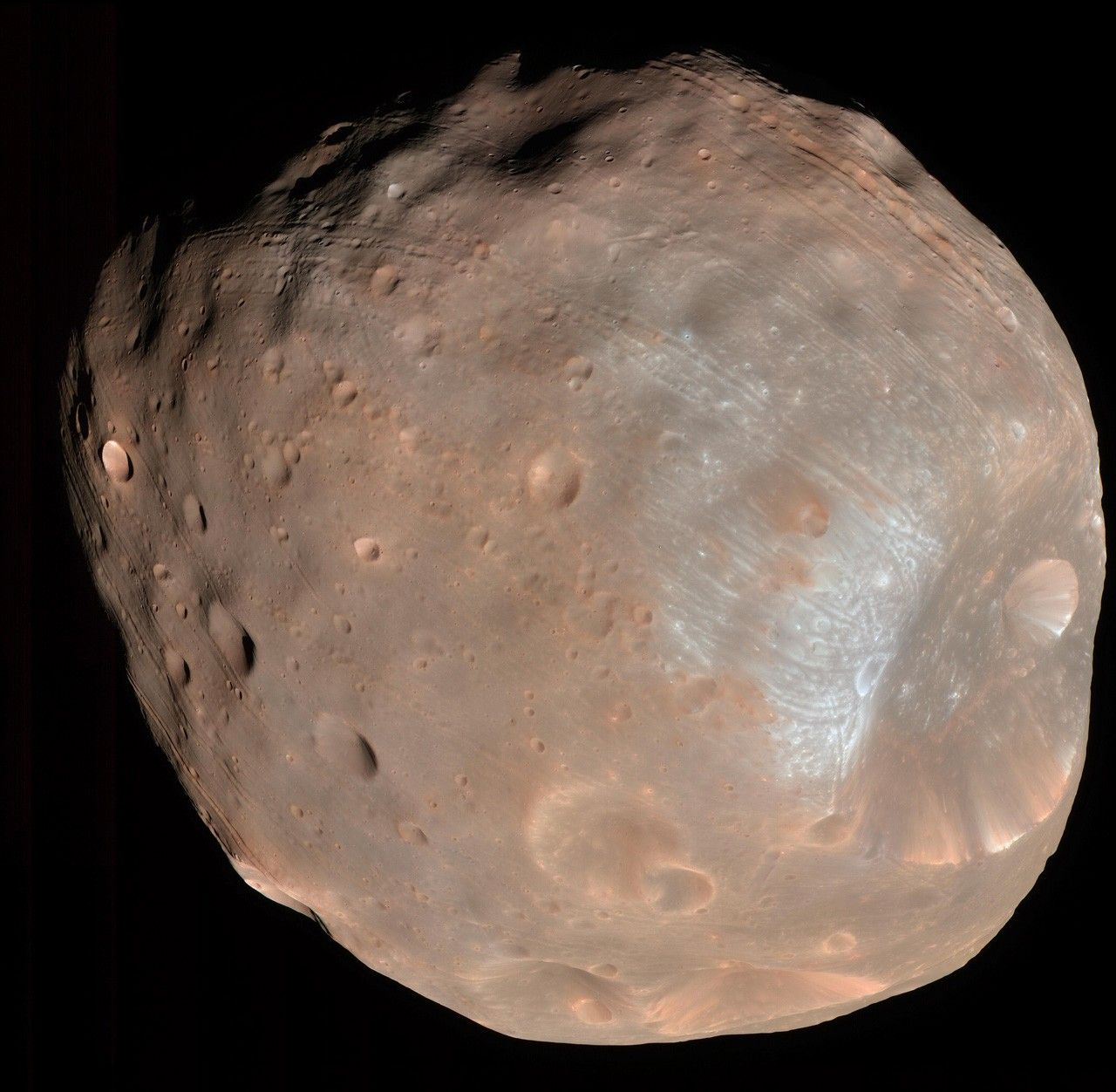
A Japanese spacecraft has embarked on a mission towards Mars, aiming to explore its enigmatic moons and retrieve samples. This five-year initiative involves collaboration from five space agencies aiming to land a robotic probe and a rover on Phobos, the larger of Mars’ two small moons. The launch, led by the Japan Aerospace Exploration Agency (JAXA), took place before dawn from Tanegashima Island.
While NASA has landed numerous spacecraft on Mars, Phobos and Deimos remain unexplored, and no samples have been collected from Mars or its moons. If this mission succeeds, soil and rock samples from Phobos could arrive on Earth by 2031. NASA astrophysicist Tom Statler, involved in the project, shared the excitement surrounding the mission. Japan has prior experience with asteroid sample returns, which gives it an advantage.
Image courtesy of NASA/JPL-Caltech/University of Arizona

Phobos is a small, irregularly shaped moon, approximately 14 miles (22 kilometers) across. Studying samples from it could provide insights into the formation of Mars’ moons and possibly others. The mission, called MMX (Martian Moons Exploration), involves a 5-ton spacecraft set to reach Mars by next summer. It will align with Phobos’ orbit before releasing a French-German rover named Idefix. This rover, no bigger than a microwave, will land and explore Phobos for 100 days. It will move at a slow pace due to the moon’s low gravity and convert its observations into safety insights.
The Japanese lander, equipped to gather samples, will follow later, aiming to avoid problematic soil during its brief landing. The lander will drill and collect at least 10 grams of material during its two-hour stay before departing for Earth. The mission also includes flybys of Deimos, Phobos’ smaller counterpart. The final leg involves returning to Earth with the samples in 2031, a task set for the Australian desert.
The mission involves risks, as past efforts to explore Phobos have failed. Phobos and Deimos’ names, meaning fear and dread, reflect these challenges. Even Japan faced hurdles with its previous Mars mission. Successful sample collection could unravel the mystery of Mars’ moons’ origins, whether from ancient collisions or capture, and may contain Martian traces that hold clues to planetary formation and life.
The samples will influence future Mars missions. NASA’s Lindsay Hays emphasized the uniqueness of this opportunity as part of the first sample return from the Martian system. China’s upcoming mission in 2028 and NASA’s plans for retrieving samples collected by the Perseverance rover highlight the competitive efforts in Martian exploration.
Japan’s mission involves a $350 million investment with contributions from NASA at $87 million and other agencies participating with varied funding. While media attention accompanies these scientific endeavors, it stands crucial in supporting informed public dialogue.