
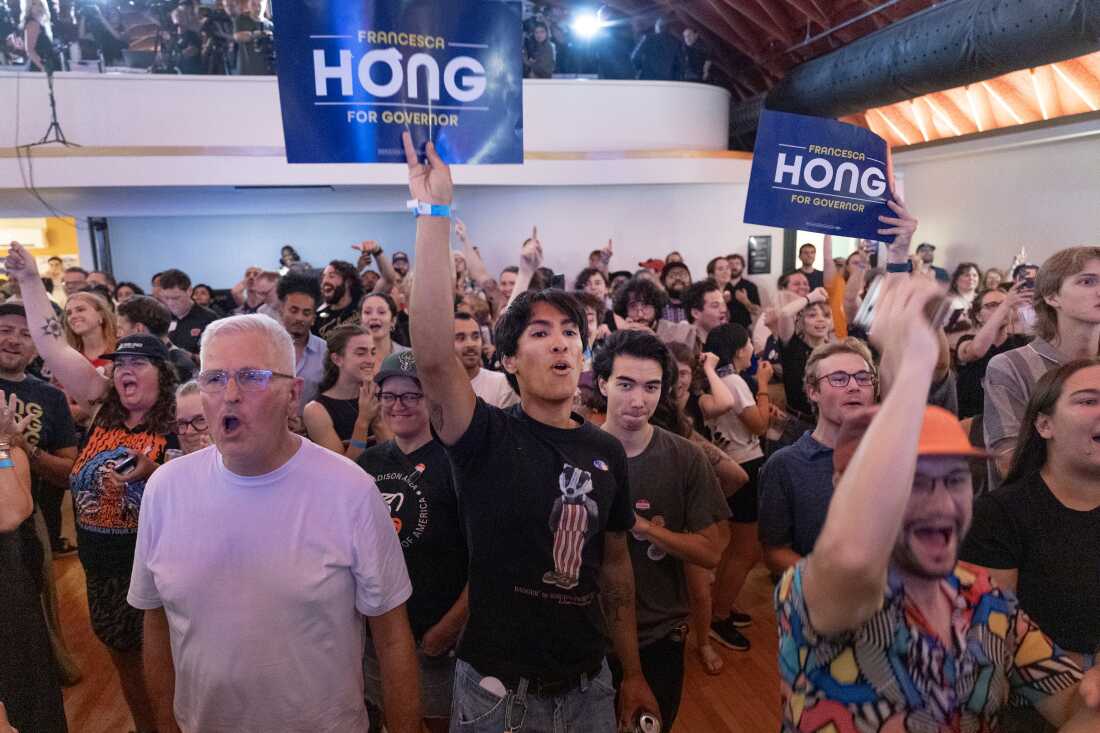
Supporters of Francesca Hong, a Democratic gubernatorial candidate from Wisconsin, gathered in Madison on election night. Hong, known as a democratic socialist, narrowly lost the primary.
A study by NPR involved observing two online focus groups of Nevada voters. These voters, who initially supported Joe Biden in 2020 and then Donald Trump in 2024, displayed a range of political affiliations. The group consisted of six self-described independents, four Republicans, and two Democrats.
Despite their diverse backgrounds, 10 out of 12 participants did not automatically reject left-wing political candidates. Jasmine, an independent voter, mentioned, “I don’t just take one thing and then label or judge somebody just for that.” Another participant, Melody, highlighted the ideology as one seeking solutions for equal rights and basic needs, such as housing and employment.
This discussion occurred during the Wisconsin Democratic primary, where a democratic socialist candidate narrowly lost. Within the Democratic Party, there is debate about the potential impact of socialist candidates on more centrist voters in upcoming elections. A recent Pew Research Center survey revealed that one-third of Democratic voters view democratic socialist leaders positively, while a significant portion of Americans remain neutral.
Focus groups, while not scientifically significant like polls, provide deeper insights into voter attitudes. Conducted by messaging firm Engagious and marketing research group Nelson Recruiting, the sessions are part of the NPR Swing Voter Project.
Rich Thau, Engagious president, moderated these groups, expressing surprise at the openness toward socialism. Despite being generally centrist, the participants showed little automatic negative response to socialist candidates. Thau noted, “I was struck by the receptivity that they had toward democratic socialism as a concept.”
The voters discussed differences between traditional Democrats and democratic socialists. Marianne, an independent, described mainstream Democrats as more centrist with ties to corporate interests. In contrast, socialists prioritize community welfare. Justin, another independent, supported this view, stating that socialist Democrats emphasize people over business interests.
Economic anxiety appears to underpin openness to socialist ideas. Among the participants, 10 expressed increased economic anxiety compared to the previous year, and seven reported higher personal debt. Katrina, an independent voter, found it difficult to articulate her anxiety but felt it keenly in her daily expenses. “I used to pay cash for groceries,” Marianne noted, “but now I sometimes use credit cards due to rising prices.”
The financial stresses extend to housing costs, with Republican Corrina highlighting increased insurance expenses affecting her mortgage.
While the group showed openness to socialism, they strongly rejected communism. Justin remarked, “Living in the ’90s, communism is very ingrained as negative.” This sentiment reflects the era’s prevailing attitudes.
The focus group’s openness to socialism reflects anxiety about current economic conditions, where traditional solutions seem insufficient. This anxiety fuels a search for alternative approaches to economic relief.