
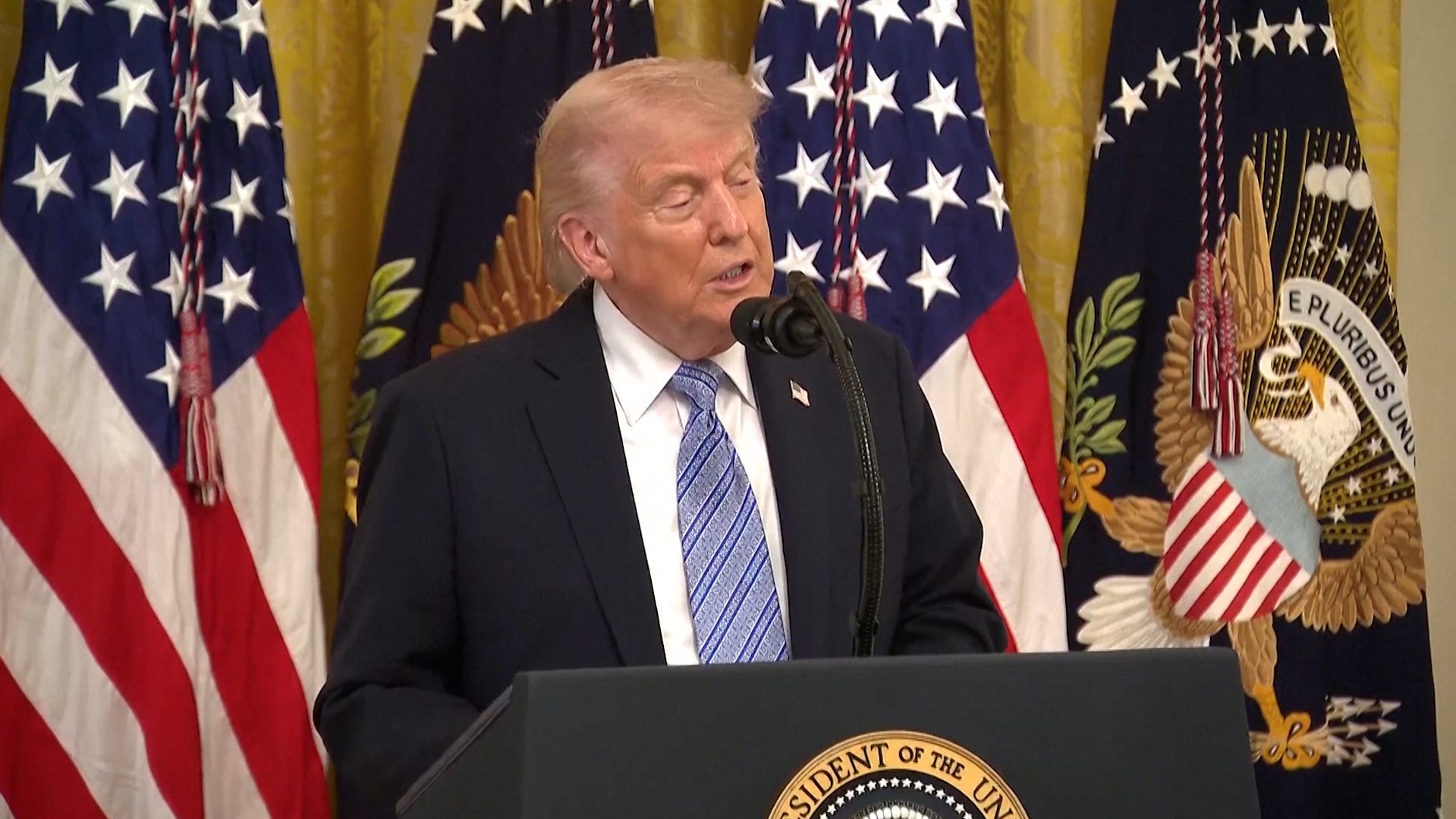
President Donald Trump stated that fuel prices are “not very high, relatively speaking,” despite the ongoing conflict with Iran increasing gas costs. Many Americans express dissatisfaction with the Trump administration’s efforts to manage the situation. A Reuters/Ipsos poll reveals that 60% of Americans disapprove of U.S. military actions against Iran, and a majority anticipate further rises in gas prices.
As of June 10, the average price for regular gasoline was $4.15 per gallon, a decrease from $4.26 the previous week and $4.52 the previous month, according to AAA. A year ago, the price was $3.12 per gallon. Blockades in the Strait of Hormuz have restricted the global oil supply, leading to a nearly 40% increase in regular gasoline costs since the conflict began. Increases of 7% in May followed a 5.4% hike in April and a 21.2% surge in March, according to Labor Department data released on June 10.
Trump responded to the Consumer Price Index report showing a 4.2% annual inflation rise in May. “The numbers were great,” he remarked, noting his appreciation for the inflation figures. Trump’s comments highlighted U.S. efforts to extract millions of barrels of oil from Iran in a bid to stabilize fuel prices.
Previously, Trump labeled Americans’ financial challenges as “peanuts” in comparison to the potential risk of Iran obtaining nuclear weapons. He urged for patience, suggesting that high prices wouldn’t persist for long. However, skepticism prevails, with 59% of respondents in the Reuters/Ipsos poll believing gas prices will worsen over the next year due to the war. This includes 83% of Democrats, 61% of Independents, and 34% of Republicans.
Elevated gas prices have negatively impacted Americans’ views on the economy, with the University of Michigan’s consumer sentiment index reaching its lowest point in May since tracking began. According to Joanne Hsu, Director of Surveys of Consumers, 57% of participants felt high prices were “eroding their personal finances.”
Fuel costs have decreased since early last month amidst hopes for a de-escalation in the Middle East and reports of tankers leaving the gulf. “A lot of oil is coming out of the Hormuz strait,” Trump said, emphasizing the relatively lower prices compared to previous administrations, specifically mentioning the Biden era. He justified current measures by pointing out the ongoing effort to prevent a country from acquiring nuclear weapons.
In April, crude oil prices reached $117.60 per barrel. As of June 10, the price was $90.30 per barrel. Although still significant, these prices have fallen from the March 2022 high of $130.50 per barrel following the Russia-Ukraine conflict, which similarly tightened global oil supplies.