
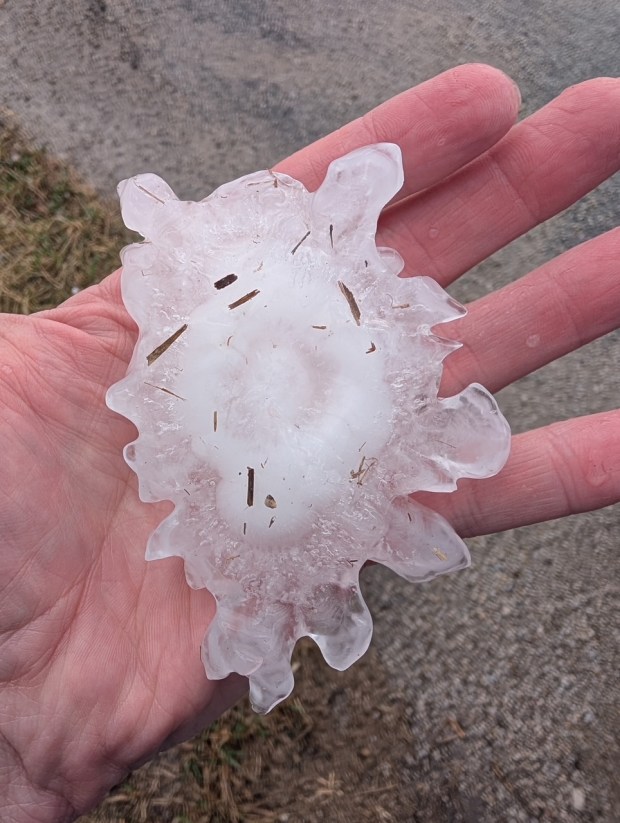
Imagine a large can of soup hurled at 80 miles an hour. That’s the size of the largest hailstone measured in Illinois, weighing as much as one of those cans, according to Ian Giammanco, lead research meteorologist at the Insurance Institute for Business and Home Safety. This massive hailstone was discovered in a Kankakee backyard during severe storms in March and was officially recorded at 6.6 inches, surpassing the previous 4.75-inch record from Minooka, set 11 years prior, as announced by the National Oceanic and Atmospheric Administration (NOAA) on Tuesday.
Verifying this record took six months. Trent Ford, Illinois state climatologist who led the evaluation committee, noted the efficiency of this process, underscoring a year marked by extreme weather. Meteorologist Victor Gensini, also involved in the committee, highlighted 2023’s exceptional storm activity, which included not just large hail but also Illinois’ record-breaking tornado occurrences. By June, Illinois exceeded its annual tornado record with over 200 occurrences, influenced by factors like climate change.
Research led by Gensini in 2024 projected that warming global temperatures would result in more frequent large hailstones, exacerbating annual property damage already amounting to billions. Hail events in the Midwest, Ohio Valley, and Northeast could increase by five or more days from mid- to late century. Hail forms when icy particles, initially the size of Dippin’ Dots ice cream, rise in thunderstorms. These particles then freeze into hailstones in the cold upper atmosphere before becoming heavy enough to fall. Warmer climates introduce more water vapor into the atmosphere, leading to stronger storms capable of producing larger hailstones.
Determining the plausibility of a new record involves studying whether conditions could realistically have produced the 6.6-inch hailstone during the March 10 storm, which experts affirmed. On that day, large hailstones, some potentially record-breaking, were observed across Kankakee and surrounding areas. Victor Gensini himself encountered a nearly 5-inch hailstone during that storm. Reports soon reached the National Weather Service about multiple potential record-breakers between 4.8 to 6 inches in size across various Illinois locations.
“There were probably larger stones that day. The record is not just proof of a unique weather event but also a key tool for understanding hail’s impact.”
Last year, Gensini ventured across the Central Plains to study hail, only to witness the largest stone of his career in his own state, adding irony to his pursuits. Preserved at Northern Illinois University, the hailstone represents a significant scientific benchmark for future studies into hailstorm impacts that inform everything from building codes to insurance rates.
NOAA reported 126 severe hail incidents from the March storm, with over 30 involving hail larger than 3 inches. The National Weather Service considers hail severe if above an inch and categorizes hail larger than 4 inches as giant, and over 6 inches as gargantuan. Victor Gensini emphasized hail’s often overlooked destructive power compared to tornadoes. Though tornadoes draw more headlines, ongoing research underscores that hail contributes significantly to severe storm damage, accounting for up to 80% of such damage annually.
In 2025, the cost of roof repairs due to hail increased significantly, reflecting an upward trend in hail-related damage claims nationwide, according to Verisk. Illinois reported $457 million in hail damage claims last year, ranking third after Texas and Missouri.
“Understanding the record,” Trent Ford stated, “can help improve our preparation for future hailstorms by informing scientific and emergency planning endeavors.”