
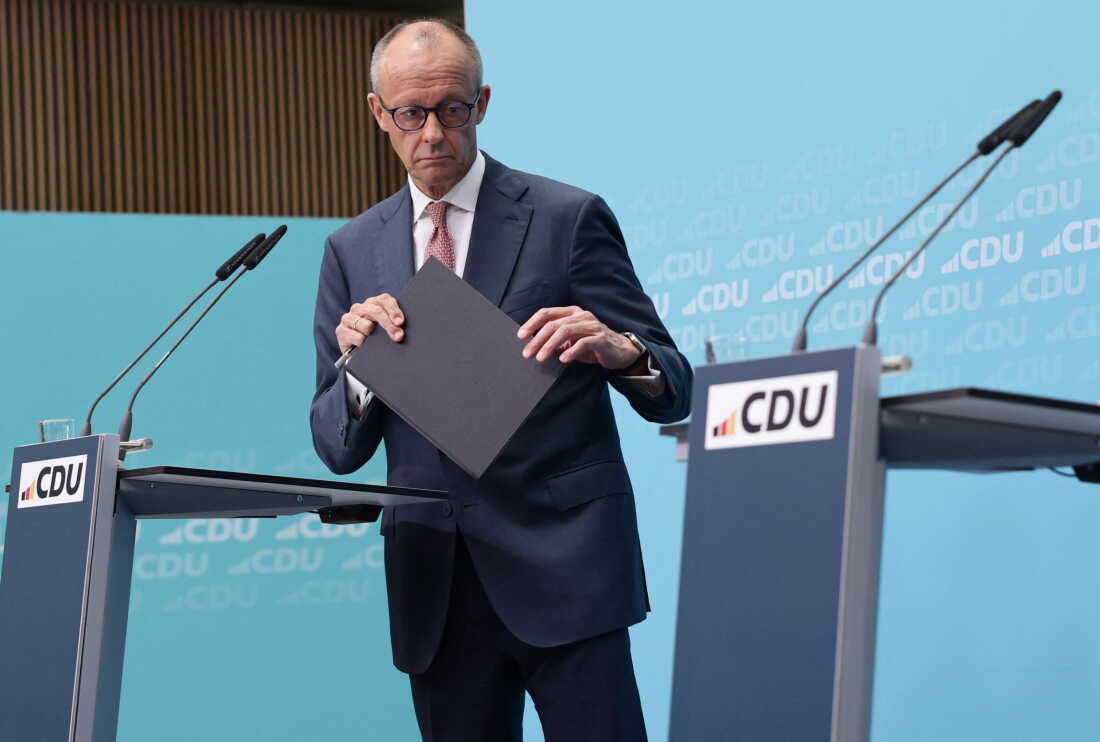
German Chancellor Friedrich Merz, leader of the Christian Democratic Union (CDU), recently faced challenges after state elections in Berlin and Mecklenburg-Western Pomerania. These elections revealed a shift in Germany’s political landscape.
In Berlin, markets offer a variety as rich as the election ballot sheets, according to pensioner Ute Istock. She notes that voting has become complicated due to the numerous parties, making it difficult to form effective governing coalitions. Istock, having voted for the far-left Die Linke party for the first time, feels the centrist parties no longer represent voters adequately. She observed an increasing political fragmentation reminiscent of a past leading to the rise of extremism.
Chancellor Merz acknowledges declining trust in state institutions and the exploitation by radical parties. His conservative party, CDU, suffered significant losses in the elections, achieving its worst results in a state election on the same day. Merz mentions that the traditional coalition between his party and the Social Democrats results in slim majorities, blurring their distinct political stances.
Social Democrat Matthias Mirsch complained in parliament about reductive political discourse after the far-right Alternative for Germany (AfD) achieved a landslide victory in Saxony-Anhalt. He emphasized the difficulty in governing during times when discourse is simplified and polarizing.
Maximilian Flügge, a Berlin-based communications adviser, blames the narrowing of debate and shrinking political center on algorithms. These algorithms favor outrage over nuance and compromise, which do not trend on social media.
Despite electoral defeats, Merz remains committed to tax and welfare reforms to boost Germany’s economy. He admits that reaching people emotionally is essential beyond citing statistics, reflecting on recent criticism that the centrist message appears negative compared to the far-right AfD’s promise of possibility.
The AfD’s vision includes controversial policies like “remigration,” aiming to deport immigrants, including those with German citizenship. Merz strongly criticizes these policies, equating “remigration” with ethnic cleansing, earning both applause and opposition jeers in the Bundestag. AfD leader Alice Weidel asserts that AfD now represents Germany’s new big tent party.