
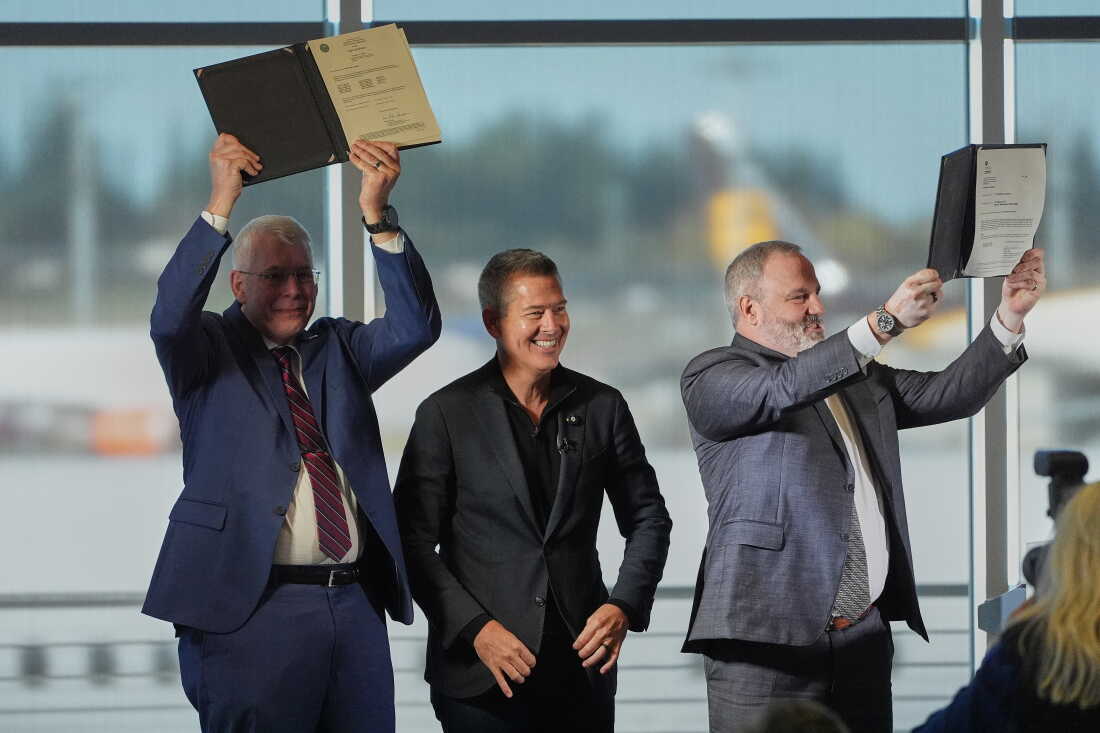
U.S. Transportation Secretary Sean Duffy presented the certification of Boeing’s 737 Max 10 aircraft to key figures in the Boeing development team, marking a significant step forward for the company. This event took place at Boeing’s factory in Everett, Washington.
The Federal Aviation Administration (FAA) has officially approved the 737 Max 10 for passenger service, resolving years of delays. This news represents a critical milestone for Boeing as they work to repair their reputation and financial stability following previous safety and quality issues. With certification in place, Boeing can now sell the aircraft to both domestic and international carriers.
Transportation Secretary Duffy emphasized the extensive safety reviews that led to the certification, including numerous test flights. He described this achievement as a major win for American manufacturing and reflected on the long journey to this point.
The 737 Max 10 plays an essential role in Boeing’s attempt to reclaim their presence in the narrow-body market. Airlines gain the advantage of transporting more passengers per flight, potentially reducing costs per seat. Passengers might see increased seating availability on popular routes, impacting fares based on airline competition.
Stephanie Pope, President and CEO of Boeing Commercial Airplanes, highlighted the importance of the certification. She noted that the Max 10 would set new standards in commercial aviation. Boeing projects seating between 185 and 210 passengers, compared to its predecessors, the Max 9 and Max 8.
Boeing plans to commence deliveries in 2027, following the jet’s introduction at the Paris air show in 2017. However, production faced repeated setbacks due to technical and regulatory challenges. Past incidents, such as the Max 8 crashes in 2018 and 2019 and a panel detachment in 2024, contributed to these delays. The company has over 30 customers with pending orders for the Max 10, including notable airlines such as United Airlines, Delta Air Lines, and Ryanair. Alaska Airlines recently joined this list with a significant order.
The Max 10 competes with Airbus’s A321neo, which boasts higher passenger capacity and longer range without refueling. Boeing designed the Max 10 for higher passenger loads and improved fuel efficiency, which is crucial for airlines facing rising fuel costs during the U.S. conflict with Iran.
Achieving FAA certification indicates compliance with safety standards following extensive reviews and testing. However, Boeing must demonstrate consistent adherence to the approved design, with each aircraft requiring clearance before carrying passengers.
The certification of the Max 10 concludes the range of four 737 Max models. The FAA had previously approved the Max 7 in August. Pope described the clearance of both models in one year as proof of Boeing’s resilience.
Following the Max 8 accidents, the FAA revised its Boeing aircraft certification processes. Gradual easing of restrictions by the agency has allowed Boeing to increase production and regain responsibility for certifying airworthiness at production completion for its Max and 787 models.