
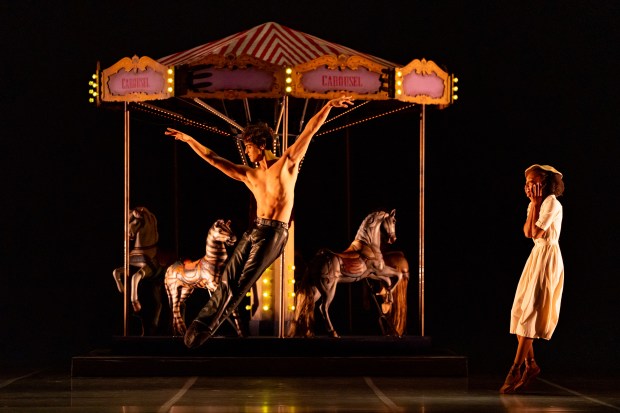
‘Liliom’ and Julie’s Journey
Julie, portrayed by prima ballerina Victoria Jaiani, is the epitome of goodness which often leads her into difficult situations. She falls for Liliom, a character played by José Pablo Castro Cuevas, whose charm as a carnival barker belies his troubled life. Audiences are drawn into the question of whether Liliom’s actions stem from his character or his circumstances. Ultimately, both factors influence his destiny, forcing Julie to confront tough choices about her future.
Choreography by John Neumeier
The ballet ‘Liliom,’ directed by John Neumeier, makes its Midwest debut as the first production undertaken by a North American dance company. While the narrative delves into the trope of a woman who stands by her flawed partner, Neumeier also examines if a man can truly steer his own destiny. This performance by Castro Cuevas showcases a significant leap beyond his previous role as Eugene Onegin.
Neumeier originally created ‘Liliom’ 15 years ago for the Hamburg Ballet. With roots in Milwaukee and a history with the Lyric Opera in Chicago, Neumeier’s career on this stage began in 1961 with Vittorio Giannini’s ‘The Harvest.’ His work with the Joffrey Ballet is part of an ongoing collaboration that started with productions like ‘Sylvia’ and ‘Orphée et Eurydice.’
Neumeier’s Unique Style
Neumeier’s style combines classical ballet, modern dance, and theatrical elements influenced by his early training in Chicago. His work can be eccentric, as seen in ‘Liliom,’ where synchronization with music varies intentionally. Dancer Evan Boersma, acting as The Balloon Man, serves as a spectral guide, leading Liliom between earthly and spiritual dimensions.
Setting and Performance
The ballet opens in silence, with Boersma walking on his knees, carrying multicolored balloons. The initially drab stage gradually comes alive with Michel Legrand’s score, interpreted by conductor Nicholas Koo and the Lyric Opera Orchestra. The carnival setting of Playland is enriched by costume and set designs from Neumeier, Ferdinand Wogerbauer, and Jim French, illustrating the social divides of the era.
Liliom’s role involves enticing people to the carnival, which he effectively does through his charisma. Castro Cuevas renders Liliom as both a seductive figure and a complex character with insecurities and aggression. This depth is displayed when Liliom turns to theft upon learning he’ll be a father during the Great Depression, a storyline that echoes Rodgers and Hammerstein’s ‘Carousel.’
Climax and Resolution
In a climactic scene, the Joffrey’s ensemble of 24 men performs a vigorous dance, expressing frustration over job scarcity after the 1920s crashed into the 1930s. Liliom’s tragic choices leave Julie with immense heartache yet demonstrate his love and vulnerability towards her, an aspect unseen by others.
The ballet concludes on a hopeful note, reflecting how Julie consistently perceives goodness in people. Her ability to love her son unconditionally despite facing immense challenges highlights Neumeier’s narrative loop where the end ties back to the beginning.
Reviewer: Lauren Warnecke
Review: 3.5 stars
- When: Through Sept. 27
- Where: Joffrey Ballet at Lyric Opera of Chicago, 20 N. Wacker Drive
- Running time: 2 hours, 25 minutes with one intermission
- Tickets: $39-$214 at 312-386-8905 and www.joffrey.org