
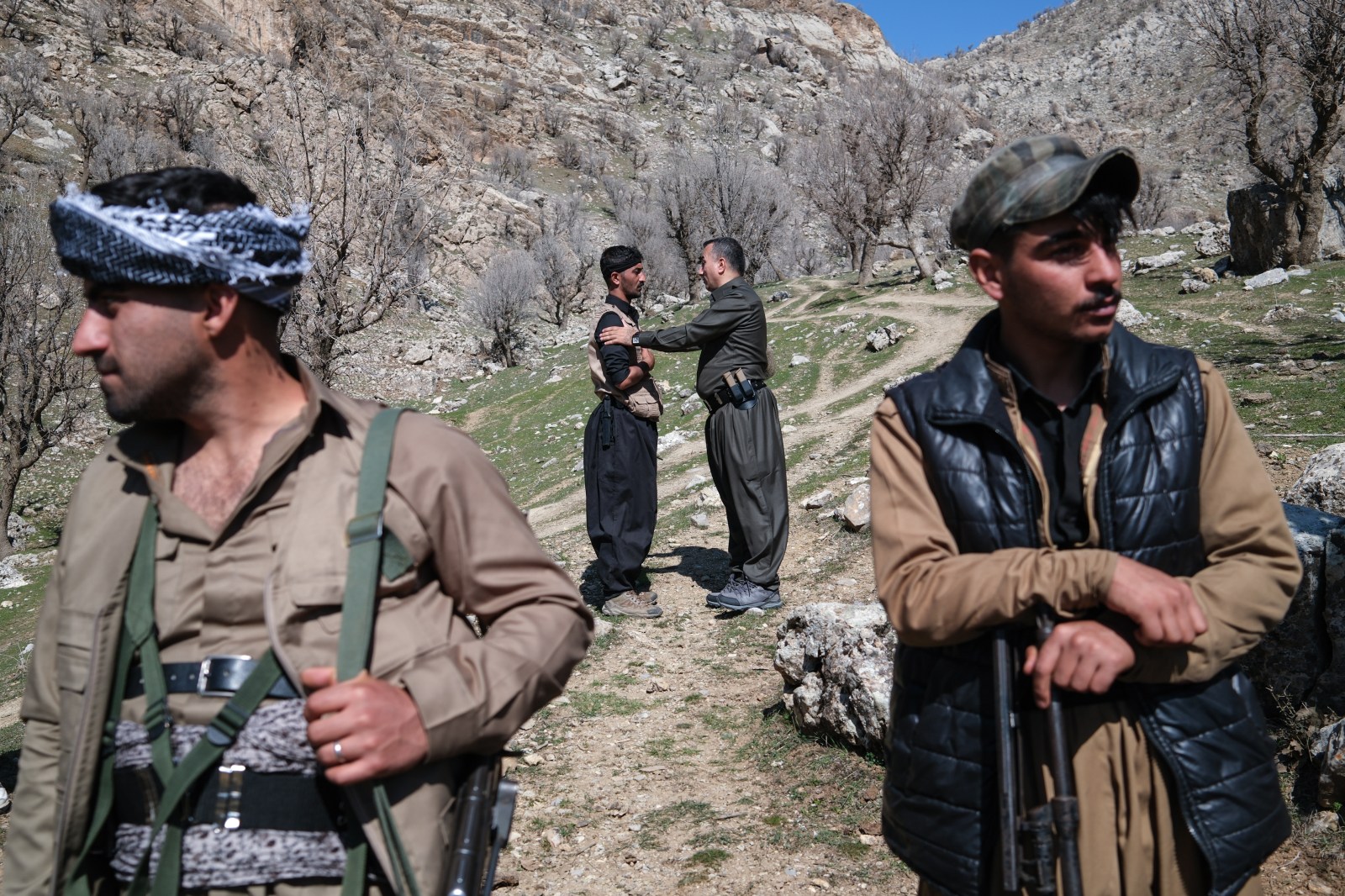
Iran’s Internal Unrest
Recent clashes between Iranian security forces and Kurdish rebel groups threaten to ignite a new aspect of the Islamic Republic’s ongoing conflict with the United States and Israel. Violence persists despite a fragile ceasefire between Tehran and Washington, which was established following a significant memorandum of understanding earlier this month. The Islamic Revolutionary Guard Corps (IRGC) reported that two of its members were killed in what officials termed a “terrorist and cowardly act” in Paveh, located in the western province of Kermanshah.
The Hengaw Organization for Human Rights, based in Norway, attributed the attack to a new Kurdish group known as Xori Hiwa, or “Sun of Hope.” On the same day, the IRGC announced a counterterrorism operation, claiming the destruction of a six-member team that had infiltrated the West Azerbaijan province, bordering Iraq’s Kurdish region. The Kurdistan Free Life Party (PJAK) rebel group confirmed the loss of four fighters in clashes near Mahabad.
Historical Context and Current Threats
These incidents form part of a series of clashes reported since last weekend. Iran’s history with Kurdish insurgency dates back to pre-revolutionary times. Current unrest mirrors earlier threats from U.S. and Israeli officials who considered leveraging Kurdish movements against Iran.
Media outlets in Iran have connected these events to reports from The New York Times and Israeli media about an alleged Mossad-supported plan for a Kurdish offensive, which did not transpire. Henri Barkey, a former State Department official and senior fellow at the Council on Foreign Relations, noted that for now, Kurdish forces are not a significant threat. He suggested that Kurdish forces could become influential if national unrest forces the dispersal of internal security forces.
Understanding the Kurdish Population
Kurds constitute a significant ethnic group across Iran, Iraq, Syria, and Turkey, with a history of seeking autonomy and independence via peaceful and armed resistance. In Iran, they make up approximately 10% of the population, concentrated primarily in the western provinces.
In addition to PJAK, other active Kurdish insurgent groups in Iran include the Democratic Party of Iranian Kurdistan (KDPI), the Kurdistan Freedom Party (PAK), the Komala Party, and several splinter organizations. During the Iran-Iraq war of the 1980s, both countries supported insurgencies to incite unrest, leading to inter-group clashes within Kurdish factions in Iran.
U.S. and Iranian Kurdish Perspectives
The Coalition of Political Forces of Iranian Kurdistan was established in January amid nationwide protests and crackdowns. Despite early intentions from the U.S. for cooperation, the prospect of a Kurdish offensive backed by the U.S. and Israel did not materialize.
The U.S. administration expressed interest yet later hesitated to proceed. Although weapons were sent to Kurdish forces, the groups were reportedly unsatisfied with subsequent support. Divergence in objectives became apparent following the U.S.-Iran memorandum of understanding, which focused on dismantling Iran’s nuclear program, missile capabilities, and regional militia networks.
PDKI representative Hejar Berenji underscored differences in goals, stating Kurdish parties sought governance changes within Iran and maintained limited reliance on external forces due to their unpredictable nature.
Potential Impact of Kurdish Forces
Kurdish factions are among Iran’s most organized insurgent forces, yet they lack the strength to challenge Iran’s robust security framework. Analysts worry about sectarian conflicts like those in Afghanistan and Iraq.
Both Kurdish factions and Iranian analysts warily view potential U.S. backing due to past inconsistencies. Barkey doubted serious plans to support Kurdish groups against Iran, noting the resources and strategy required are beyond current capabilities.
Mohammed Salih, an expert on regional affairs, linked recent confrontations to intensified government security measures against Kurdish opposition, suggesting local-level threats rather than existential ones.
He asserted that without renewed conflict and guaranteed air support, substantial cooperation remains unlikely. For now, ordinary Kurds face further security pressures, and increased demands on Iraq and the Kurdish government to remove Iranian Kurdish opposition from their territory.