
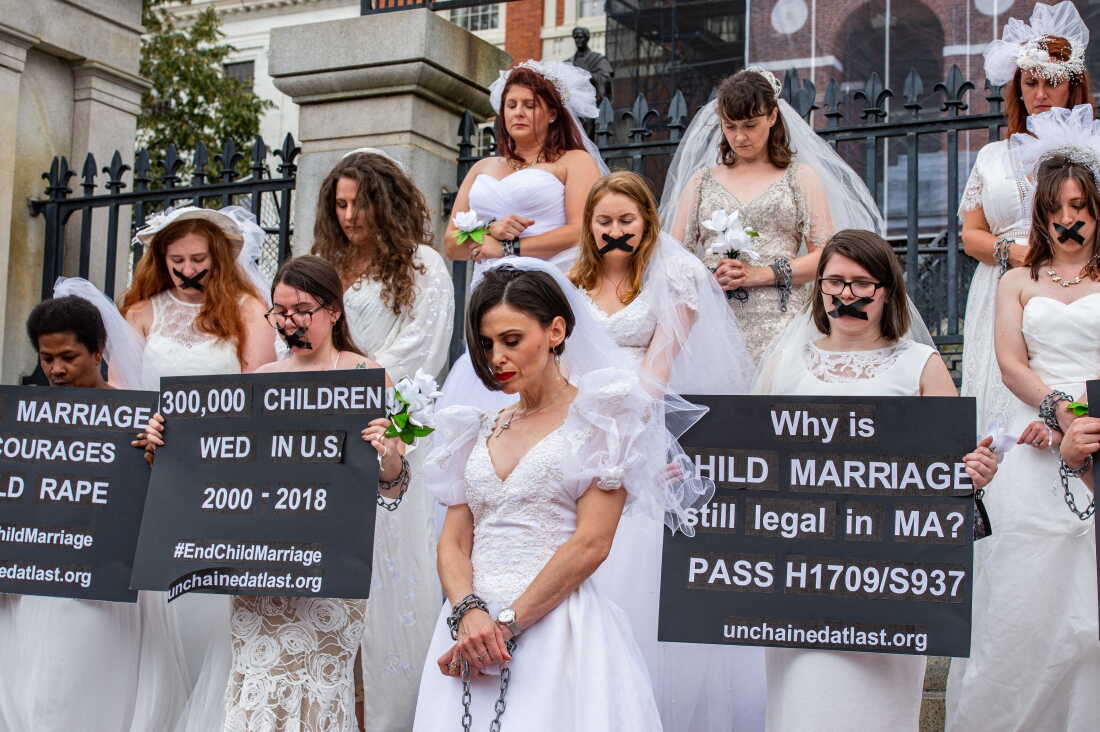
Advocates and child marriage survivors recently gathered in Boston to advocate against child marriage. Currently, over two dozen U.S. states allow marriage for those under 18 under specific circumstances. A new bill in Congress seeks to establish a national ban.
Our global health team has been covering child marriage, a practice involving those under 18. The United Nations describes it as a human rights violation that can lead to early pregnancy, social isolation, disrupted education, limited career opportunities, and risks of domestic violence. Annually, 12 million girls globally become brides, according to U.N. estimates. Boys forced into marriage face pressures such as leaving school and supporting a family.
The U.N. aims to end child marriage by 2030.
Efforts to outlaw child marriage are increasing, with new legislation introduced in the U.S. in July. The U.N. General Assembly adopted a resolution on September 4, declaring November 27 as the International Day to End Child, Early, and Forced Marriage.
Nations worldwide are aligning with the U.N.’s goal to abolish child marriage by 2030. Since 2021, countries like Sierra Leone, England, the Philippines, and the Dominican Republic have raised the marriage age to 18 without exceptions. In the U.S., the push for national legislation faces controversy. Some critics argue the proposed bill overlooks significant issues, and opponents are concerned about government overreach.
Legislation’s Impact in the U.S.
In July, U.S. Representative Gwen Moore and Senators Dick Durbin, Brian Schatz, and Kirsten Gillibrand introduced the Child Marriage Prevention Act. This federal bill seeks to standardize a minimum marriage age of 18 across all states. In 34 states, including Wisconsin, child marriage is currently legal, often between young girls and adult men.
Data reveals more than 314,000 minors married legally in the U.S. from 2000 to 2021. Most involved underage girls and adult men. Unchained At Last, an organization fighting child marriage, estimates at least 66,415 of these marriages involved a minor at an age where sexual relations would be considered statutory rape.
The Tahirih Justice Center, a long-time advocate for ending forced and child marriage, supports this legislation. Director of public policy Casey Carter Swegman emphasizes that apparent consent from minors can be deceiving, as pressure from family often compels them to agree to marriage.
While the bill has support from many advocates, some, like Fraidy Reiss from Unchained At Last, caution against provisions they believe are insufficient. Critically, the bill permits federal grants for states to study child marriage instead of banning it outright, and it allows minors as young as 16 to qualify for spousal visas under certain conditions, which could facilitate trafficking.
Comparing Global Efforts
As the U.S. considers the bill this fall, other nations have implemented more comprehensive restrictions. Sierra Leone’s Prohibition of Child Marriage Act 2024 prohibits marriage under 18 without any exceptions. Similarly, Colombia and Bolivia have passed laws banning child marriage outright, removing provisions for parental consent or judicial approval.
However, laws alone are not a definitive solution. In sub-Saharan Africa and India, weak enforcement often undermines the effectiveness of child marriage bans. Deeply ingrained cultural practices still drive child marriage in many areas, creating complex challenges for reform.
Renu Singh, executive director at Young Lives India, notes that child marriage persists due to numerous social and cultural factors. The organization’s research shows that child marriages occur across various income groups, with parents seeing marriage as a security measure for daughters.
Despite strong laws, India reports numerous yearly child marriages. Singh stresses that sustainable change requires community-level shifts in attitudes and behaviors.
Casey Carter Swegman from the Tahirih Justice Center highlights that deeply entrenched gender roles and societal pressures in the U.S. also drive child marriage. A change in laws alone won’t suffice; altering community beliefs and providing supportive services are crucial.
Global Political Efforts
The international drive to end child marriage is gaining momentum. A U.N. resolution establishes an International Day to End Child, Early, and Forced Marriage, urging nations to hold each other accountable and enforce protective laws. Bhuwan Ribhu of Just Rights for Children, a key advocate for the resolution, emphasizes the global consensus that child marriage must end by 2030.
This push requires sustained commitment to legislative and cultural transformation, not just in the U.S., but globally. The world has indicated a collective intent: ending child marriage is essential.