
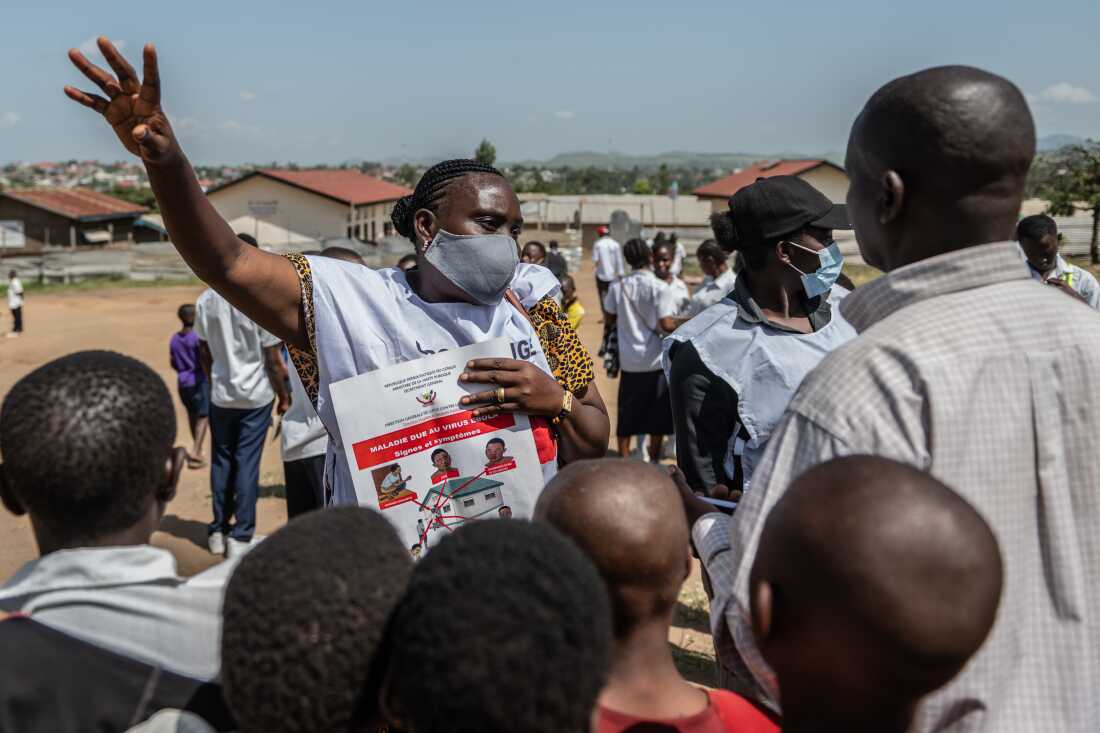
Vanny Birungi, a volunteer with the Red Cross in eastern Congo, tirelessly works to raise awareness about the recent Ebola outbreak. With suspected cases nearing 1,000, she faces two major threats: the rare Bundibugyo strain of Ebola, which lacks a vaccine or treatment, and the hostility from residents in Bunia, where she conducts her campaigns.
“We continue to tell them that the disease is out there. Some accept, and others don’t,” Birungi explained to The Associated Press during one of her campaigns. Aid workers like her operate in a volatile region where armed groups have killed thousands and displaced many. Here, trust is scarce among a population traumatized and wary of outsiders.
Surveillance efforts have been hampered by aid cuts. Distrust runs deep, with residents like Pierre Basola, aged 56, expressing skepticism. “These people should stop bothering us. They just want to get rich. Let’s not forget that Ebola is a white man’s invention,” he stated.
Healthcare Facilities Under Attack
The growing number of cases has fueled violence against healthcare facilities. In the past week alone, three facilities have been attacked. Recently, a hospital treating Ebola patients was stormed, forcing staff to evacuate. Another attack saw a tent for Ebola cases set aflame, and in a separate incident, a center was burned down after a suspected Ebola patient’s body was retained for safety reasons.
The virus spreads through bodily fluids, making healthcare workers and family caregivers the most vulnerable. “Trust is almost as important as the health response,” emphasized Heather Kerr, the country director for the International Rescue Committee in Congo. Without it, people avoid health centers, hindering containment efforts.
Challenges and Escalating Threats
The region is also troubled by armed conflict. Aid groups traveling between Bunia and Mongbwalu face potential attacks. The outbreak has reached over 900 suspected cases and 220 suspected deaths. Tedros Adhanom Ghebreyesus, director general of the World Health Organization (WHO), noted, “We are now playing catch-up with a very fast-moving epidemic.”
Mado Nditamba, a 70-year-old resident, shared her concerns. “The last time Ebola came, it was not on the scale that we see today,” she said. Despite efforts, even doctors in hospitals fall victim to the disease. “We don’t know what to do and we leave everything to God.”
Congo, familiar with Ebola outbreaks, is trying to respond, but early efforts focused wrongly on a different strain, costing precious time. Limited testing capabilities and ongoing conflicts further complicate the situation.
Health workers have reported inadequate protection. Several responders have been infected, with some fatalities. A Congolese doctor was among the recent deaths, as reported by Rubens Dhedgia, coordinator of the Ebola response.
Skepticism and Community Engagement
In Uganda, where a smaller spread has been noticed, three health workers have been infected. Worryingly, three Red Cross volunteers died in Mongbwalu. Their deaths, believed to be from handling bodies, suggest the outbreak began much earlier than recorded.
Skepticism is prevalent, with residents doubting the virus’s existence. Action Aid reported a high level of mistrust and misunderstanding following the outbreak announcement in mid-May.
“The only way to go, as far as this particular virus is concerned, is community engagement,” noted Yakubu Mohammed Saani, Action Aid’s country director in Congo.
The exact strategy for improving this engagement remains unclear. Both the WHO and Africa Centers for Disease Control and Prevention suspect the outbreak is more extensive than documented cases indicate.