
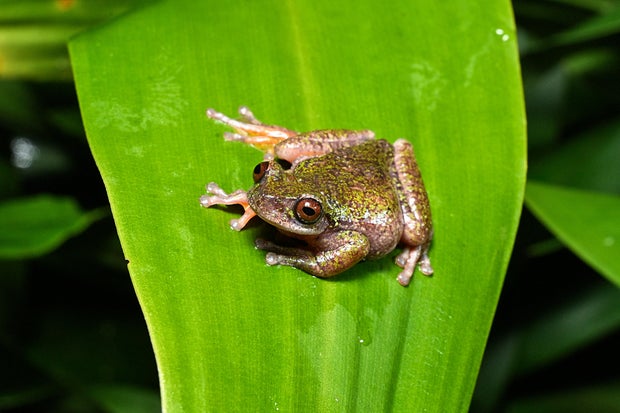
A small greenish frog species has been discovered in Costa Rica’s central Pacific region, thriving in coffee plantations yet facing threats from agricultural chemicals. Known as the “spring frog,” this amphibian measures less than 4 centimeters. Researchers observed these dark green-spotted frogs in San Lorenzo de Tarrazu.
New Species
According to researcher Wagner Chaves-Acuna, it is a new species of tree frog endemic to Costa Rica. The findings come from colleagues at the University of Costa Rica and Argentina’s National Council for Scientific and Technical Research.
A view of the newly discovered “Rana de las nacientes” (Isthmohyla nacientes) frog species was captured in San Jose, Costa Rica on August 6, 2026.
First observed in the 1960s, it was initially misidentified as another species. Rediscovered in 2021, genetic and morphological studies confirmed its unique nature. The National Alliance for the Conservation of Amphibians and Reptiles (ANCAR) provides this context.
Distinct Characteristics
Nicknamed the “coffee frog,” it has a translucent throat that inflates when males call. At night, these frogs are highly active, singing and perched on coffee shrubs. Their diet consists of small insects in the habitat, avoiding the coffee berries themselves.
Scientists from the International Institute for Wildlife Conservation and Management at the National University of Costa Rica have photographed this new frog species.
Risks and Threats
Wagner Chaves-Acuna warns that pesticide use on coffee plantations could harm these amphibians. Chemicals can disperse through air and seep into soil, reaching aquatic systems where tadpoles develop.
Other threats include waste dumping, increased tourism, and loss of vegetation from the invasion of protected areas, as noted by ANCAR.