
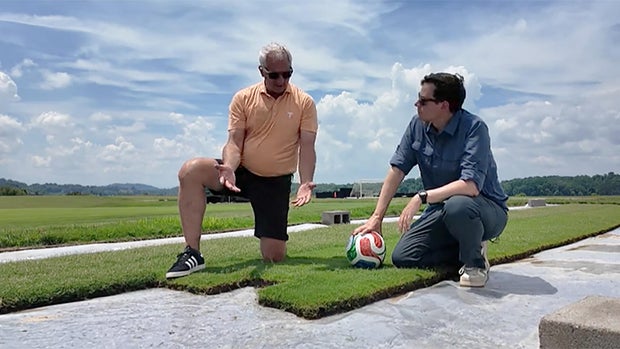
This year, the World Cup has captivated audiences, breaking viewership records. Hosting this event has driven Americans to engage with soccer in unprecedented ways. Today’s final match, featuring Spain and Argentina, is projected to mark another historic high in viewership. However, for one individual in Tennessee, the tournament’s excitement parallels watching grass grow, and to him, that’s high praise.
Understanding the Importance of Pitch Quality
Dr. John Sorochan, a renowned Turfgrass Science professor at the University of Tennessee, Knoxville, emphasizes the significance of high-quality pitches. He states, “The number one thing is the pitches, right? We need to have a good surface, a good canvas for the players to play on.” He notes that many viewers might overlook field conditions, although they play a crucial part in the quality of gameplay. Given the staggering statistic from the last men’s World Cup, where 1.8 billion people watched the final, ensuring a top-notch playing surface was vital. Despite its importance, spectators rarely consider the complexities involved in preparing the field.
“And they enjoyed it. And they didn’t even think of the field, sadly. But there’s so much that went into it, right?” – Dr. John Sorochan
For the past five years, the University of Tennessee and Michigan State University have collaborated on the FIFA Pitch Research Project. This year’s World Cup is the largest ever, encompassing 104 matches across 16 stadiums in three countries, each adhering to FIFA’s mandate for natural grass.
Adapting Grass for Different Conditions
The diversity in stadium elevation and climate necessitates unique grass species adapted to local conditions. Scientifically-engineered sod, transported from farms nationwide, often overlays existing artificial grass fields. For instance, the grass at MetLife Stadium in New Jersey, hosting today’s final, originated from North Carolina. To cope with the enclosed environments of five domed stadiums, FIFA invested in an indoor facility at the Tennessee campus to explore grass response to grow lights. These lights simulate daylight for 12-14 hours daily, ensuring grass remains alive over weeks.
Sorochan explains, “But we need [grass] to be alive inside for, you know, 10 to 12 weeks.”
Testing Resilience and Performance
Evaluating grass durability involves technology like a robot designed to emulate the force exerted by professional soccer players. Sorochan details, “We just go row by row by row, and we get a heat map of the variability or the consistency of that surface – hopefully, for World Cup pitches, the more consistent the better.” Studies also examine ball behavior on different grass types, focusing on optimal skipping and minimal bouncing, beneficial for player performance.
Grass Types and Their Applications
Among various grasses tested, traditional Meyer Zoysia and the drought-tolerant TifTuf Bermuda stand out. Brad Jean, owner of Crossroads Sod Farm, collaborates closely with the University of Tennessee experts. Sourcing sod is significant for diverse customers, including residential properties and golf courses, revealing a business worth approximately $2.2 billion.
Jean voices his preference for real grass over artificial turf, citing concerns over heat and comfort. “If it’s 90 degrees, AstroTurf is going to be really, really hot, and the grass is going to be really cool,” he emphasizes.
Nostalgia and Physical Benefits
While newer artificial turfs may reduce injury risks compared to older versions, Sorochan believes grass offers intangible advantages. “It’s the play of the game, and the beauty of the game,” he reflects. Natural grass enhances the fluidity and authenticity of soccer play.
In the semi-final match at Atlanta Stadium, players Enzo Fernandez of Argentina and Djed Spence of England experienced the harmony of soccer on a grass blend of Kentucky bluegrass and perennial ryegrass.
Preserving Memories
Post-tournament, the World Cup offers an intriguing memento: slices of the match grass sold for $450. This piece of sporting history can become part of your home backdrop.
For further information:
- Dr. John Sorochan, University of Tennessee, Knoxville
- FIFA Pitch Research Project
- Crossroads Sod Farm, Belvidere, Tenn.