
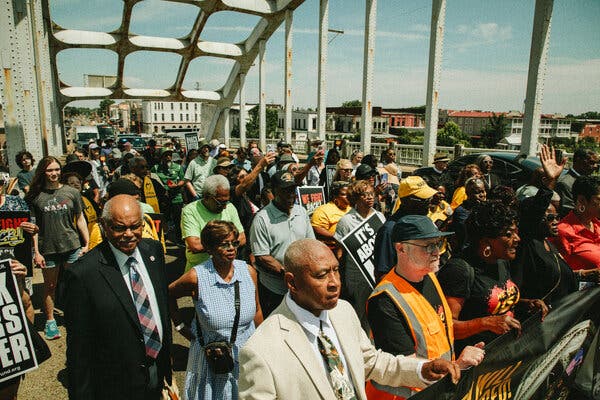
People from across the United States gathered in Selma, Alabama, earlier this month. They marched for voters’ rights, starting at Tabernacle Baptist Church and ending across the Edmund Pettus Bridge. This event follows significant changes in the political landscape, causing mixed emotions among different groups.
Republican leaders are celebrating, while some voters express confusion and concern. Civil rights activists are preparing for what they call a significant battle for voters’ rights. The recent Supreme Court decision has weakened the Voting Rights Act, prompting Republican officials to quickly redraw congressional maps in the South.
This redistricting wave began as Republicans push to solidify their hold on the region, potentially ending political careers for several Black Democrats. The changes raise critical questions about political representation and the practical aspects of altered district boundaries.
Mayor Chaz Molder of Columbia, Tennessee, voiced his frustration. A new map drawn by Republican lawmakers placed his home outside the district where he was campaigning for Congress. He stated, “It’s the voter that loses in this kind of partisan gamesmanship.”
While these efforts are notably impactful in the South, redistricting is not confined to this region. President Trump previously encouraged this strategy to maintain the Republican majority in the House. Last summer, Texas initiated the redistricting, aiming to flip five House seats to Republicans. California Democrats and other states also adjusted their maps last fall.
The recent Supreme Court ruling has escalated redistricting, especially in the South. Historically, the Voting Rights Act protected districts with a majority of Black voters, who typically elected Black Democrats. Now, this protection is compromised, leading to swift and dramatic political shifts.