
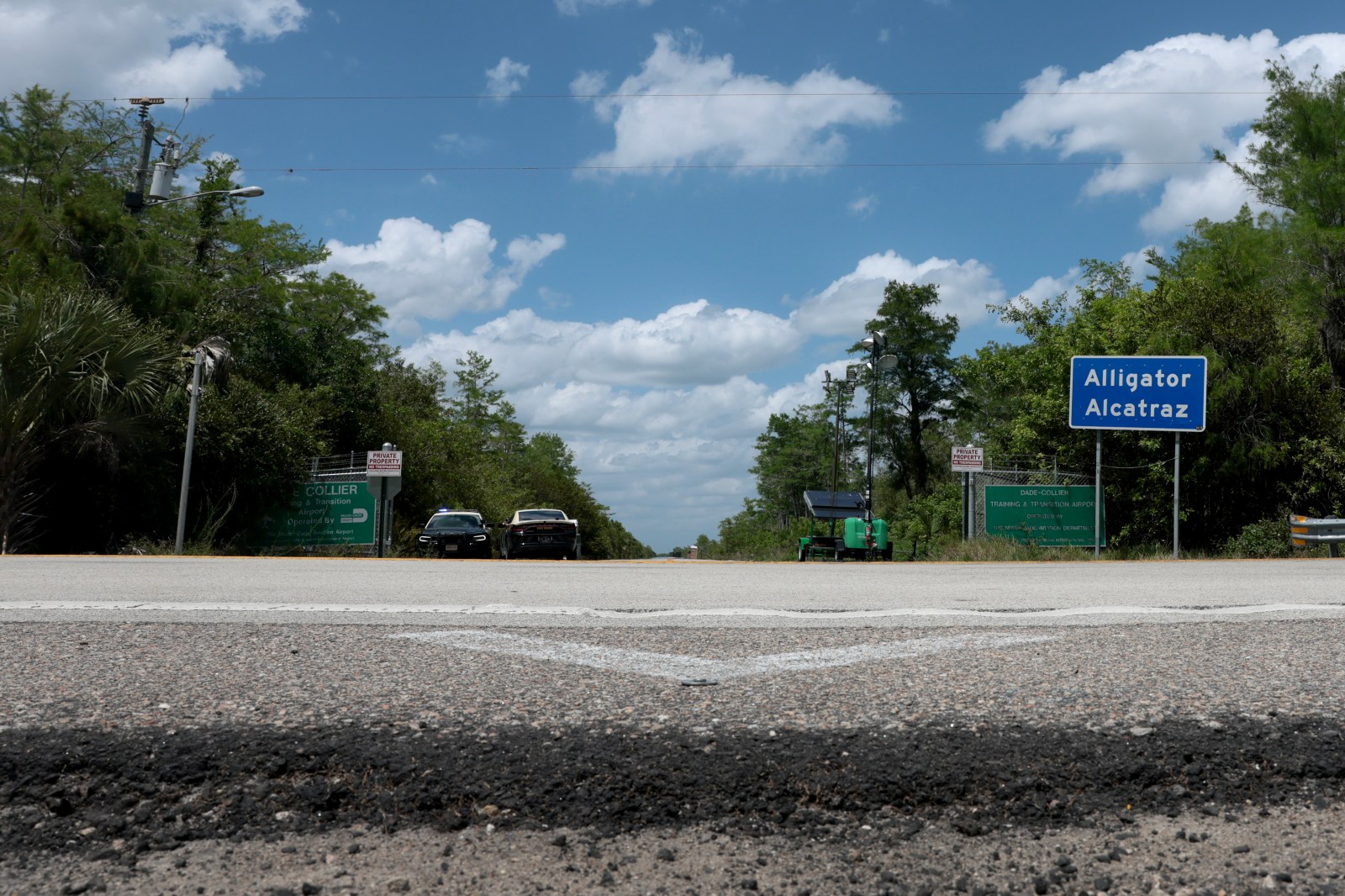
The Department of Homeland Security’s (DHS) watchdog has flagged significant issues at Florida’s now-closed immigrant detention facility, known as ‘Alligator Alcatraz.’ These problems may also occur at another major site in the state.
Report Findings
A report by the DHS Office of Inspector General (OIG) describes the troubling conditions observed at the temporary facility. Immigrants were reportedly confined in phone-booth-sized enclosures for up to two hours at a time. The site faced severe overcrowding, with unclear responsibility between federal and state agencies.
Thomas Kennedy from the Florida Immigration Coalition told Newsweek that the conditions equated to torture, stating, ‘It is torture, locking people up outside in the middle of the Florida summer, in a cage, exposed to the elements.’
Although ‘Alligator Alcatraz,’ located in the Everglades, closed earlier this year, the OIG warns that similar issues may arise at ‘Deportation Depot,’ another site operated in conjunction with ICE and Florida authorities.
‘Alligator Alcatraz’ Inspection
The OIG carried out an unannounced inspection in January 2026. At that time, around 1,800 individuals were detained at the state-run site managed on behalf of U.S. Immigration and Customs Enforcement (ICE).
Inspectors noted significant overcrowding. Where detention standards required 75 square feet per detainee, detainees had closer to 28 square feet. Housing units meant for 32 immigrants were holding about three times more than intended. Photos showed metal cages with bunk beds inside temporary white tents.
Confinement Conditions
At least 79 detainees experienced confinement in metal enclosures of approximately 18 square feet from July 2025 to January 2026. Inspectors criticized these phone-booth-like structures as ‘unprecedented’ and potentially harmful to health and well-being.
Thomas Kennedy described these as torture devices, ‘constituted solitary confinement with people exposed to elements in the middle of a swamp.’
Responsibility Debate
There was confusion over who was responsible for standards at the site. A DHS representative stated it was not accountable since the facility was Florida-run. However, the OIG argued that ICE had oversight obligations due to its involvement and the issuance of ICE handbooks to detainees.
Kennedy mentioned an ongoing lawsuit highlighting the state’s misuse of 287(g) agreements, which allow local authorities to partner with DHS on immigration enforcement.
Ongoing Concerns
Florida’s embracement of the 287(g) program is evident, with broad participation from law enforcement agencies. Another significant facility, Deportation Depot, continues operating. Concerns linger as it remains uninspected by ICE’s Office of Detention Oversight and unscheduled for inspections in the near future.
Asked about whether the OIG report would spur accountability, Kennedy expressed skepticism, anticipating no accountability and noting significant spending of over a billion dollars in state funds without oversight.