
While Americans prepare for futuristic AI conflicts, experts warn that China’s strategy to undermine U.S. global dominance with AI is already underway. This warning comes just before President Xi Jinping’s visit to the U.S.
Experts outlined a stealthy playbook that includes:
- Extracting logic from American AI models
- Undercutting U.S. developers with free open-source software
- Weaponizing these systems for cognitive warfare
China circumvents U.S. research costs by copying cutting-edge American AI and flooding the global market with free alternatives.
“A ‘race’ is not the right metaphor,” said Leah Siskind, an AI research fellow. “It’s like a multi-front war where we’re both winning and losing.”
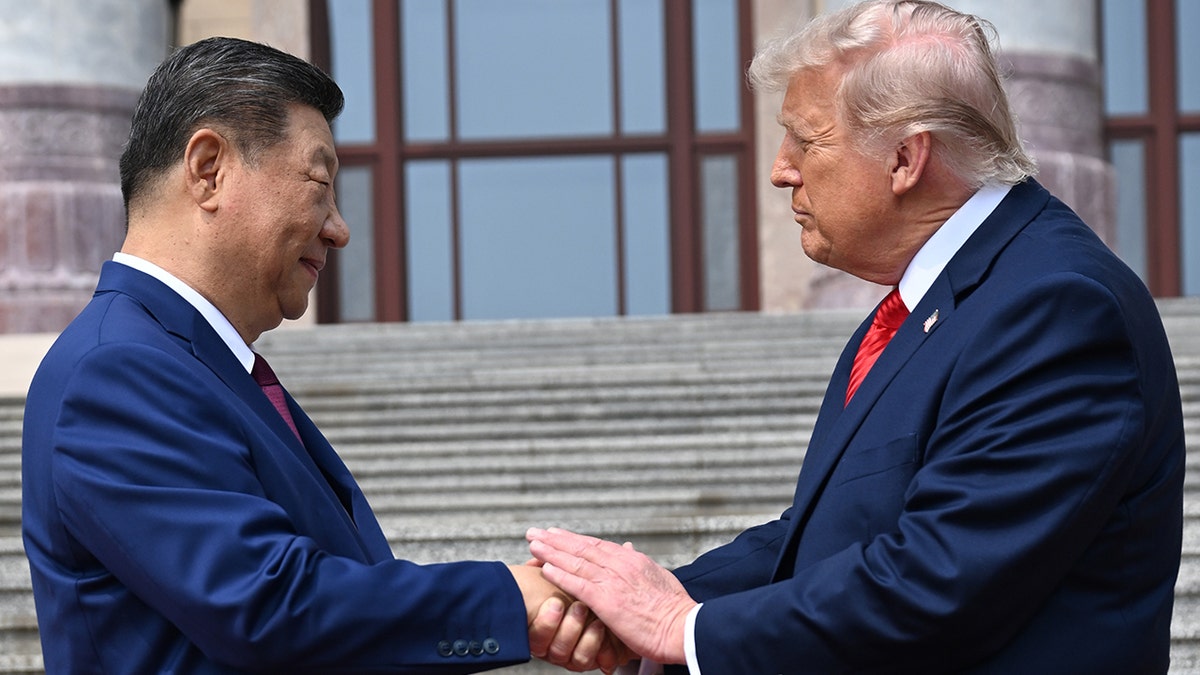
Chinese President Xi Jinping shakes hands with former U.S. President Donald Trump in Beijing, 2026. China strategically distributes open-source models, luring companies with lower costs. Siskind cautions about potential censorship and backdoors in these models.
“Can we ensure that a Chinese model is free of CCP censorship? We can’t know,” Siskind stated.
Gordon Chang, a China expert, notes Beijing’s tactic resembles their solar panel industry strategy, potentially driving out American AI on cost and availability. The U.S. has an advantage in physical infrastructure, with more data centers and superior microchips. However, China uses knowledge distillation to learn from American models without incurring high costs.
Siskind highlighted the Chinese model DeepSeek as evidence of this approach.
The Department of Homeland Security recently warned of China’s large-scale knowledge distillation campaigns extracting proprietary U.S. capabilities. Beyond economic moves, China integrates AI into physical supply chains and influence campaigns.
“Their cognitive warfare capabilities are enhanced by AI,” Chang warned, highlighting the threat to democratic processes.
As President Xi visits the U.S., experts urge the White House to treat non-traditional threats with urgency. Measures include:
- Tightening chip export regulations
- Blacklisting deceptive foreign labs
- Incentivizing U.S. open-source development
Siskind emphasized the importance of democratic values guiding advanced system development.
“Xi Jinping has pushed the notion of ‘Tianxia’, or ‘all under heaven’, asserting China’s right to rule globally,” Chang warned, noting the potential of an AI-powered regime.
In a United Nations address, former President Donald Trump reaffirmed U.S. goals to maintain a lead in AI, branding it as “superintelligence” and rejecting attempts at global AI control.