
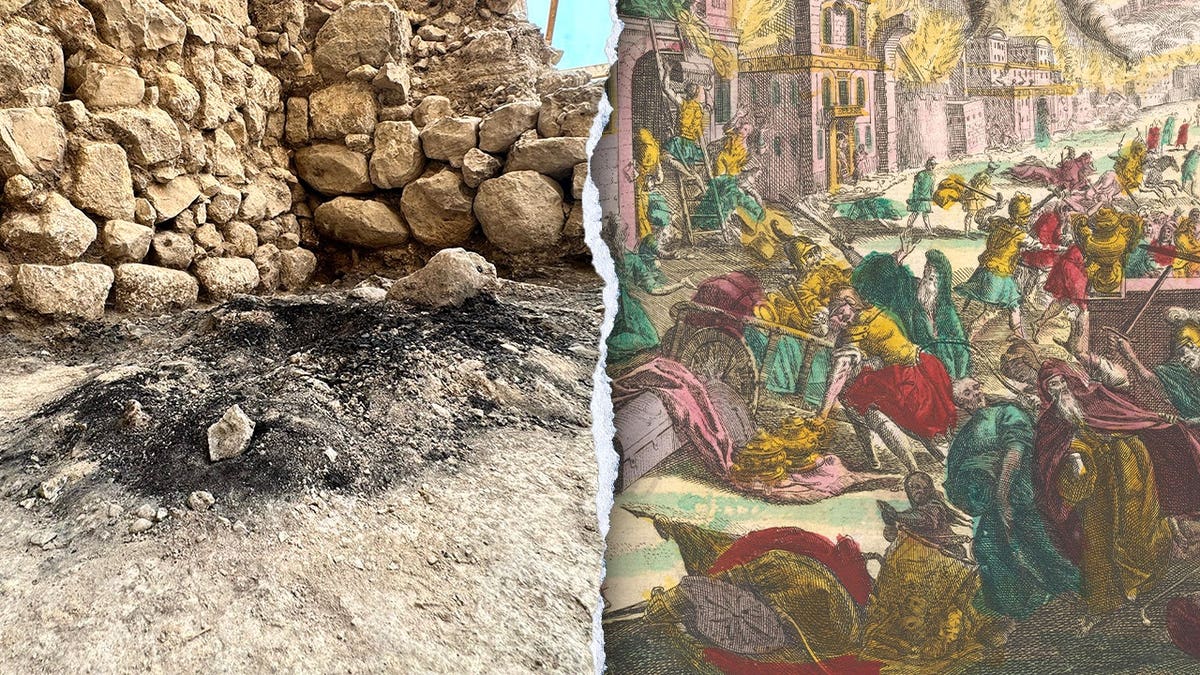
Archaeologists in Jerusalem have discovered charred wooden beams that date back approximately 2,600 years. These are thought to be remnants from the destruction of Solomon’s Temple. The Israel Antiquities Authority (IAA) reported this find beneath a parking lot in the City of David.
Details of the Discovery
The IAA explained that the wood, embedded in a collapsed building, was preserved by plaster that melted and covered the beams during a fire in the First Temple’s destruction. Solomon’s Temple, also known as the First Temple, was destroyed by Babylonian King Nebuchadnezzar II in 586 B.C. after his army captured Jerusalem.
King Solomon initially built the temple in the 10th century B.C. to house the Ark of the Covenant, as described in religious texts. The destruction led to the Second Temple period, a significant era in Jewish history.
Research and Preservation
Efrat Bocher, an excavation director, stated the beams likely formed the roof of an inner courtyard and collapsed during the temple’s destruction. The IAA noted the plaster shielding preserved the charred beams exceptionally well. These beams contain a large number of growth rings, facilitating precise dating within about ten years.
Johanna Regev, a radiocarbon dating expert, expressed the rarity of finding wood in Israel with so many growth rings. The discovery offers significant research potential, enhancing dating accuracy considerably. Previously, dating estimates spanned hundreds of years; this discovery allows for precision down to a decade.
Preserving History
Experts believe the residents of Jerusalem chose to leave some ruins in place as a remembrance of the destruction. Yiftah Shalev, another director of the excavation, spoke about preserving memory as a human need to remember what once existed.
These charred beams provide a rare view into the events of 586 B.C. The discovery was described as deeply moving, creating a sense of witnessing historical moments.
Recent archaeological activities in Jerusalem have been fruitful. Last year, experts unveiled the longest and best-preserved section of the Hasmonean-era wall in the city. Additionally, this year saw the discovery of an impressive tunnel near Jerusalem’s biblical-era Kingdom of Judah.