
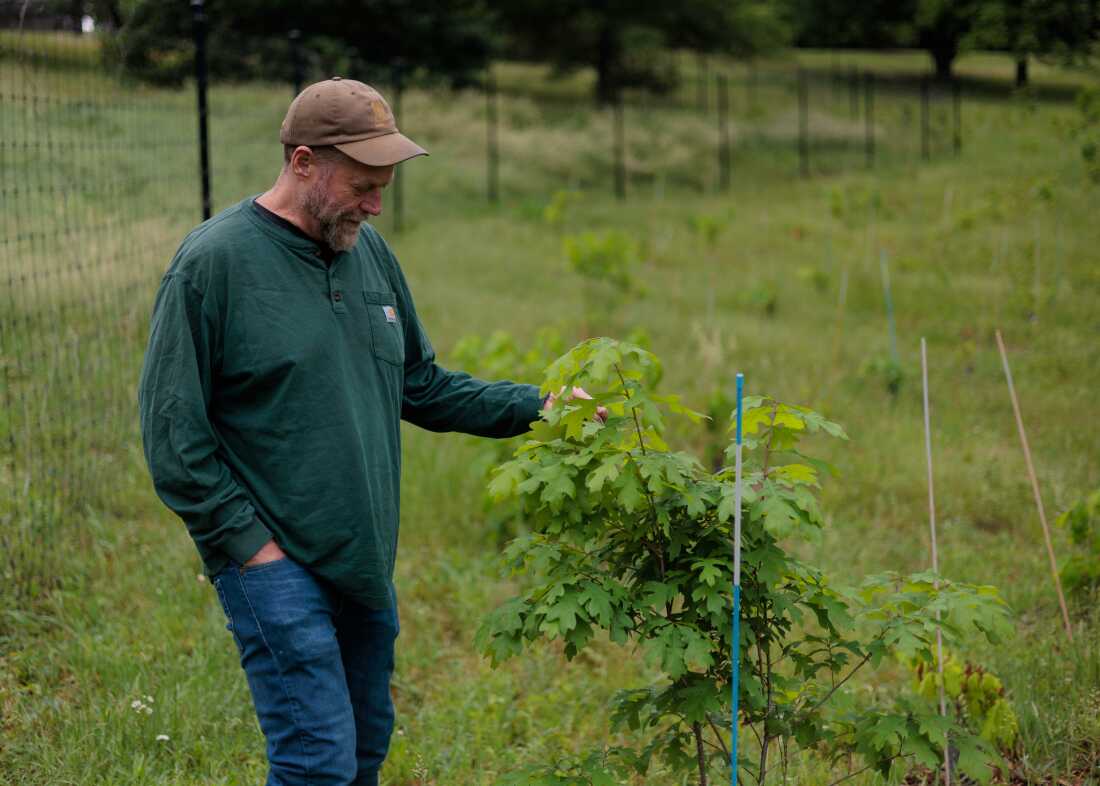
Former Forest Service researcher Morgan Grove examines a white oak tree planted by agency scientists in the Cylburn Arboretum in Baltimore, MD. When trees die and fall in Baltimore, the city doesn’t send them to landfills. Instead, they are taken to a recycling facility that transforms them into products like furniture and flooring. This facility has become a profitable model for other cities. Shaun Preston, who oversees Camp Small, states the site might have failed without research support from U.S. Forest Service scientists based in Baltimore. He said, “The U.S. Forest Service was vital in helping us develop and grow Camp Small.”
The U.S. Forest Service employs over 1,000 researchers across multiple facilities nationwide. These employees work in diverse environments, from urban labs in Baltimore to rural areas near national forests. Their projects include restoring trees in Hawaii and learning to prevent wildfires in Montana. These initiatives often involve local partners like Camp Small, representing the world’s largest forestry research network.
However, on March 31, the Forest Service announced plans to reorganize, which would include closing research facilities in Baltimore. President Trump’s 2027 budget proposed no funding for Forest Service research, compared to $309 million in 2026. This has led to more than 100 facilities being considered for closure.
During a budget hearing, Forest Service Chief Schulz stated that the agency aims to achieve fiscal responsibility and to bring its employees closer to the lands they manage. Part of the reorganization includes moving the headquarters to Salt Lake City and closing regional offices that manage permits and land.
The closures could affect 229 employees, according to the Forest Service Council, which represents the workers. The Forest Service insists the closures are not meant to force resignations but plans to consolidate staff in Colorado. However, this strategy may discourage staff from staying due to increased research costs and reduced local collaboration.
Many of the facilities being considered for closure are owned by the government, costing less than $1 in rent annually. However, deferred maintenance on these properties amounts to $3 billion, far less than maintaining other assets like roads and bridges, costing over $8 billion.
Some leases, such as the one in Hilo, Hawaii, cost the government only a one-time fee, yet are still evaluated for closure. Employees argue that the reorganization does not consider the ownership and financial efficiencies of current facilities.
Current Forest Service scientists, including Morgan Grove, argue against the move. Grove highlights research complexities, like studying urban oak growth in Baltimore, that cannot be relocated without disrupting studies. He noted the importance of local collaboration and research continuity.
Four Forest Service scientists stated they would resign if forced to relocate, emphasizing the irreplaceable value of current research data and resources. The Forestry Inventory Analysis, a congressionally mandated program, could incur significant travel costs if employees are relocated, according to former employees.
Research continuity depends on localized operations, and changing this dynamic could lead to substantial data and collaboration losses. The reorganization proposal contradicts prior agreements requiring congressional approval for such changes, as stated by union representatives.
Union representative Steven Gutierrez argues the agency is violating a law, leading to negotiations with Forest Service leadership. The proposed changes might dismantle the agency’s research division, a critical component of U.S. forestry.
Experts warn the reorganization could harm public access to information on forest health and wildfire prevention. Long-serving researchers, like Hessburg in the Pacific Northwest, warn of the lasting consequences of cutting back on research.