
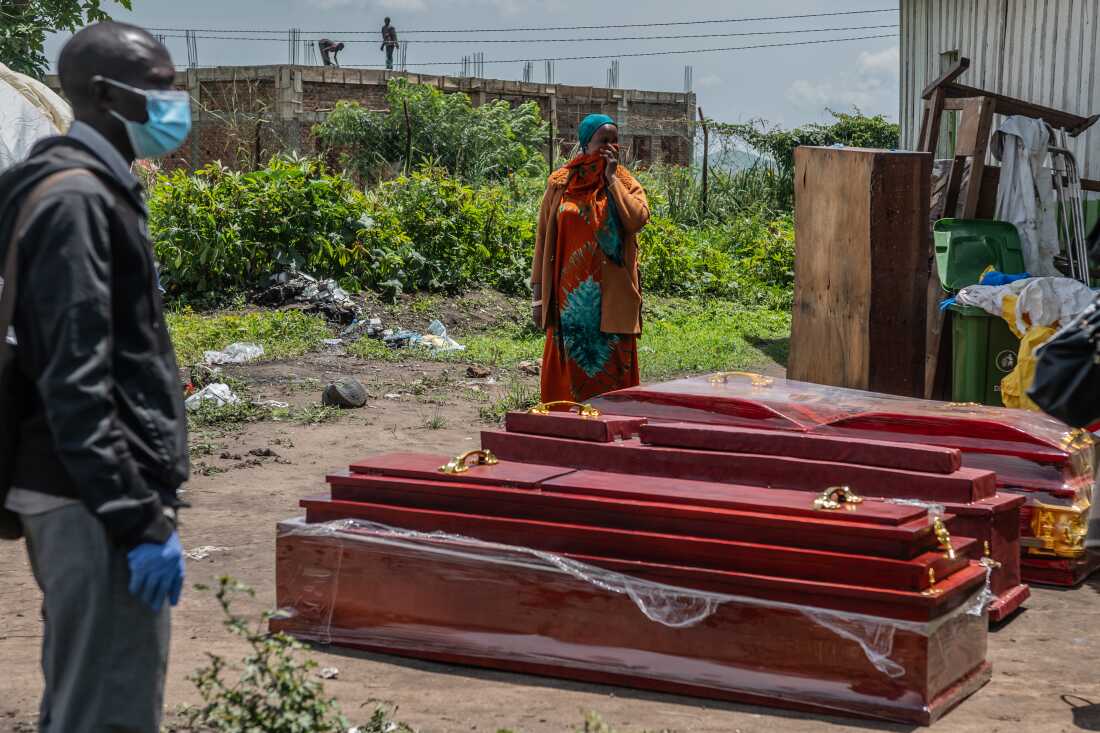
BUNIA, Congo — Health workers in eastern Congo face challenges during an Ebola outbreak caused by a rare virus. The outbreak spreads quickly in a region with frequent attacks by armed groups, complicating response efforts. Local leaders reported militants linked to the Islamic State killed 17 people recently in Alima village, Ituri province, intensifying concerns.
The World Health Organization (WHO) noted low global risk but admitted that ‘patient zero’ remains unidentified. Justin Ndasi, a resident of Bunia, expressed sorrow over the situation, worsened by the ongoing security crisis. Supplies reach Bunia, where the first known Ebola death occurred recently. However, residents face shortages; masks are scarce, and disinfectant prices quadrupled.
At a Rwampara treatment center, families mourn as healthcare workers in protective gear prepare bodies for secure burial. Symptoms mimicked other illnesses, leading to rapid deterioration. Botwine Swanze, who lost her son, described severe symptoms including bleeding and vomiting. The Ebola virus spreads through contact with bodily fluids and causes fever, hemorrhaging, and other symptoms.
The WHO declared the outbreak an international public health emergency due to its scope. WHO predicts the crisis will persist for months. The Bundibugyo virus, a rare Ebola type, spread undetected initially, complicating control efforts. WHO’s Anaïs Legand said the outbreak probably began months ago. So far, Congo reports 51 confirmed cases, and two are in Uganda. There are 139 suspected deaths and approximately 600 suspected cases, but WHO Director-General Tedros Adhanom Ghebreyesus warns the actual scale is larger.
The London-based MRC Centre for Global Infectious Disease Analysis suggests the true case number could exceed 1,000. This is Congo’s 17th Ebola outbreak, with past ones involving a more common type. Dr. Vasee Moorthy of WHO indicated a vaccine for Bundibugyo isn’t expected for at least six to nine months. Dr. Lievin Bangali of the International Rescue Committee highlighted pressure from conflicts and a weak health system, partly due to cuts in U.S. foreign aid. The U.S. pledged $23 million and prioritized funding 50 emergency clinics.
Panic is limited in regions like Bunia, with schools and churches open. However, inadequate protection and healthcare resources pose challenges. In some hospitals, suspected Ebola cases are mixed with other patients. Trish Newport from Doctors Without Borders noted a shortage of isolation wards in Bunia’s Salama hospital. Local leader Chérubin Kuku Ndilawa mentioned normal activities continue, but public awareness is increasing.
Mongbwalu General Hospital has around 30 Ebola patients, including a deceased medical student. Dr. Didier Pay and Dr. Richard Lokudu highlighted the need for proper triage and isolation facilities. Staff shortages, lack of training, and insufficient protection worry healthcare providers if cases rise.
In Goma, where M23 rebels control the area, WHO’s Dr. Anne Ancia acknowledged complications. Meanwhile, a U.S. national with Ebola was isolated in Germany where health officials conducted tests. Germany plans to accommodate the patient’s family at the U.S. request. The Czech Republic received an American doctor working in Uganda, monitoring for symptoms. Dr. Satish Pillai of the CDC explained the coordination between U.S. authorities to transport affected individuals to Europe for treatment.