
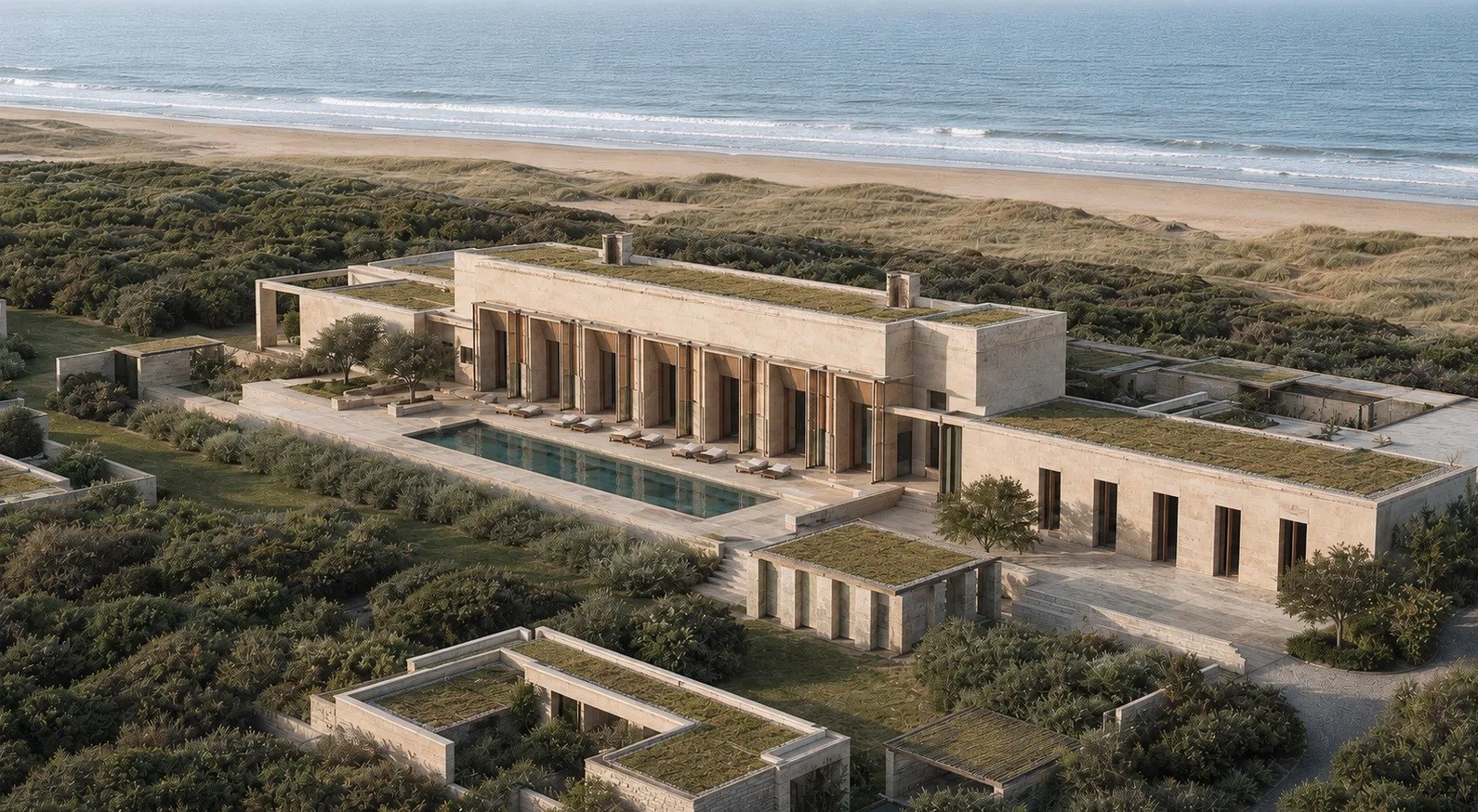
A billion-dollar waterfront community is planned in South America, and it promises to epitomize a ‘city of the future’ focused on sustainability, technology, and economic innovation. Praxis, the company behind this ambitious project, recently announced selecting Uruguay for the development citing the landscape, stability, and space as major influencing factors. Dubbed ‘+Colonia,’ the city will be built adjacent to Colonia del Sacramento, and residents are expected to inhabit it by mid-2027.
Praxis aims to generate $1 billion in investment over the coming three years to establish the world’s first digital nation, emphasizing residences, hospitality, culture, and a future defined by artificial intelligence (AI). Supporters highlight the potential quality of life offered by +Colonia, whereas critics question the practicality of an AI-driven community functioning effectively as a city and express skepticism over realistic investment targets.
‘From Saudi Arabia to California, multiple ambitious city proposals in recent times seek to redefine living conditions worldwide.’
California Forever in the US
In the United States, California Forever aspires to be ‘America’s next great city,’ backed by Silicon Valley investors. It targets a medium-density, walkable city featuring parks, plazas, playgrounds built sustainably and resistant to climate change.
Situated in Solano County between the Bay Area and Sacramento, it is hailed as the ‘largest construction labor agreement in history.’ The project intends to create 530,000 new jobs, provide 170,000 new homes, and introduce clean energy sources for the region. Known for the intersection of land, rail, sea, and air transportation corridors near Travis Air Force Base, Solano’s development is centered on expanding Suisun City.
Local officials are collaborating on annexation and redevelopment plans. The next key milestone is Suisun City’s Draft Environmental Impact report expected year-end. However, past controversy surrounds land acquisitions, water usage, and environmental impacts.
Woven City in Japan
Toyota’s Woven City ranks among the most advanced future cities dedicated to mobility, aiming to ‘enhance well-being for all.’ Located in Susono’s foothills near Mount Fuji, Woven City was introduced at the 2020 Consumer Electronics Show in the U.S.
Conceived as a ‘living laboratory,’ residents, researchers, and businesses test mobility technologies, robotics, and AI systems. Residents began moving in last September, with 160 individuals across 80 households now living in phase one.
Phase two construction started in September 2026. Completion is set for November 2028, welcoming visitors starting October 1. Despite being operational, scaling beyond corporate research settings remains uncertain.
Telosa in the US
Telosa was launched by billionaire Marc Lore in 2021. Designed by Bjarke Ingels Group, it embraces ‘equitism,’ focusing on shared land ownership while emphasizing sustainability and social equality.
Lore envisions Telosa as the ‘most open, fair, and inclusive city globally.’ While the U.S. city hopes to house millions, final locations are undecided, with options including Nevada, Utah, Idaho, Arizona, Texas, or the Appalachian Region. Residents might move in by 2030.
Despite urban planners praising the concept, questions arise concerning the practicality of constructing a new city alongside financial feasibility.
Rio AI City in Brazil
Rio AI City aims to represent the ‘city of the future,’ integrating data center infrastructure fueled by renewable energy. Elea Data Centers partnered with Rio de Janeiro’s municipal government on this substantial venture within the Olympic Park region.
The multi-billion-dollar project is touted as one of the world’s largest digital infrastructure initiatives. It focuses on renewable power, using water-free cooling systems and green architecture, with digital zones devoted to eco-friendly technology. Although the first data center operates, construction on a second begins this year.
While some view the city as an economic and job growth catalyst, concerns exist regarding energy demands and the environmental footprint tied to large-scale AI infrastructure.
Oceanix Busan in South Korea
Oceanix Busan was unveiled in 2022 and aims to be the world’s first floating city within South Korea’s port city of Busan. The community seeks to be the ‘world’s first prototype sustainable floating city,’ incorporating flood-proof infrastructure that adjusts with sea levels.
Strategically engineered to produce food, energy, and water, it employs a ‘closed-loop processing’ system that transforms waste into energy, feedstock, and recycled materials. While climate experts welcome floating infrastructure experimentation, questions persist about cost, scalability, and longevity concerning ocean-based urban developments.
The Line in Saudi Arabia
The Line is a planned linear city, a flagship project within NEOM, a comprehensive multi-region initiative in Saudi Arabia. Spanning 170 kilometers in length, 200 meters in width, and 500 meters in height, it covers desert and mountain landscapes. This car-free city, relying on renewable energy, aims to house 9 million people.
Despite suspension until 2030, Saudi Arabia’s Public Investment Fund prioritizes infrastructure including ports and data centers. Yasir Al-Rumayyan, the fund’s governor, noted some delays yet no project cancellations within NEOM.
Newsweek has contacted teams behind Rio AI City, +Colonia, Telosa, The Line, and Oceanix Busan for additional comments.